Twelve Apostles & Port Campbell
Twelve Apostles guide: how many stacks remain, the best viewpoints, Loch Ard Gorge and London Arch, helicopter flights, and how to avoid the midday crowds.
Melbourne: From melbourne great ocean road and twelve apostles tour
Quick facts
- Location
- Port Campbell National Park, ~3.5–4.5 hours from Melbourne
- Stacks remaining
- 8 visible from the main viewing platform (never actually 12)
- Formed by
- Ongoing erosion of soft limestone cliffs by the Southern Ocean
- Nearby sights
- Loch Ard Gorge, London Arch, the Grotto, Gibson Steps
- Best light
- First hour after sunrise or last hour before sunset
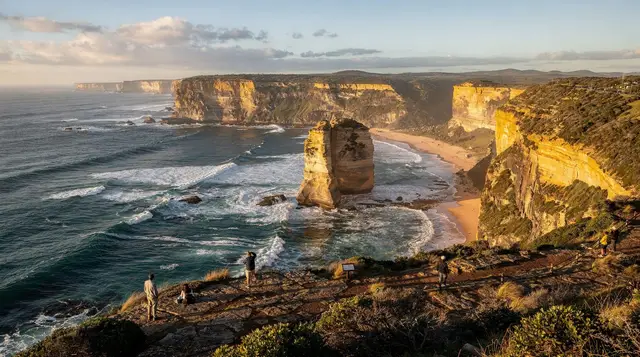
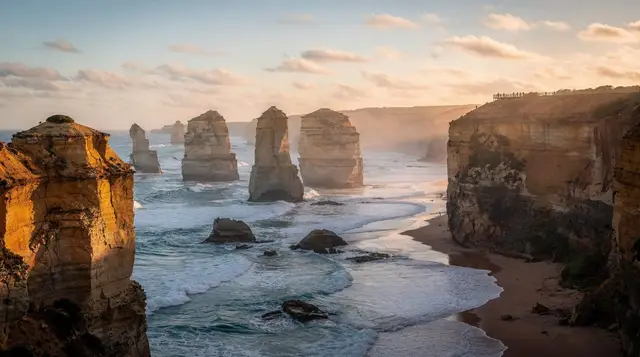
5 hours from Melbourne depending on route, and they are the single most-photographed sight on the Great Ocean Road. The honest fact worth knowing before you arrive: there were never actually twelve stacks visible at once from the main viewing platform — the formation was originally known, less romantically, as the Sow and Piglets, and was renamed for tourism purposes in the mid-20th century, with a count that historically sat closer to eight or nine even before erosion and a 2005 collapse reduced the number further. Roughly eight stacks are visible from the main platform today.
None of this makes the site less worth visiting — the scale and colour of the formations against the Southern Ocean is genuinely dramatic — it just means arriving expecting to literally count to twelve is setting yourself up to be puzzled rather than awed.
| Where | Port Campbell National Park, ~3.5–5h from Melbourne |
| Cost | Free — no entry fee to the park or viewing platforms |
| Time needed | 1–2 hours at the main site; half a day with Loch Ard Gorge and London Arch |
| Getting there | Self-drive or guided tour; no train service |
| Best time | First hour after sunrise or last hour before sunset |
Why they’re disappearing
The Apostles are limestone, a soft, easily eroded rock, and the same wave action that originally carved them from the mainland cliffs roughly 10,000–20,000 years ago continues to erode them today, at a rate that means the formations you see now will not exist in their current shape indefinitely. One stack collapsed dramatically in July 2005, witnessed by tourists on the viewing platform, and the cliffs themselves continue to recede a small amount most years.
This isn’t marketing hyperbole — it’s the specific geological process (differential erosion of the softer limestone versus the more resistant headland rock) that created the stacks in the first place, and it will eventually finish removing them, potentially replaced by new stacks forming from the retreating cliff line over a much longer timescale.
The main viewing platform
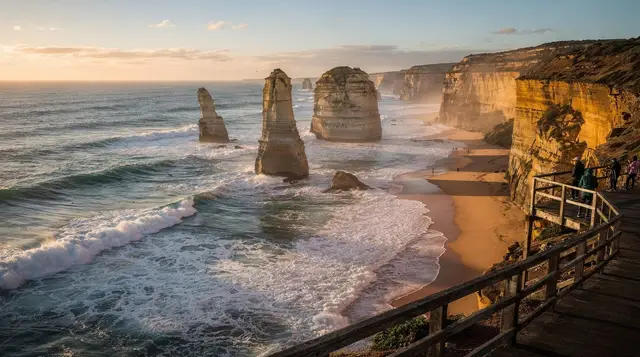
The primary viewing area, reached via a short walk from the visitor centre car park (which requires walking under the Great Ocean Road itself via an underpass), offers the classic elevated view over the stacks and is the site’s busiest point, particularly from around 11:00 to 15:00 when the bulk of Melbourne-based day tours arrive together. Arriving at sunrise or in the final hour before sunset avoids most of this crowd and gives noticeably better light for photography — the limestone takes on a warmer, more dramatic colour in low-angle light than the flatter midday sun.
From Melbourne: Great Ocean Road and Twelve Apostles tourLoch Ard Gorge
A short drive from the main Apostles viewpoint, Loch Ard Gorge is named for the Loch Ard, a clipper ship wrecked nearby in 1878 with only two survivors — a young apprentice and a passenger, who scrambled ashore into this exact gorge and sheltered in a cave still visible today. Beyond the shipwreck history, the gorge itself is arguably as photogenic as the main Apostles site, with a set of stairs leading down to an enclosed beach between sheer cliffs, and generally fewer visitors than the main platform. It’s one of the better honest recommendations in this guide: many day-trippers skip it in favour of more time at the Apostles proper, but it rewards the short detour.
London Arch and the Grotto
London Arch, formerly London Bridge, was a double-span natural arch until January 1990, when the section connecting it to the mainland collapsed without warning — two tourists were stranded on the newly created island for several hours before being rescued by helicopter, a story locals still tell partly as a caution about how unpredictable this coastline’s erosion can be. What remains is a single, still-impressive arch a short drive from the main site. The Grotto, further along, is a sinkhole-and-arch combination allowing a walk down to a rock pool framed by the eroded limestone — quieter again than the main platform and worth the stop if time allows.
Melbourne: 12 Apostles, Otways and Great Ocean Road day tourHelicopter flights
Scenic helicopter flights depart from a pad near the main visitor centre, giving an aerial view of the full stack formation that’s genuinely impossible to replicate from the clifftop platforms — from the air, the relationship between the stacks, the retreating headland and the gorge systems along the coast becomes much clearer. Flights are short (typically 10–15 minutes) but not cheap, and represent the single best way to see the site’s full scale if budget allows.
Melbourne: helicopter tour to the 12 Apostles and Great Ocean RoadGibson Steps
A short drive before the main Apostles site (coming from Melbourne), Gibson Steps is a carved stairway down to beach level, giving a rare sea-level view of two of the stacks (Gog and Magog) from below rather than the clifftop perspective everywhere else along this stretch — a genuinely different vantage point, though the beach itself is not safe for swimming given strong currents and should be treated as a viewing stop rather than a swim spot.
Avoiding the crowds
Because the vast majority of Melbourne day tours run on similar schedules — leaving the city in the morning and arriving at the Apostles around midday — the single most effective crowd-avoidance strategy is timing rather than avoiding the site altogether. Sunrise visits require either staying overnight in Port Campbell or a very early self-drive departure from Melbourne (around 3:00–4:00 for a genuine sunrise arrival, which is a lot to ask on a day trip); a more realistic middle ground is a reverse-route tour or self-drive that reaches the Apostles in the late afternoon instead.
Great Ocean Road sunset tour from MelbourneHow the stacks were formed
The Twelve Apostles began as part of the mainland cliff face, carved into separate stacks over roughly the last 10,000 to 20,000 years as the Southern Ocean’s constant wave action eroded softer sections of limestone faster than the surrounding, slightly harder rock. The process follows a predictable sequence still visible along this stretch of coast today: wave action first hollows out a cave in the cliff face, the cave eventually erodes through to form an arch, and the arch’s roof eventually collapses, leaving an isolated stack standing offshore while the cliff line itself continues retreating landward.
London Arch’s 1990 collapse and the July 2005 stack collapse are simply this same process playing out on a human observation timescale rather than a geological one — the coastline here is retreating, by some estimates, at roughly two centimetres a year on average, though the process is uneven and unpredictable rather than steady.
Visitor centre and facilities
The Twelve Apostles visitor centre, on the inland side of the Great Ocean Road opposite the main viewing platform, has toilets, a café and information displays on the site’s geology and shipwreck history, and is the starting point for the underpass walk to the viewing platforms. Facilities are more limited at Loch Ard Gorge, London Arch and the Grotto, so it’s worth using the main centre’s amenities before continuing along the route. Mobile phone reception in this part of Port Campbell National Park can be patchy, worth noting if relying on a phone for navigation or photos to share in real time.
Getting there
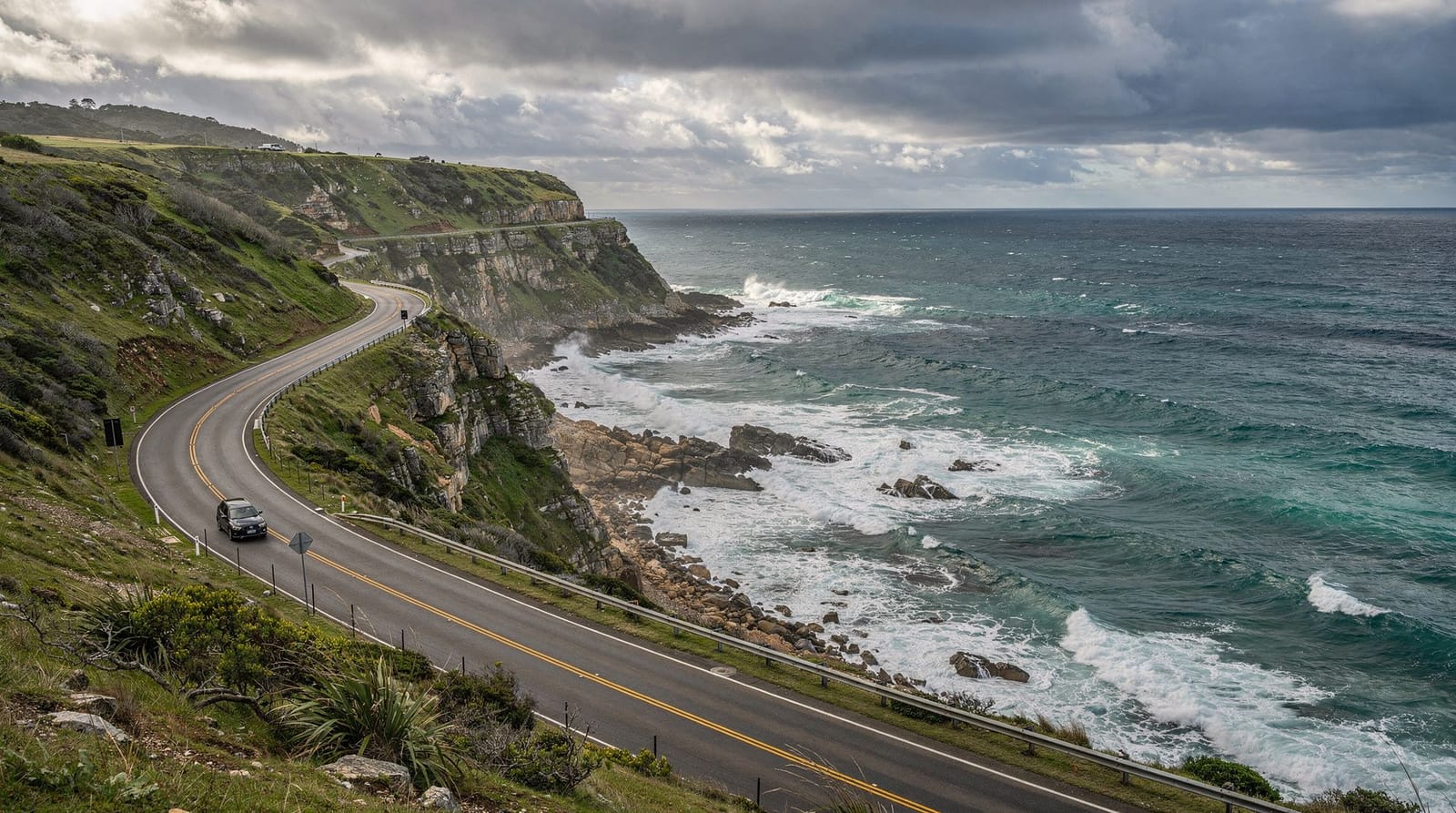
By car, the direct inland route via the Princes Highway takes roughly 3.5 hours from Melbourne; the full coastal route via Lorne and Apollo Bay takes 4.5–5 hours but includes the rest of the Great Ocean Road’s scenery along the way. There is no train service to Port Campbell; the realistic options without a car are a guided day tour or a hire car.
Budget for a Twelve Apostles visit
Viewing the main platform, Loch Ard Gorge, London Arch and the Grotto is entirely free — there’s no entry fee to Port Campbell National Park itself. A guided full-day tour from Melbourne including these stops typically runs 130–200 AUD per person. A short scenic helicopter flight typically costs 150–160 AUD per person for around 15 minutes, considerably more for longer routes. Café food at the visitor centre is priced similarly to other regional Victorian tourist-area cafés, a little above capital-city averages given its relatively remote location. See the Twelve Apostles day trip guide for a fuller cost and time breakdown.
Self-drive vs guided tour
Reaching the Twelve Apostles from Melbourne means either a self-drive along the Great Ocean Road or a guided day tour, and the choice shapes the whole day. Self-driving via the Great Ocean Road self-drive guide gives full control over timing — useful for chasing sunrise or sunset light — but means a long day behind the wheel, since driving in Victoria on unfamiliar coastal roads takes real concentration. A guided tour removes the driving but usually arrives during the busiest midday window, along with most other Melbourne day tours. Staying overnight in Port Campbell, or breaking the trip with a stop in Apollo Bay or Torquay on the way down, avoids the single-day round-trip crunch entirely.
Wildlife along the way
The drive to the Twelve Apostles passes through the Great Otway National Park, where koalas are regularly spotted in roadside gum trees, and the Southern Ocean along this stretch is a recognised whale-watching area during the southern right whale migration season (roughly June to September). See whale watching in Victoria for seasonal timing if a whale sighting is part of the plan alongside the rock formations.
Planning the rest of the coast
The Apostles work best as one chapter of a longer trip rather than a single box to tick. If you are still deciding whether the effort pays off, the is the Great Ocean Road worth it guide weighs the long drive against the scenery, and Great Ocean Road tour vs drive helps you pick between a coach seat and your own wheels. Anyone short on time can follow the Great Ocean Road day trip outline, while the Great Ocean Road in one day article is honest about what you give up by squeezing everything into daylight hours.
If you would rather slow down, the Melbourne and Great Ocean Road in 3 days itinerary builds in an overnight so that sunrise or sunset at the stacks becomes realistic. For a longer loop that continues inland, the Great Ocean Road and Grampians road trip pairs the coast with the mountains. Before you leave the city, the driving tips for the Great Ocean Road article covers the practical side of the route, and Great Otway National Park is worth a look if the forest section of the drive appeals as much as the cliffs do.
Frequently asked questions about the Twelve Apostles
How many of the Twelve Apostles are actually still standing?
Roughly eight stacks are visible from the main viewing platform today; the name “Twelve” was always more evocative than literal, and the count has reduced further with erosion and a 2005 collapse.
Why are they called the Twelve Apostles if there aren’t twelve?
The formation was originally called the Sow and Piglets and was renamed for tourism appeal in the mid-20th century; the new name was never meant as a precise, literal count.
How far is the drive from Melbourne to the Twelve Apostles?
About 3.5 hours via the direct inland route, or 4.5–5 hours via the full scenic coastal road through Lorne and Apollo Bay.
What’s the best time of day to visit?
Early morning or the last hour before sunset, both for the light quality and to avoid the roughly 11:00–15:00 window when most Melbourne day tours arrive together.
Is Loch Ard Gorge worth visiting alongside the main Apostles site?
Yes — many day-trippers skip it for more time at the main platform, but it combines dramatic shipwreck history with a beach walk between sheer cliffs and is generally quieter.
Can I swim at the Twelve Apostles?
No — the beaches here (including at Gibson Steps) have dangerous currents and are not patrolled; they’re viewing points, not swimming beaches.
Are helicopter flights over the Twelve Apostles worth the cost?
If budget allows, yes — the aerial perspective on the full stack formation and surrounding coastline is genuinely different from anything visible at ground level, though flights are short and priced at a premium.
Is it worth staying overnight near the Twelve Apostles?
Yes, if you want a sunrise or sunset visit without a very long same-day drive — Port Campbell is the closest base, a few minutes from the main site.
Can I see whales near the Twelve Apostles?
Southern right whales pass along this stretch of coast roughly from June to September, making a sighting possible but not guaranteed during a visit to the Apostles in those months — see the whale watching in Victoria guide for the best-known viewing spots and timing.
Should I self-drive or take a tour to the Twelve Apostles?
Both work well. Self-driving via the Great Ocean Road gives full control over timing, useful for sunrise or sunset visits, while a guided tour removes the driving but usually arrives during the busier midday window along with most other tours.
Top experiences
Bookable activities with verified prices and instant confirmation on GetYourGuide.