Puffing Billy: riding Australia's most famous heritage steam train
Melbourne: Dandenong ranges tour by puffing billy steam train
What is Puffing Billy and how far is it from Melbourne?
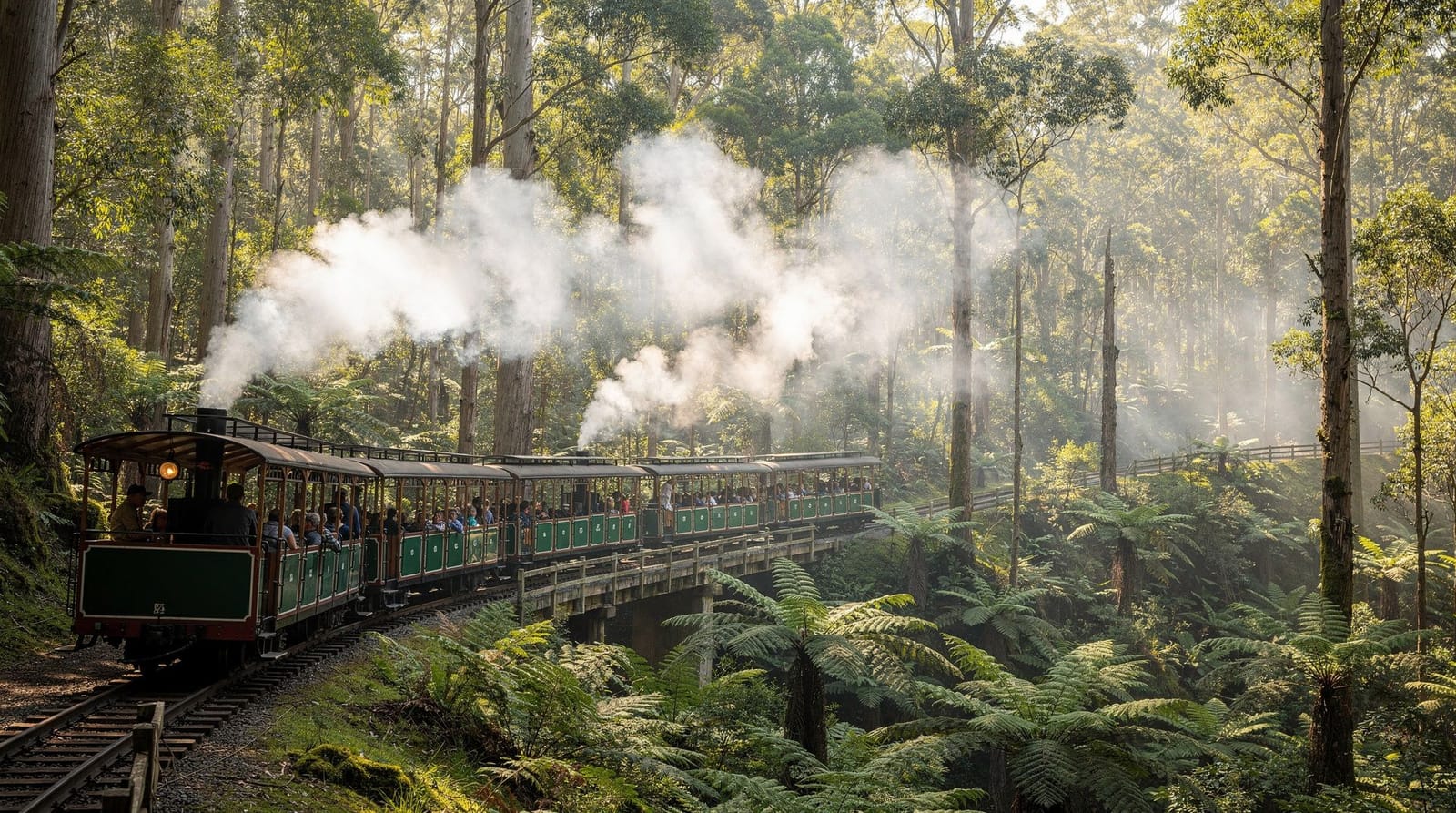
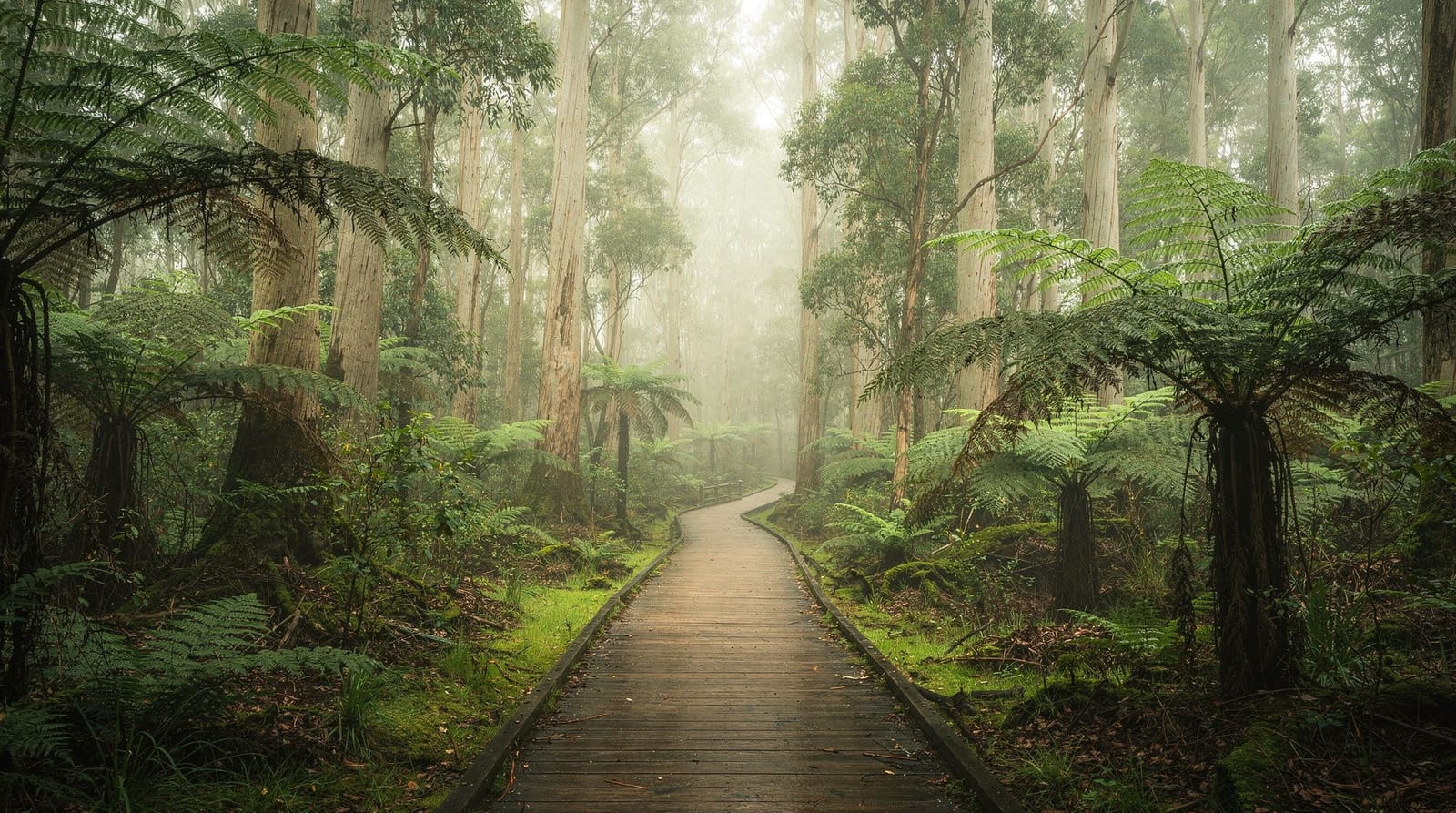
Puffing Billy is a heritage narrow-gauge steam train running through fern gully forest in the Dandenong Ranges, about an hour east of Melbourne. The full return journey between Belgrave and Gembrook takes around four hours; most visitors ride the shorter, more popular Belgrave-to-Lakeside leg (roughly 1 hour each way), which passes the famous Trestle Bridge, a favourite spot for the tradition of dangling legs out the carriage windows.
Why the narrow gauge matters
Puffing Billy’s distinctive narrow gauge (2 feet 6 inches, considerably narrower than Victoria’s standard broad-gauge rail network) was a deliberate engineering choice suited to the tight curves and steep gradients of the Dandenong Ranges’ hilly terrain, allowing the line to navigate the landscape without the extensive cutting and earthworks a standard-gauge line would have required. This same narrow gauge is part of what gives the carriages their distinctively compact, open-sided character, and it’s a detail rail enthusiasts specifically appreciate, since narrow-gauge heritage lines of this scale and continuous operating history are genuinely uncommon internationally.
A genuine working steam train, not a museum piece
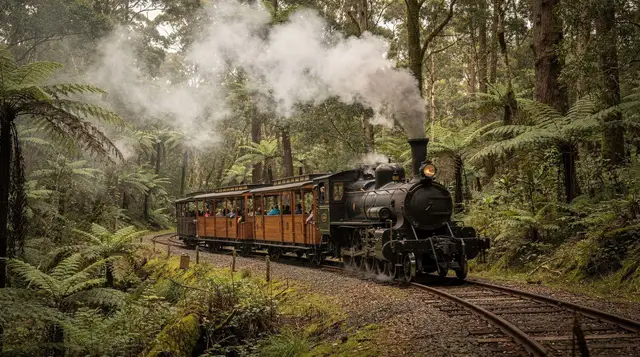
Puffing Billy is a narrow-gauge heritage steam railway running through the fern gully forest of the Dandenong Ranges, about an hour east of Melbourne, and it’s a genuinely operating steam train rather than a static museum exhibit or a modern train dressed up to look historic. The line originally opened in 1900, and today it’s run largely by volunteers through the Puffing Billy Preservation Society, using original and faithfully restored steam locomotives and carriages on the surviving section of track between Belgrave and Gembrook.
That authenticity — the coal smoke, the whistle, the genuinely vintage rolling stock — is the core of its appeal, and it’s part of why it remains one of Victoria’s most recognisable family day-trip attractions decades after most other steam lines in the state stopped running.
| Where | Belgrave, Dandenong Ranges, about an hour east of Melbourne |
| Cost | Return fare to Lakeside or the full Gembrook run; family tickets available |
| Time needed | 3-4 hours for Belgrave-Lakeside return; a full day for Gembrook |
| Getting there | Metro Belgrave line direct from the CBD, or self-drive |
| Best time | Year-round; autumn for mild conditions and colour, early morning in summer |
Ticket types and what they include
Standard fares cover a return journey on the chosen route (Lakeside or the full Gembrook run), with various family and group ticket options generally offering better value than purchasing individual adult and child fares separately. Some ticket tiers include additional inclusions such as a Devonshire tea or a specific seating class within a heritage carriage, worth checking against the standard fare if a slightly more premium experience appeals, though the core experience — the ride itself, the Trestle Bridge crossing and the surrounding forest scenery — remains consistent regardless of which specific ticket tier is purchased.
Booking online ahead of a visit is worth doing year-round, and becomes genuinely important on weekends, school holidays and around special event trains, when specific services can sell out. Walk-up tickets are usually available on quieter weekdays outside peak season, but relying on that for a weekend visit is a riskier approach than locking in a service time in advance.
Choosing your route — Lakeside or the full Gembrook run
The most popular and practical option for most visitors, particularly families with young children, is the Belgrave-to-Lakeside leg, roughly an hour’s ride each way through the most scenic section of forest, including the Trestle Bridge. Lakeside itself has picnic areas, a playground and lake views, giving a natural stopping point before the return trip, and the round trip comfortably fits into half a day. The full route continues on to Gembrook, adding roughly two more hours of round-trip travel through further forest scenery — a better fit for steam train enthusiasts, photographers, or visitors without young children who want the complete, slower-paced experience rather than the condensed family-friendly version.
Puffing Billy day trip tickets from Melbourne typically bundle return transport to Belgrave with the train ride itself, a convenient option for visitors without a car or who’d rather not navigate parking around Belgrave station on a busy weekend.
The Trestle Bridge and the window-dangling tradition
The single most photographed moment on the line is the crossing of the Trestle Bridge, a curved wooden viaduct spanning a fern gully, where a long-standing and genuinely permitted tradition sees passengers sitting on the open carriage window sills with legs dangling outside as the train crosses. It’s an unusual, distinctly old-fashioned experience that modern rail safety standards would rarely permit on a conventional train, and it’s a large part of what makes riding Puffing Billy feel different from any other heritage railway experience in Australia. Supervise children closely around the open windows regardless of the tradition’s long safety record, and expect this to be the moment most cameras and phones come out along the whole journey.
Comparing Puffing Billy with heritage railways elsewhere in Australia
Australia has a handful of other heritage steam railways, but Puffing Billy stands out both for its continuous operating history since restoration began and for its unusually direct public transport connection from a major capital city — few equivalent heritage lines elsewhere in the country are reachable by a standard metropolitan train service the way Belgrave is from central Melbourne. This accessibility, combined with the line’s genuine scenic quality through the Dandenong Ranges’ fern gully forest, is a significant part of why Puffing Billy consistently ranks among Australia’s most visited heritage rail attractions.
Getting there from Melbourne
Belgrave station, the main starting point, sits at the end of Melbourne’s Metro Belgrave train line, meaning it’s directly reachable from the CBD by public transport with no bus transfer or long walk required at the Belgrave end — one of the more genuinely accessible day trips from central Melbourne for visitors without a car. Driving takes roughly an hour from the CBD via the Burwood Highway or Monash Freeway and Mount Dandenong Tourist Road, with paid parking available near Belgrave station.
If you are going by train, a loaded Myki card is what you need for the Metro leg, and getting around Melbourne explains how it fits with trams and buses for the rest of your stay. Self-drivers unused to local roads can read driving in Victoria beforehand.
For a fuller, guided day that also covers rainforest walking trails around the line, the Puffing Billy rainforest tour combines the train ride with additional time in the surrounding Dandenong Ranges forest. Visitors with limited time can instead consider the half-day Puffing Billy experience, built specifically around a shorter overall time commitment from Melbourne.
Self-drivers should note that Belgrave station’s car park fills quickly on weekends and school holidays, so arriving at least 30 minutes before your booked departure is worth building in if driving rather than taking the train, particularly during the December-January peak season when demand for both parking and tickets is highest.
Combining with Yarra Valley wine
Because the Dandenong Ranges sit reasonably close to the Yarra Valley wine region, several tours combine a Puffing Billy ride with wine tasting on the same day. The Puffing Billy and Yarra Valley private tour handles the transport and logistics for pairing both, useful for travellers who want a family-friendly morning followed by a wine-focused afternoon without arranging two separate trips. If the wine side appeals more than the train, the Yarra Valley day trip and the Yarra Valley wine guide cover the region on its own terms.
Weather and seasonal notes
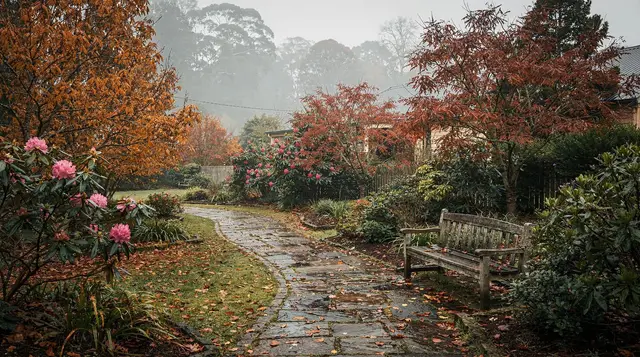
Puffing Billy runs year-round, and the surrounding fern gully forest has a distinct character in every season — deep green and cool in summer, with a noticeable chill in the shaded gullies even on warm days; crisp and comfortable in autumn (March-May), when parts of the Dandenong Ranges show attractive deciduous colour introduced by early European settlers; and atmospheric, if cold, through winter (June-August), when open-window carriages mean dressing considerably warmer than the temperature at ground level in Melbourne might suggest. Summer heat (December-February) can make an open carriage genuinely warm around the middle of the day, so an earlier morning departure is worth prioritising in peak summer.
Fire risk and total fire ban days
Because the Dandenong Ranges sit within a bushfire-prone forest region, Puffing Billy’s operations can occasionally be affected on days of extreme fire danger, given the obvious risk considerations of running a coal-fired steam locomotive through dry forest during a total fire ban. This is a genuinely rare occurrence rather than a routine concern, but it’s worth being aware of if travelling during the peak of Victoria’s summer fire season (typically December through March), and checking the railway’s current operational status is a sensible precaution if extreme heat or fire danger warnings are in effect for the region on the day of a planned visit.
What to bring
Warm layers are worth packing regardless of season, since the carriages are largely open-sided and forest gullies run noticeably cooler than open ground, even in summer. A camera or phone charged and ready for the Trestle Bridge crossing is essential — this is genuinely the moment most visitors remember the trip for. Comfortable shoes suit the walk between Belgrave station’s car park or tram stop and the platform, and picnic supplies are worth bringing if riding to Lakeside, where picnic tables and a playground make for a natural lunch stop.
Planning the wider trip
Puffing Billy slots easily into a family-focused stay, and Melbourne with kids gives ideas for filling the other days. For a fuller picture of the ranges beyond the railway, the Dandenongs day trip guide and the blog’s Puffing Billy and the Dandenongs piece offer a second angle. Timing matters too: the best time to visit Melbourne and Melbourne in winter help you decide which season suits the open carriages, and the Melbourne 4-day wildlife and nature itinerary shows one way to build the hills into a longer plan.
Combining with the rest of the Dandenong Ranges
Beyond the railway itself, the Dandenong Ranges hold the villages of Olinda and Sassafras, known for cafes, art galleries and cool-climate gardens, both a short drive from the Puffing Billy stations. Walking trail options through the broader ranges are covered in Dandenong Ranges walks, useful for extending a Puffing Billy day into a fuller exploration of the region’s forest scenery.
Visitors continuing further east sometimes combine a Dandenong Ranges day with Healesville Sanctuary, given both sit broadly in the same eastern direction from Melbourne, though they’re separate day trips rather than an easy same-day double for most itineraries given the driving involved.
For a broader sense of the Dandenong Ranges as a destination beyond the railway itself, the Dandenong Ranges destination page covers the wider region’s villages, gardens and lookout points, useful if Puffing Billy is just one piece of a longer day or overnight stay in the hills east of Melbourne.
Food and drink along the way
Belgrave station has a few cafes and a small bakery-style option near the platform for a coffee or snack before boarding, and Lakeside has a kiosk selling light refreshments, useful if you haven’t packed a picnic. There’s no formal dining car on the train itself, so plan meals around the stations rather than expecting to eat during the ride, and note that the full Gembrook run has more limited food options at the far end than the better-serviced Belgrave and Lakeside stops.
Photography tips beyond the Trestle Bridge
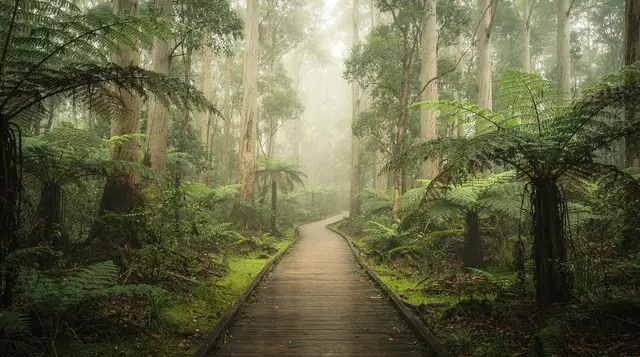
While the Trestle Bridge crossing gets most of the attention, the ride through the fern gully forest itself offers plenty of other photo opportunities — dappled light through the tree canopy, the locomotive’s smoke trailing back past the carriages on curves, and glimpses of the Dandenong Ranges’ understorey vegetation that’s easy to miss if you’re solely focused on the bridge moment. Sitting on the side of the carriage that faces outward on the tightest curves (ask station staff which side that is for your specific service) gives the best view of the locomotive itself mid-journey, a classic heritage-train photo that many first-time visitors don’t think to plan for in advance.
Belgrave station and the surrounding township
Belgrave itself, beyond simply being the railway’s starting point, has a small township centre with cafes and shops worth a look either before boarding or after returning from Lakeside or Gembrook, particularly useful for a coffee or light breakfast before an early departure. The station precinct includes a gift shop selling Puffing Billy and railway-themed souvenirs, along with a small museum display covering the line’s history for visitors wanting more background before or after the ride itself.
How long to plan for
The Belgrave-to-Lakeside return trip, including time at Lakeside itself, comfortably fits into 3-4 hours from arrival at Belgrave station. Adding the full run to Gembrook extends this to a genuine full day. Factor in travel time to and from Melbourne on either end — roughly an hour each way by train or car — when planning the overall length of the outing.
A brief history of the line
Puffing Billy’s history stretches back to 1900, when the line was built to serve timber and produce transport for the then-remote Dandenong Ranges communities, using an unusually narrow gauge track suited to the steep, winding terrain that a standard-gauge line couldn’t easily navigate. Devastating bushfires in 1953 badly damaged sections of the original line and led to its closure as a commercial railway, but a dedicated group of volunteer rail enthusiasts subsequently formed the Puffing Billy Preservation Society, progressively restoring and reopening sections of track from the 1960s onward.
Today’s operation remains substantially volunteer-supported alongside paid staff, a genuinely unusual model for a major tourist attraction and part of why the line carries such a strong sense of grassroots heritage preservation rather than feeling like a purely commercial tourist operation.
The locomotives themselves
Puffing Billy operates a small fleet of steam locomotives, some dating to the line’s earliest years and others built later but in a faithfully matching style, each requiring specialised maintenance from engineers with expertise in historic steam technology — a genuinely rare skill set that the Preservation Society has worked to keep alive through dedicated training and apprenticeship programs, given how few working steam railways remain globally to train new engineers on this technology.
Visitors with a specific interest in the locomotives themselves can sometimes arrange a closer look at the engine shed facilities near Belgrave, worth asking about at the station on the day if a behind-the-scenes glimpse of the working railway appeals beyond simply riding the train.
Special event trains and seasonal programming
Beyond standard daily services, Puffing Billy runs occasional special event trains tied to particular seasons or occasions — themed Santa trains around the December holiday period, and various other seasonal specials throughout the year, each typically requiring separate, advance booking given strong demand for these limited-capacity events. Checking the current special events calendar is worth doing if visiting during a period that might coincide with one of these themed services, since they often sell out considerably further in advance than standard daily services.
Volunteer opportunities and supporting the railway
Because Puffing Billy operates substantially through volunteer support, the Preservation Society periodically seeks volunteers for a range of roles, from guard duties on operating trains through to engineering and maintenance support for the historic rolling stock. For visitors with a genuine long-term interest in heritage rail preservation, rather than a single visit, this volunteer pathway is worth researching separately from the standard visitor experience, and donations to the Preservation Society directly support ongoing track and locomotive maintenance beyond standard ticket revenue.
What previous visitors often say surprises them
First-time visitors, particularly those without a strong personal interest in trains going in, often report being surprised by how much the overall atmosphere — the smell of coal smoke, the sound of the whistle, the visible effort of a genuinely working steam engine — adds to the experience beyond simply “riding a scenic train.” The window-dangling tradition at the Trestle Bridge in particular tends to be described as more memorable than expected, precisely because it’s such an unusual, distinctly old-fashioned moment that modern safety-conscious attractions rarely replicate anywhere else.
Accessibility on the heritage carriages
Because Puffing Billy’s rolling stock dates to a period long before modern accessibility standards, some carriages have limited wheelchair access, typically requiring a step up from platform level rather than a level boarding surface. Staff at Belgrave station can advise on which specific services and carriages offer the most practical access for visitors with mobility needs, and it’s worth contacting the railway directly ahead of a visit if accessibility is a significant concern, rather than assuming standard modern-train accessibility applies to a heritage service of this age.
Weekday versus weekend and school holiday crowds
Weekday services outside school holidays run noticeably quieter than weekend and school holiday services, both in terms of platform crowding at Belgrave and carriage occupancy on the train itself. Given the popularity of the window-dangling photo opportunity at the Trestle Bridge specifically, a quieter weekday service can mean a considerably more relaxed, less jostled experience securing a window seat for that moment, compared with a packed school holiday weekend service where carriages fill close to capacity.
Lakeside vs the full Gembrook run
| Belgrave-Lakeside | Full Belgrave-Gembrook | |
|---|---|---|
| Time | About 1 hour each way | About 2 hours each way |
| Best for | Families, young children, first-timers | Steam enthusiasts, photographers, unhurried days |
| Stops at | Lakeside picnic and playground area | Further forest scenery through to Gembrook |
| Total round trip | 3-4 hours including Lakeside time | A full day |
A realistic verdict
Puffing Billy earns its status as one of Victoria’s best-known family day trips through genuine historical authenticity rather than a manufactured tourist gimmick — this is a real, volunteer-preserved steam railway doing what it’s always done, through consistently attractive forest scenery, with a distinctive, memorable photo moment built into the route itself. The shorter Belgrave-to-Lakeside leg suits most families well; steam enthusiasts and those without time pressure should consider the full Gembrook run for the complete experience.
More tours on Viator
Top-rated experiences with verified reviews, bookable on Viator (a Tripadvisor company).


Frequently asked questions about Puffing Billy
Should I ride the full Belgrave-to-Gembrook route or just to Lakeside?
Most visitors, especially families with young children, ride the shorter Belgrave-to-Lakeside leg (about an hour each way), which covers the most scenic section including the Trestle Bridge, and allows time at Lakeside's picnic and playground area before the return trip. The full run out to Gembrook adds roughly two more hours of round-trip travel through additional forest scenery, better suited to steam train enthusiasts or a slower-paced day without young children in tow.What is the famous window thing on Puffing Billy?
It's a long-standing, genuinely permitted tradition of sitting on the carriage window sills with legs dangling outside as the train crosses the Trestle Bridge and moves through the forest — an iconic photo opportunity that's part of what makes Puffing Billy distinctive compared with a standard enclosed heritage train ride.How do I get to Puffing Billy from Melbourne without a car?
Belgrave, the main starting station, is reachable by Metro train directly from the CBD (the Belgrave line), making Puffing Billy one of the more accessible day trips from Melbourne for visitors without a car — no bus transfer or long walk is required at the Belgrave end.Is Puffing Billy suitable for very young children?
Yes, generally — the train moves at a gentle pace and the Belgrave-to-Lakeside leg is short enough to suit shorter attention spans, though supervise children closely around the open carriage windows and platform edges given the nature of an open-window heritage train.What's the best time of year to ride Puffing Billy?
Puffing Billy runs year-round, and the surrounding fern gully forest looks striking in every season, though autumn (March-May) brings cooler, comfortable conditions and the Dandenong Ranges' notable deciduous colour in some sections, while summer heat can make the open-window carriages warm during the middle of the day.Can Puffing Billy be combined with other Dandenong Ranges attractions?
Yes — the Dandenong Ranges' villages of Sassafras and Olinda, known for cafes, art galleries and cool-climate gardens, sit a short drive from the Puffing Billy stations, and several tours bundle a Puffing Billy ride with wider Dandenong Ranges sightseeing or a Yarra Valley wine stop on the same day.
Top experiences
Bookable activities with verified prices and instant confirmation on GetYourGuide.