Queen Victoria Market district
Queen Victoria Market guide: the Dairy and Meat Halls, the seasonal Wednesday and Friday Night Markets, best food stalls, and current opening hours.
Melbourne: Flavours queen victoria market food tour
Quick facts
- Location
- Northern edge of the CBD, corner of Elizabeth and Victoria Streets
- Founded
- 1878, on the site of Melbourne's original cemetery
- Size
- Largest open-air market in the Southern Hemisphere
- Night market
- Wednesday and Friday evenings, seasonal (roughly Nov–Mar/Apr)
- Best for
- Fresh produce, deli goods, street food, souvenirs
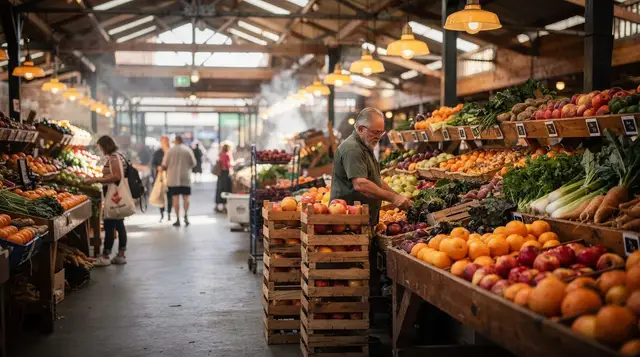
Queen Victoria Market occupies several city blocks on the northern edge of the CBD and is, by trading area, the largest open-air market in the Southern Hemisphere — a working produce, deli and general goods market that has operated on this site since 1878, rather than a market built for tourism. It sits on the site of Melbourne’s first general cemetery, closed for burials in the 1850s as the city expanded; a small memorial near the market’s northwestern corner acknowledges the estimated tens of thousands of people still buried beneath the car park and surrounding grounds, a fact many visitors (and plenty of locals) don’t know until they look for it.
Locals genuinely shop here — for produce, deli goods, meat and fish at prices generally better than inner-city supermarkets — which distinguishes it from purely tourist-facing markets elsewhere. That said, the tourist-facing souvenir and clothing stalls toward the Queen Street end are a different, more mixed proposition, priced and stocked for foot traffic rather than local repeat business.
| Where | Northern edge of the CBD, corner of Elizabeth and Victoria Streets |
| Cost | Free to browse; a market lunch runs around 10–18 AUD |
| Time needed | Half a day for the day market; an evening for the seasonal Night Market |
| Getting there | 10–15 min walk from Flinders Street Station, or tram along Elizabeth/Victoria St |
| Best for | Fresh produce, deli shopping, budget multicultural food |
If you want a wider comparison before you commit a morning, Melbourne’s markets puts this one next to the others, and the dedicated Queen Victoria Market guide goes deeper on the practical side of a visit. For a stall-by-stall look at what to eat, see Queen Victoria Market food.
The heritage halls
The market’s Dairy Produce Hall and Meat Hall, both 19th and early 20th-century structures with distinctive sawtooth roofs designed to maximise natural light before refrigeration was reliable, remain in active daily use rather than preserved as museum pieces. The Meat Hall in particular houses dozens of independent butchers and delis trading in the same stalls their businesses have occupied for generations in some cases. These halls are worth visiting for the architecture alone, quite apart from any shopping.
Fresh produce and deli shopping
The open-air produce sheds cover fruit, vegetables, flowers and a wide multicultural spread of specialty grocers — the market’s stallholder mix reflects Melbourne’s migration waves from Italian and Greek postwar communities through more recent Middle Eastern, Asian and African arrivals. Prices are generally competitive with or better than supermarket prices for equivalent quality, particularly toward closing time on trading days when produce stallholders discount rather than hold stock overnight.
The Wednesday and Friday Night Markets
The market’s seasonal night trading — historically the Wednesday Night Market running through the warmer months, alongside additional Friday night dates — turns part of the grounds into a food-stall and live-music event, with cuisines spanning dumplings, paella, churros, craft beer and wine alongside buskers and a genuinely festive atmosphere distinct from the practical, shopping-focused daytime market. Exact dates shift year to year and are worth checking directly before planning an evening around it, since the schedule is seasonal rather than year-round.
Melbourne: ultimate Queen Victoria Market foodie tourMulticultural food stalls and quick eats
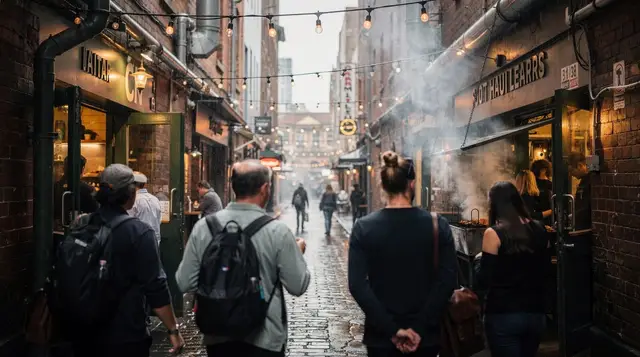
Beyond the produce halls, the market’s food-stall alley is one of the better budget lunch options in the CBD — a jaffle (toasted sandwich) van that has become something of a market institution, doughnut vans with a queue at almost any hour, and a spread of quick multicultural food at prices noticeably below the CBD’s café and restaurant strips. This is a genuinely useful budget option for visitors trying to keep food costs down without resorting to fast food chains.
Melbourne multicultural markets culinary culture tourA sensible way to pace the food side of the visit is to walk the whole market once before buying anything. Look at the deli counters, the produce sheds and the food-stall alley, then circle back to whatever looked best. You will eat better and spend less than if you buy at the first queue you meet. If you enjoy this kind of grazing, Melbourne’s food tours cover other neighbourhoods built around the same idea, and the Dandenong Market is another working market worth knowing about for a different crowd and a different mix of stalls.
Souvenirs and general goods
The general merchandise sheds toward the Queen Street end sell clothing, souvenirs, leather goods and household items at a wide range of quality and authenticity — this is the part of the market closest to a typical tourist bazaar, and prices here benefit from comparison shopping across a few stalls before buying, since quality and pricing both vary considerably stall to stall.
Cooking classes and food tours
The market runs its own cooking school on-site, along with independent guided food tours that combine tastings across the produce halls with historical and cultural context on the market’s stallholder communities. These are a reasonable way to get past the surface-level browsing experience, particularly for visitors without much time to explore independently.
Queen Victoria Market: early access food tourOpening hours and trading days
The market’s day trading runs Tuesday, Thursday, Friday, Saturday and Sunday, with Monday and Wednesday closed for general shopping (though Wednesday hosts the seasonal Night Market in its own right). Morning is the best time for the freshest produce selection and to avoid the busiest weekend crowds; Sunday mornings are consistently the busiest trading period. Always check the market’s current hours before visiting, since they can shift around public holidays.
A brief history
Queen Victoria Market’s site was originally Melbourne’s first general cemetery, established in the 1830s as the young colonial settlement’s population grew and needed formal burial grounds beyond the immediate town centre. As Melbourne expanded rapidly through the gold rush decades of the 1850s and 60s, pressure grew to reuse the increasingly central cemetery land, and burials were progressively wound down before the site was redeveloped as a produce and general market from 1878 onward, absorbing an earlier, smaller market that had traded nearby since the 1860s.
The market’s most architecturally significant buildings — the Meat Hall and the Dairy Produce Hall — date from this late-Victorian and early Federation-era expansion, and their sawtooth roof design, still visible today, was a deliberate response to the practical problem of lighting a large indoor trading hall before electric lighting was reliable or affordable at scale.
The market survived several 20th-century redevelopment proposals that would have significantly reduced its footprint, and a series of more recent renewal projects have focused on modernising infrastructure (refrigeration, drainage, market-shed renovation) while preserving the heritage-listed halls and the market’s working, rather than purely ceremonial, character.
Ongoing renewal and what’s changed
The City of Melbourne has run a long-term renewal program at the market covering infrastructure upgrades, public realm improvements around the surrounding streets, and — more controversially among some long-standing stallholders and heritage advocates — changes to car parking and shed layouts. Visitors returning after a few years away may notice altered shed numbering or relocated stalls as a result; the core produce, meat and deli halls, however, have remained substantively unchanged in character and operation throughout this process.
Getting there
The market sits at the northern edge of the CBD grid, a 10–15 minute walk from Flinders Street Station or Melbourne Central, and is served by several tram routes along Victoria Street and Elizabeth Street. It’s just outside the Free Tram Zone boundary on some approaches, so check whether your route requires a tapped-on Myki. A large multi-level car park serves visitors arriving by car, though the walk from the CBD is usually simpler given city parking costs.
Two other pages help with the logistics. The Free Tram Zone guide explains where free riding stops, which matters on some approaches to the market, and the Myki card guide covers how to pay when your route does leave the zone. For the station you will probably start from, see Flinders Street Station.
Budget for a market visit
Browsing and the heritage halls cost nothing. A market lunch (a jaffle, dumplings or a similar quick food stall option) runs 10–18 AUD. Produce shopping is generally cheaper than CBD supermarkets for equivalent quality. A guided food tour with tastings typically runs 90–140 AUD per person. Night Market entry is free; individual food and drink stalls are priced per item, typically 10–20 AUD per dish.
Queen Victoria Market vs other Melbourne food destinations
| Queen Victoria Market | Lygon Street (Carlton) | Footscray | |
|---|---|---|---|
| Character | Working produce/deli market since 1878 | Historic Italian dining strip | Multicultural, budget-friendly |
| Best for | Produce, deli goods, budget lunches | Sit-down Italian dining | Vietnamese and East African food |
| Price level | Generally cheaper than CBD supermarkets | Mixed, touristy near the university end | Noticeably cheaper than the CBD |
| Distance from CBD | Walkable, ~10-15 min | Short tram ride north | Train or the 82 tram, west |
Visitors wanting a single, budget-friendly food outing generally get the most value from either the market or Footscray; see Melbourne food guide and Footscray’s Little Saigon for both in more depth.
The market is also one of the easiest ways to keep a trip affordable, because a good lunch here replaces a more expensive café stop. Melbourne on a budget shows how to build that habit into the rest of your days, and the Melbourne coffee guide is the natural follow-up if you want a proper flat white after the stalls.
Combining the market with the rest of the CBD
Queen Victoria Market sits close enough to the CBD proper that it fits naturally into a broader day rather than requiring a dedicated trip — a morning at the market followed by an afternoon exploring the CBD’s laneways or a short tram ride down to Docklands makes a reasonable full day without much backtracking. Visitors staying near Southbank can walk the market into a longer loop that also takes in Flinders Street Station and Federation Square.
Fitting the market into a longer plan
Because it is so close to the centre, the market slots easily into most first-time schedules. The 3-day Melbourne itinerary and the food and coffee itinerary both work well with a market morning, and Lygon Street’s Italian dining makes a good contrast for a dinner after a day of grazing. If you are still deciding how long to stay overall, how many days in Melbourne will help you decide where the market fits.
Frequently asked questions about Queen Victoria Market
Is Queen Victoria Market open every day?
No — it trades Tuesday, Thursday, Friday, Saturday and Sunday, with Monday and Wednesday closed for general daytime trading (Wednesday evenings host the seasonal Night Market separately).
When does the Night Market run?
Seasonally, historically Wednesday evenings through the warmer months with additional Friday dates — check current listings before planning a visit, as exact dates and months shift year to year.
Is Queen Victoria Market touristy or do locals actually shop there?
Both — the produce, deli and meat halls are working markets with a strong local customer base and competitive pricing; the general merchandise and souvenir stalls toward Queen Street are more tourist-oriented.
Is the market built on a cemetery?
Yes — part of the site was Melbourne’s first general cemetery, closed for burials in the 1850s. A memorial near the northwestern car park acknowledges those still buried beneath the grounds.
How do I get to Queen Victoria Market from the CBD?
It’s a 10–15 minute walk from Flinders Street Station, or a short tram ride along Elizabeth or Victoria Street.
What’s the best day to visit for produce?
Weekday mornings (Tuesday or Thursday) are quieter than the weekend for produce shopping, with Sunday mornings the busiest overall.
Is there cheap food at the market?
Yes — the food-stall alley offers some of the CBD’s better budget lunch options, generally cheaper than nearby café and restaurant strips.
Is Queen Victoria Market better than Footscray for food?
They serve different purposes — the market is a working produce and deli market with budget quick eats and heritage architecture, right on the edge of the CBD; Footscray has cheaper, more specifically Vietnamese and East African dining but requires a train or tram trip west. Many visitors do both on separate days.
Top experiences
Bookable activities with verified prices and instant confirmation on GetYourGuide.