SEA LIFE Melbourne for families: prams, timing and the LEGOLAND combo
Melbourne: Sea life melbourne aquarium
Is SEA LIFE Melbourne Aquarium good for families with young children?
Yes — the route is a single, mostly flat indoor path with ramps rather than stairs, prams are permitted throughout, and the touch pool and walk-through shark tunnel are genuine highlights for younger children. Booking online at least a week ahead saves a meaningful amount versus walk-up prices, and the neighbouring LEGOLAND Discovery Centre combo pass is worth it for families doing both.
| Where | Corner of King & Flinders Streets, CBD/Southbank edge |
| Cost | Around 39 AUD adult, ~25 AUD child (2-15) booked in advance |
| Time needed | 75-90 minutes with young kids, up to 2 hours in holidays |
| Getting there | ~10 min walk from Flinders Street Station, pram-friendly |
| Best time | Weekday mornings, first hour after opening |
Why the aquarium format specifically suits families with a wide age range
Unlike attractions built around a single dominant activity, an aquarium’s format — a continuous walking route past a series of self-contained tank displays — naturally suits mixed-age family groups, since each visitor can engage with any given tank for as long or as briefly as their attention span allows without disrupting the group’s overall progress. A toddler can linger at the touch pool while an older sibling reads the interpretive signage at the next tank along, and the group naturally reconvenes at the route’s next major set piece.
This structural flexibility is part of why aquariums generally rank among the more reliably successful family attractions across a wide range of children’s ages and interests, rather than skewing heavily toward one specific age bracket the way some attractions do.
First impressions on arrival
Because SEA LIFE Melbourne Aquarium is entirely below or at ground level within its building rather than spread across a sprawling site, families arrive and begin the experience almost immediately after entering, without the extended walk to a first exhibit that some larger attractions require. This immediacy is particularly useful for managing a young child’s patience, since there’s minimal delay between arrival and the first genuinely engaging display.
The reliable family fallback, done right
SEA LIFE Melbourne Aquarium sits at the CBD’s southern edge near Southbank, and while the general visitor case for it — a compact, indoor, roughly 90-minute attraction built around an Antarctic-themed penguin exhibit and a shark walkway — is covered in full in SEA LIFE Melbourne Aquarium, the practical questions families actually need answered are slightly different: how easy is it with a pram, what genuinely holds a toddler’s attention, and is the LEGOLAND combo worth the extra cost. This guide answers those specifically.
Understanding the pricing tiers in more detail
SEA LIFE Melbourne Aquarium’s tiered pricing structure (lower for advance bookings, higher for late or walk-up purchases) reflects a common yield-management approach used across many ticketed attractions, rewarding visitors who commit to a specific date ahead of time. For families with a fixed, non-flexible Melbourne itinerary, locking in the advance price as soon as the visit date is confirmed removes any risk of the higher walk-up rate applying, and most bookings allow date changes if plans shift slightly, worth checking the specific terms at the time of booking rather than assuming a fixed, non-refundable date.
Booking ahead saves real money for a family group
Adult tickets booked online at least a week in advance start from around 39 AUD, rising to roughly 53 AUD for late bookings or walk-up purchases at the door — a gap that adds up quickly across a family group of four or more. Children aged 2-15 start from about 25 AUD in advance, with under-2s free. For any family planning the visit even loosely in advance, booking online ahead of arrival is the single most effective way to reduce the overall cost.
What actually works well for young children
The touch pool, positioned partway through the route, is consistently the section that holds younger children’s attention longest — a hands-on, supervised opportunity to touch specific marine creatures under staff guidance, rather than only observing through glass. The walk-through shark tunnel, where the path runs beneath a suspended acrylic tunnel with sharks and rays swimming overhead, is the aquarium’s most photographed moment and tends to produce genuine excitement rather than the fear a “shark tunnel” label might suggest, since the animals are clearly separated from visitors by the tunnel itself.
Some tank rooms along the route use deliberately dim lighting for atmospheric effect, which can occasionally unsettle very young children unused to darker indoor spaces — if this is a concern, staff near the entrance can advise on which sections are dimmer, and there’s no requirement to linger any longer than comfortable in any single room before moving on.
What sets the touch pool and shark tunnel apart from the rest of the route
The touch pool is staffed by trained aquarium personnel who supervise interaction directly, ensuring both the safety of the specific marine species available for touching (typically hardy, touch-tolerant species like rays or certain invertebrates) and appropriate, gentle handling technique from young visitors. This staffed supervision is part of why the touch pool works so well for very young children specifically — it’s a genuinely guided, safe interaction rather than unsupervised handling, giving parents confidence in a way that a more hands-off exhibit doesn’t provide.
The shark tunnel, by contrast, is purely observational (no touching involved), but its acrylic overhead structure creating a true 360-degree immersive viewing experience, with sharks and rays visibly swimming directly overhead, tends to produce the loudest, most excited reactions from children anywhere along the route.
Pram access and baby facilities
The full route is a single, mostly flat indoor path, with ramps rather than stairs at the handful of level changes — genuinely pram-friendly from entrance to exit. Baby-change facilities are available on site, and the aquarium’s compact layout means there’s rarely a long walk back to facilities if needed mid-visit, unlike some of Melbourne’s larger museum sites.
Accessible entry and facilities for families with additional needs
SEA LIFE Melbourne Aquarium’s flat, ramped route is genuinely accessible for wheelchairs and mobility aids as well as prams, and staff can advise on any specific accommodations for children with sensory sensitivities, since some of the dimmer tank rooms and occasional loud feeding demonstrations may not suit every child equally. Contacting the aquarium ahead of a visit to discuss specific accessibility or sensory needs is a reasonable step for families who want to plan the visit’s pacing around a child with particular requirements, rather than discovering potential issues only once inside.
The LEGOLAND combo pass
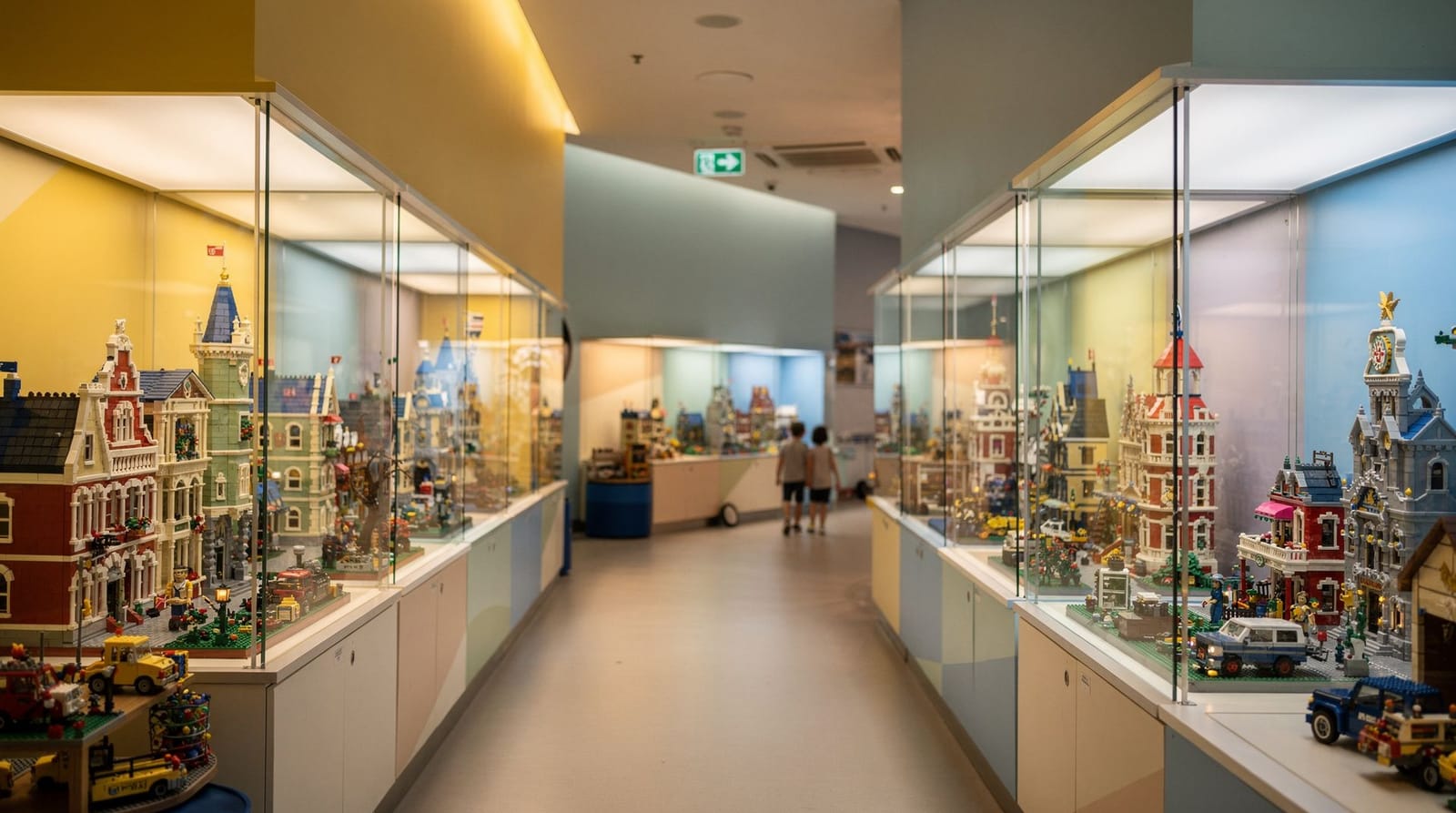
LEGOLAND Discovery Centre Melbourne sits within the same Southbank precinct as the aquarium, and for families planning to visit both on the same trip, the combined double-attraction pass, running around 67 AUD per person booked in advance, is genuinely better value than paying separate general admission to each. For a full breakdown of what LEGOLAND itself offers and how it works for different age groups, see LEGOLAND Discovery Centre — noting that LEGOLAND’s standalone Chadstone location and the Southbank combo pass with SEA LIFE cover the same underlying attraction network, so check current venue details when booking either.
Managing meals and snacks during a visit
SEA LIFE Melbourne Aquarium has a small on-site cafe offering snacks and light meals, though given the roughly 90-minute standard visit length, many families choose to eat beforehand or afterward at one of Southbank’s broader dining options rather than relying solely on the aquarium’s own limited food offering. Bringing a small snack for younger children who might need something partway through the visit is a reasonable practical step, particularly for a visit timed around a toddler’s usual snack schedule, since there’s no formal restriction on bringing food into the general visitor areas outside the immediate tank displays.
Timing a visit around nap schedules and crowds
Weekday mornings, particularly the first hour after opening, are the most reliable time to visit with a toddler still on a predictable nap or feeding schedule, before school holiday crowds and weekend family traffic build up through the aquarium’s compact route. Queues tend to form specifically at Penguin Passage and the shark tunnel during peak periods (summer school holidays especially), so an early visit avoids the worst of the bottlenecks at those two highlight sections.
What to bring for a smoother visit
A change of clothes for younger children is a reasonable precaution given the touch pool’s water element, and comfortable, flat shoes suit the aquarium’s smooth, flat indoor flooring throughout. A light jacket is worth having on hand even in summer, since the aquarium, like most large indoor marine displays, maintains a cooler ambient temperature than outdoor Melbourne conditions to protect the animals and equipment, noticeable particularly to small children more sensitive to temperature changes than adults.
Managing a visit around a child’s specific interests
Some children develop a strong specific fascination with one particular species or tank during a visit, and staff generally don’t mind a family lingering longer at one favourite display rather than moving through the whole route at an even pace. Allowing extra time for whatever specifically captures a child’s attention, even if it means moving more quickly through other sections, tends to leave a stronger overall impression than insisting on an even, comprehensive pace through every single tank.
How long to plan for with children
Most families spend 75-90 minutes moving through the full route at a comfortable pace with young children, including a proper stop at the touch pool and time for photos at the shark tunnel. Budget closer to two hours during school holidays, when the pace naturally slows due to higher visitor volume throughout the route.
What visitors sometimes get wrong about the aquarium’s scale
First-time visitors occasionally arrive expecting a sprawling, half-day marine park experience given the “Melbourne Aquarium” branding, and are surprised by how compact the actual venue is compared with larger dedicated marine parks elsewhere in Australia or internationally. Setting the right expectation from the outset — a focused, roughly 90-minute experience built around a small number of genuinely strong set pieces rather than a comprehensive, all-day marine biology showcase — tends to produce a more satisfied visit than arriving expecting something closer to a full-scale oceanarium.
Combining with a broader CBD family day
SEA LIFE Melbourne’s Southbank location puts it within easy walking distance of Federation Square, ACMI’s free permanent gallery, and the Yarra River promenade, making it straightforward to combine with a wider CBD family day. For a fuller list of the strongest family attractions across the city, see Melbourne with kids, and for indoor options specifically suited to a wet-weather day, rainy day Melbourne with kids.
What’s inside beyond the touch pool and shark tunnel
Beyond its two headline sections, SEA LIFE Melbourne Aquarium’s route covers a range of themed zones including a rainforest display, various Australian native fish and invertebrate exhibits, and a dedicated seahorse display that tends to fascinate younger children given how unusual and slow-moving seahorses appear compared with the faster fish elsewhere in the aquarium. The Antarctic-themed penguin exhibit, positioned partway through the route, features gentoo penguins in a climate-controlled enclosure and includes a viewing window that puts younger children at eye level with the birds, a genuinely popular photo moment that rivals the shark tunnel for most-photographed section of the visit.
Talks, feeding sessions and keeper interactions
SEA LIFE Melbourne Aquarium runs a schedule of keeper talks and scheduled feeding sessions throughout the day at various tanks, including shark and ray feeding sessions that draw a crowd given the visual spectacle of larger marine predators feeding at close range through the viewing glass. Checking the daily program board near the entrance and timing the visit loosely around one or two of these sessions adds considerably more engagement for children than a purely self-guided wander through the tanks, since the keeper commentary during feeding times typically covers behaviour and conservation details not otherwise available on the static signage.
Managing a visit with more than one young child
Families with more than one child, particularly a mix of ages, benefit from the aquarium’s single-path route design, since there’s no risk of the group splitting up or losing track of each other the way a more sprawling, multi-path attraction might allow. Older children who move through sections faster than a lingering toddler can be encouraged to wait at natural pause points — the touch pool and shark tunnel in particular — where there’s usually enough visual interest to hold their attention while younger siblings catch up.
Birthday parties and special events
SEA LIFE Melbourne Aquarium offers bookable birthday party packages, typically including aquarium entry alongside a themed party room session, a popular option for Melbourne families given the venue’s strong appeal to primary-school-age children specifically. Seasonal special events, including holiday-period theming around major school holidays, periodically add extra activities on top of the standard visitor experience, worth checking the current events calendar for if visiting during a specific school holiday window.
Photography and the digital photo pass
Every general admission ticket includes a Digi Photo Pass, covering a professional photograph typically taken at a set point during the visit (often near the shark tunnel or aquarium entrance) that can be downloaded digitally after the visit — a genuinely useful inclusion for families who might otherwise struggle to get a decent group photo while also managing children through the aquarium route. Beyond this included photo, personal photography is welcomed throughout the aquarium, unlike the strict no-photography rule enforced during Phillip Island’s Penguin Parade.
Group bookings and school excursions
Beyond individual family visits, SEA LIFE Melbourne Aquarium accommodates school groups and larger organised parties through separate group booking arrangements, meaning families visiting during weekday term time may occasionally share the space with an organised school excursion. This rarely disrupts the general visitor experience meaningfully given the aquarium’s single continuous route naturally spaces visitor groups out along the path, though families specifically seeking the quietest possible visit might prefer weekends or school holiday periods for this reason, accepting the trade-off of slightly higher general visitor numbers on those days.
Two headline moments compared
| Touch pool | Shark tunnel | |
|---|---|---|
| What it is | Hands-on, staff-supervised contact with rays | Walk-through acrylic tube beneath the main tank |
| Best for | Toddlers and preschoolers | All ages, especially school-age kids |
| Time to allow | 10-15 minutes | 5-10 minutes, unhurried |
| Crowd pattern | Builds steadily through the day | Spikes around Penguin Passage feeding times |
SEA LIFE Melbourne versus a general CBD family day
Families sometimes ask whether SEA LIFE is worth building a whole day around or better treated as one stop among several. The honest answer is the latter: at 75-90 minutes, it’s rarely worth a dedicated half-day trip on its own unless the weather is genuinely poor. Pairing it with Federation Square, a walk along the Yarra promenade, or a stop at Eureka Skydeck makes for a fuller, better-paced family day than treating the aquarium as the sole destination.
Matching the visit to your child’s age
Under 2 (free entry): the touch pool and dim lighting matter less than nap timing — a mid-morning slot right after a feed tends to work best, and prams move through the whole route without issue.
2-5 (toddlers/preschool): the age group SEA LIFE is arguably best designed for — short attention spans suit the self-paced single-path layout, and the touch pool and shark tunnel are both genuinely exciting rather than overwhelming at this age.
6-10 (school age): the conservation and species information on the signage starts to land properly at this age, and keeper talks or feeding sessions (check the board on arrival) add real engagement beyond just looking at tanks.
11+ (older kids/teens): likely to move through faster than younger siblings and may find the visit modest at 90 minutes; pairing with Eureka Skydeck or a Southbank walk extends the outing without repeating the same style of attraction.
A realistic verdict for families
SEA LIFE Melbourne Aquarium delivers reliably for families with young children specifically because of its compact, pram-friendly, single-path layout and its two genuinely strong interactive moments — the touch pool and the shark tunnel — rather than relying on scale the way a larger marine park elsewhere in Australia might. Booking ahead for the lower advance price, timing the visit for a weekday morning, and adding the LEGOLAND combo if both are on the itinerary are the three practical levers that make the most difference to a family visit here.
More tours on Viator
Top-rated experiences with verified reviews, bookable on Viator (a Tripadvisor company).


Frequently asked questions about SEA LIFE Melbourne for families
How much can families save by booking SEA LIFE Melbourne tickets in advance?
Adult tickets booked online at least a week ahead start from around 39 AUD, rising to roughly 53 AUD for late or walk-up bookings — a meaningful saving for a family group booking multiple tickets, making advance booking the single biggest cost lever available.Is the LEGOLAND Discovery Centre combo pass worth it for families?
Yes, if visiting both attractions on the same trip — the combined double-attraction pass runs around 67 AUD per person in advance, noticeably cheaper than buying separate general admission to SEA LIFE Melbourne Aquarium and LEGOLAND Discovery Centre Melbourne, both of which sit in the same Southbank precinct.What's the best time to visit with young children to avoid crowds?
Weekday mornings, ideally the first hour after opening, are consistently the quietest — school holidays (particularly the December-January summer break) and weekend afternoons bring the heaviest family crowds, with queues forming at Penguin Passage and the shark tunnel specifically.Can I bring a pram through the whole aquarium route?
Yes, the route is a single, mostly flat path with ramps rather than stairs at the few level changes, and prams are permitted throughout, with baby-change facilities available on site.Is SEA LIFE Melbourne suitable for toddlers who might be scared of dim lighting?
It's generally one of the more toddler-friendly indoor attractions in the CBD, though some tank rooms use dim lighting for effect, which can occasionally unsettle very young children — the touch pool and walk-through tunnel sections tend to reassure rather than unsettle, and there's no requirement to linger in any one darker room longer than comfortable.Should I bring my own pram or can I hire one on site?
Bring your own — SEA LIFE Melbourne doesn't run a pram hire service on site, and given the compact single-path route, most families find their own pram, or simply carrying a toddler through the busier sections, perfectly manageable without needing one anyway.
Top experiences
Bookable activities with verified prices and instant confirmation on GetYourGuide.