Yarra Valley wine guide: the wineries worth your day trip
Melbourne: Yarra valley wine experience
What is the Yarra Valley best known for?
The Yarra Valley, about an hour east of Melbourne, is Victoria's most historic and best-known cool-climate wine region, famous specifically for Pinot Noir and Chardonnay, plus some of Australia's best sparkling wine from Domaine Chandon (owned by Moët Hennessy). Yering Station, established in 1838, is Victoria's oldest winery and a good first stop for context before visiting more boutique cellar doors.
The Yarra Valley’s best wineries range from Victoria’s oldest estate to a Champagne-house sparkling specialist, all within a compact area about an hour from Melbourne.
| Where | Yarra Valley, around Coldstream, Yarra Glen and Healesville |
| Cost | Tastings around AUD 10-20; bottles around AUD 30-60 |
| Time needed | Full day; 3-4 cellar doors realistic |
| Getting there | Around 1 hour self-drive; train to Lilydale plus transfer is possible |
| Best time | Autumn (Mar-May) for vintage and foliage |
A note on wine club memberships
Several Yarra Valley estates offer wine club or mailing list memberships, typically involving a regular shipment of new releases at a member discount, alongside invitations to member-only tasting events. If a particular estate genuinely impresses you during a visit, joining is a reasonable way to maintain a connection to the wine after you’ve left Australia, though it’s worth checking international shipping costs and any destination-country import restrictions before committing, since ongoing international wine club shipments can become considerably more expensive or logistically complicated than a one-off in-person purchase.
How the Yarra Valley compares internationally
For visitors with wine experience elsewhere, a useful mental comparison: the Yarra Valley’s climate and resulting wine style sit closer to Burgundy or Oregon’s Willamette Valley than to warmer new-world regions like Napa or the Barossa. If you enjoy restrained, elegant Burgundian Pinot Noir and Chardonnay, the Yarra Valley’s output will likely feel more familiar and appealing than a heavier, more fruit-forward Australian red from a warmer region. This makes the valley a genuinely good introduction to Australian wine specifically for visitors who assume, incorrectly, that all Australian wine trends toward big, high-alcohol reds — the Yarra Valley is Australia’s clearest rebuttal to that stereotype.
Rochford, TarraWarra and the rest of the valley’s estates worth knowing
Beyond the headline names already covered, a handful of other Yarra Valley estates come up repeatedly in local recommendations. Rochford Wines, mentioned briefly above, is worth a second look specifically for its outdoor concert series through summer, which draws major national and international touring acts to a genuinely picturesque vineyard amphitheatre — worth checking the calendar if live music alongside wine appeals, since tickets for the bigger shows sell out well ahead. Innocent Bystander, in Healesville itself, pairs a more casual, food-truck-adjacent cellar door vibe with a working cider house alongside its wine offering, a good stop if your group wants something more relaxed than a formal tasting flight.
Giant Steps, also in Healesville, has built a strong reputation among serious Pinot Noir drinkers specifically, with a cellar door that leans toward a more contemporary, industrial-chic aesthetic than the valley’s older, more traditional estates.
Why the Yarra Valley is Victoria’s benchmark wine region
The Yarra Valley is Victoria’s oldest and most internationally recognised wine region, with grape-growing dating back to 1838 when Swiss immigrants first planted vines at what is now Yering Station. Its cool climate — cooler than the Barossa or Hunter Valley further north — makes it particularly well suited to Pinot Noir, Chardonnay and traditional-method sparkling wine, and the valley’s proximity to Melbourne (roughly an hour’s drive) makes it one of the most accessible serious wine regions to any major Australian city.
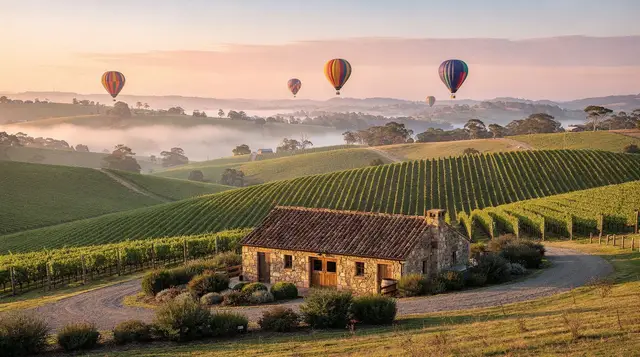
Unlike some wine regions built primarily around tourism, the Yarra Valley’s reputation rests on genuinely well-regarded wine first and scenery second, though the scenery — rolling hills, the Yarra River, the Dandenong Ranges as a backdrop — is a legitimate reason to visit even for non-drinkers in the group.
Yering Station: Victoria’s oldest winery
Yering Station, established in 1838, is Victoria’s oldest vineyard and a natural first stop for historical context — its cellar door occupies a striking modern building with an undulating roofline overlooking the original vines, and the estate’s restaurant is one of the valley’s better lunch options if you want a proper sit-down meal alongside tastings. The wines span an accessible everyday range through to a premium “Yarrabank” sparkling label and reserve still wines.
 Yarra valley winery tour with lunch at yering stationCheck availability
Domaine Chandon: sparkling wine with a view
Domaine Chandon, owned by Moët Hennessy and using the same méthode traditionnelle technique as Champagne, is the valley’s best-known sparkling wine producer, with a cellar door and terrace overlooking its own vineyards that ranks among the best single views in the region. Even visitors who don’t usually drink sparkling wine tend to come away impressed, and the estate’s still Pinot Noir and Chardonnay are worth trying alongside the sparkling range rather than skipping past them.
How the Yarra Valley’s reputation was rebuilt
It’s worth knowing that the modern Yarra Valley wine industry is, in a sense, a revival rather than an unbroken continuation of its 1838 origins. Phylloxera (a vine-destroying insect) and changing agricultural priorities led to a significant decline in the region’s vineyards through the late 19th and early 20th centuries, and much of what visitors see today dates to a renewed wave of planting from the 1960s and 70s onward, when a new generation of winemakers recognised the region’s cool-climate potential and began replanting on a serious scale.
Yering Station’s own modern era, alongside estates like De Bortoli, is part of this 20th-century revival story as much as it is a direct link to the valley’s 1838 founding — worth knowing if you want an accurate rather than romanticised sense of the region’s continuous history.
De Bortoli, Oakridge and the boutique tier
De Bortoli, one of the valley’s larger producers, runs a well-regarded restaurant (Locale) alongside its cellar door and is a reliable, less exclusive-feeling stop for a relaxed tasting. Oakridge and TarraWarra Estate both lean into contemporary architecture and art (TarraWarra has its own museum of Australian art on-site) alongside serious cool-climate wine, appealing to visitors who want the cellar door experience paired with design and culture rather than a purely rustic farmhouse feel. Rochford Wines hosts occasional outdoor concerts and has one of the valley’s more photogenic vineyard settings, useful if you’re timing a visit around a live event.
a Yarra Valley wine, gin, cheese and chocolate tourTour versus self-drive: the honest recommendation
Victoria enforces strict drink-driving laws with genuine random breath testing on regional roads, and the Yarra Valley’s wineries are spread across a fairly wide area with limited public transport connecting them directly. If you want to actually taste — rather than sip a token mouthful and spit or pour out the rest at every stop — book a tour with a driver, or hire a private driver for the day.
Self-driving works fine if one person in your group is genuinely happy to skip tasting and drive, or if you’re planning to buy bottles rather than drink on-site, but for most visitors the honest recommendation is a guided tour: it removes the driving calculation entirely and usually includes lunch and cellar door access that can be harder to arrange independently at the more boutique estates.
a full-day Yarra Valley wine experience with lunchGetting there without a tour
By car, the Yarra Valley is roughly an hour east of central Melbourne via the Eastern Freeway and Maroondah Highway, with most of the well-known wineries clustered around Coldstream, Yarra Glen and Healesville. Without a car, the Lilydale train line (part of Melbourne’s metro network) reaches Lilydale in about an hour, from where a taxi, rideshare or pre-arranged transfer covers the final 15-20 minutes into the valley proper — workable, but genuinely more efficient with a tour or private transfer given how spread out the cellar doors are.
If you do plan to drive yourself, our driving in Victoria guide covers the rules of the road, including driving on the left, which is worth reading before you collect a hire car. For the city end of the journey, the getting around Melbourne guide explains how the metro network fits together, and the Myki card guide is useful if you take the train towards Lilydale.
Combining wineries with Healesville Sanctuary
A popular single-day itinerary pairs a morning at Healesville Sanctuary, a wildlife park specialising in native Australian animals, with an afternoon of two or three wineries — Healesville township sits only 15-20 minutes from the heart of the wine region, making the combination genuinely efficient rather than a compromise between two separate day trips.
Understanding the region’s wine styles
For visitors newer to wine, it helps to know roughly what to expect before you start tasting. The Yarra Valley’s Pinot Noir tends toward a lighter-bodied, more elegant style than warmer-climate Australian reds like Barossa Shiraz — think red cherry and earthy, savoury notes rather than heavy tannin and jammy fruit. The region’s Chardonnay has shifted over the past two decades away from the heavily oaked, buttery style once common in Australian wine toward a leaner, more mineral, food-friendly style closer to what you’d find in cooler parts of Burgundy.
The sparkling wine, led by Domaine Chandon, uses the same méthode traditionnelle (secondary fermentation in the bottle) as Champagne, giving genuinely fine, persistent bubbles rather than the coarser carbonation of cheaper sparkling wine.
If a cellar door offers a tasting flight, asking staff to talk you through how each wine differs is a good way to build a working vocabulary over the course of an afternoon.
Staying overnight in the valley
While most visitors treat the Yarra Valley as a day trip from Melbourne, staying overnight opens up a more relaxed pace — an evening and morning without the pressure of a return drive or last train, plus the chance to visit a cellar door for a quieter, less rushed weekday tasting if you time it right. Accommodation ranges from farmstay cottages to more polished boutique hotels near Healesville and Yarra Glen, and prices sit noticeably higher during weekends and the autumn vintage season than midweek or in the quieter winter months.
If you would rather keep Melbourne as your base, the where to stay in Melbourne guide helps you choose a neighbourhood that makes the morning departure easy, and a stay in Healesville puts you close to the cellar doors on the valley’s eastern side.
Cellar door etiquette
A few points of etiquette make cellar door visits smoother for both visitors and staff. It’s standard to expect a tasting fee at most cellar doors (often waived against a purchase), so don’t be surprised or offended when asked to pay for a flight — this is normal practice, not a sign of an unwelcoming venue. Spitting out wine during a tasting, using the provided spittoon, is entirely normal and expected if you’re visiting multiple cellar doors in a day and want to stay reasonably sober; nobody will think less of you for using it. It’s also polite to buy at least an occasional bottle across a day of tastings if a particular winery’s wine genuinely impressed you, though there’s no strict obligation to buy at every single stop.
Shipping wine home
If you fall in love with a specific Yarra Valley producer and want to bring bottles home beyond what fits in checked luggage, most of the wineries covered in this guide can arrange international shipping directly from the cellar door, though costs and import regulations vary considerably by destination country — check specific requirements (import duties, bottle limits, customs declarations) for your home country before assuming this is straightforward, since some countries have restrictive personal-import alcohol rules that make direct shipping impractical despite the winery’s willingness to send it.
Seasonal timing
Autumn (March-May) is the standout season, coinciding with vintage harvest activity at the wineries and the valley’s deciduous vines turning gold and red — arguably Victoria’s best rural scenery window, and worth prioritising if your dates are flexible. Spring (September-November) brings fresh growth and mild weather, also a strong choice. Summer (December-February) can be hot, and the valley gets busier with weekend day-trippers from Melbourne. Winter (June-August) is quieter and cooler, with some smaller cellar doors reducing their opening hours — check ahead if visiting outside the main season.
| Season | Scenery | Crowds |
|---|---|---|
| Autumn (Mar-May) | Vintage harvest, vines turning gold and red | Busy on weekends during vintage |
| Spring (Sep-Nov) | Fresh growth, mild weather | Moderate |
| Summer (Dec-Feb) | Green vines, can be hot | Busiest — weekend Melbourne day-trippers |
| Winter (Jun-Aug) | Quiet, cool | Quietest; some smaller cellar doors reduce hours |
For a deeper look at the colours and harvest-time atmosphere, see our autumn in the Yarra Valley guide, and if you are still deciding when to travel at all, the best time to visit Melbourne page puts the valley’s seasons in the context of the whole trip.
Budget expectations
Cellar door tastings typically run 10-20 AUD per person (often waived with a bottle purchase), and a bottle of Yarra Valley Pinot Noir or Chardonnay from the cellar door usually costs 30-60 AUD, reflecting the region’s premium cool-climate reputation rather than budget bulk wine pricing. A guided full-day tour with lunch and several cellar door stops typically costs meaningfully more than a self-drive day once you account for tasting fees and lunch, but includes the driving and logistics that would otherwise eat into the day.
Wine day trips are easier to afford when the rest of the trip is planned sensibly, so the Melbourne trip cost guide is a useful companion when deciding how much of your budget to set aside for tastings, lunch and bottles to take home.
Non-drinkers and designated drivers
If part of your group doesn’t drink, the Yarra Valley still works as a day trip destination — the scenery, several estates’ food offerings, and the general rural change of pace from the CBD all stand on their own without wine being the point for everyone. Most cellar doors are entirely comfortable with a visitor who orders a coffee, juice or simply sits with the group without tasting, and staff won’t push a non-drinker to participate. If one person in the group is happy to be the designated driver for the day, self-driving becomes a realistic option again, provided that person genuinely commits to minimal or no tasting rather than a token compromise that undermines the entire safety rationale.
Where this fits in a Victoria itinerary
The Yarra Valley pairs naturally with the Dandenong Ranges and Puffing Billy steam railway on a longer day trip, or stands alone as a relaxed day away from central Melbourne. See our Yarra Valley day trip guide for a full single-day itinerary, and compare it against the Mornington Peninsula’s wineries if you’re deciding between Victoria’s two best-known wine day trips — the honest difference is that the Yarra Valley leans more toward serious still wine and historic estates, while Mornington pairs wine with coastal scenery and hot springs.
More tours on Viator
Top-rated experiences with verified reviews, bookable on Viator (a Tripadvisor company).
 Viator
Yarra Valley Wine Tour w Exclusive Gin, Cider & Chocolate Tasting
FromAUD 115Check availability → Viator
Melbourne: Yarra Valley Wine, Gin, Whisky and Chocolate Tour
FromAUD 115Check availability → Viator
Melbourne: Epic Yarra Valley Wine Tour & Lunch - Gin/Beer Upgrade
FromAUD 179Check availability →Frequently asked questions about Yarra Valley wine guide
How far is the Yarra Valley from Melbourne?
Roughly 50-60 km east of central Melbourne, about a 1-hour drive by car without traffic, or 1.25-1.5 hours via a combination of train to Lilydale and a connecting bus or taxi for the final stretch into the valley itself, since the wineries are spread out and not well served by public transport alone.Do I need a designated driver or should I book a tour?
If you want to actually taste wine at multiple cellar doors rather than just buy bottles, a tour with a driver (or a hired car with a driver) is the honest recommendation — self-driving between wineries while tasting seriously limits how much you can actually drink at each stop, and Victoria enforces strict drink-driving laws with random breath testing on regional roads.What is the best time of year to visit Yarra Valley wineries?
Autumn (March-May) is widely considered the best season, coinciding with vintage harvest and the valley's vineyards turning gold and red — genuinely spectacular scenery alongside the wine. Spring (September-November) also works well with mild weather and new growth on the vines; summer can be hot and busy, winter quieter and cooler but with fewer events.How many wineries can I realistically visit in one day?
Three to four cellar doors is realistic for a relaxed day that includes lunch, without rushing tastings or spending the whole day in transit between stops. Trying to fit in more than four typically means shorter, less considered visits at each.Is Domaine Chandon worth visiting if I'm not usually a sparkling wine drinker?
Yes — Domaine Chandon's cellar door has one of the valley's best views over its own vineyards from an elevated terrace, and its sparkling wines (méthode traditionnelle, the same technique as Champagne) are genuinely well regarded even among still-wine drinkers, plus the estate makes reasonable still Pinot Noir and Chardonnay too.Can I combine Yarra Valley wineries with Healesville Sanctuary in one day?
Yes, and it's a popular combination — Healesville Sanctuary is a 15-20 minute drive from the heart of the wine region, so a morning of wildlife followed by an afternoon of two or three wineries is a realistic single-day itinerary, covered in more detail in our Healesville Sanctuary guide.
Top experiences
Bookable activities with verified prices and instant confirmation on GetYourGuide.