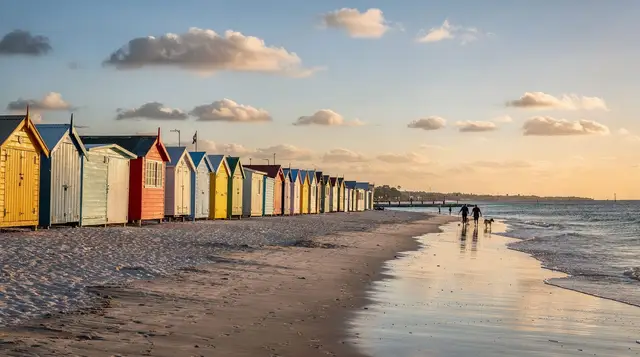
Brighton bathing boxes: the honest visitor guide
Melbourne: Melbourne brighton beachbathing boxes photoshoot
Duration: 1 hour
Can you go inside the Brighton bathing boxes?
No. The 82 colourful bathing boxes at Dendy Street Beach are privately owned, with owners leasing the land from Bayside City Council, and they are not open to the public or available to rent for visitors. You can walk right up to them and photograph them from the beach for free, but entry inside is not possible.
One of Melbourne’s most photographed rows of colour
If you’ve scrolled through Melbourne photos on social media, there’s a good chance you’ve seen this exact stretch of sand without knowing its name: a row of small, boxy timber huts, each painted a completely different bold colour or pattern, standing shoulder to shoulder along the beach with the bay stretching out behind them. That’s Dendy Street Beach in Brighton, home to 82 bathing boxes that have become one of the most recognisable and most photographed spots in the entire city.
What makes them worth an honest, non-hyped explanation is that visitors often arrive with a slightly wrong idea of what they are. They’re not a public art installation built for tourists, not rentable holiday huts, and not something you can walk into. Understanding what they actually are — and the etiquette around them — makes for a much better visit than showing up expecting something else.
No, you can’t go inside them
This is the single most important thing to know before making the trip out to Brighton: the bathing boxes are privately owned. Each owner leases the small plot of land beneath their box from Bayside City Council, and the box itself belongs to them, generally passed down through families or bought and sold as a distinct, sought-after property in its own right (they do occasionally change hands for surprising sums, given how small and how non-functional as full-time housing they are). They are not open to the public, not available to rent for an afternoon or a photoshoot inside, and there’s no booking system for entry of any kind.
Visitors can, and absolutely should, walk right up to them, admire the colours and patterns up close, and photograph them freely from the beach — that part is entirely public and free. What you can’t do is open a door and step inside, and it’s worth setting that expectation clearly before you go, since a genuine number of first-time visitors arrive assuming otherwise.
Getting there from central Melbourne
Dendy Street Beach sits in Brighton, about 11km south of the CBD, and the drive takes roughly 20 minutes outside of peak traffic, following the bayside roads down through South Melbourne and the string of beachside suburbs. If you’re driving, remember that Australians drive on the left, standard advice worth repeating for visitors more used to right-hand traffic, particularly navigating the roundabouts common in this part of Melbourne.
Public transport is a genuinely easy alternative and avoids any parking hassle. The Sandringham line train from Flinders Street Station to Brighton Beach station takes about 29 minutes, and from there it’s a short, flat walk to the beach and the bathing boxes themselves. This is a comfortable option even for visitors without a car, and it removes any need to think about parking availability, which can be tight on weekends. Our Melbourne tram guide covers the Myki card system and network in more detail if this is your first time using Melbourne’s public transport.
Parking realities
If you do drive, paid parking is available in two main areas: near the Brighton Beach Life Saving Club to the north of the bathing boxes, and around Green Point to the south. Both are roughly 850-950m walk from the boxes, so factor in a short stroll either way rather than expecting to park immediately alongside them.
Weekends, particularly during summer, see these car parks fill up relatively early in the day, especially once the weather turns warm and the wider beach draws its own crowd of swimmers and sunbathers in addition to bathing-box visitors. Arriving in the morning, or accepting the slightly longer walk from whichever car park still has space, is the realistic approach if you’re set on driving rather than taking the train.
Best times for photos
Photographers and casual visitors alike get the most out of the bathing boxes at sunrise or in the late afternoon moving into sunset, when the lower sun angle produces warmer, softer light that makes the already-bright colours pop without the flat, harsh contrast of midday sun. Sunset in particular tends to silhouette the boxes attractively against the bay if you’re shooting from slightly further along the beach.
For fewer people in your shots, weekday mornings are the clear winner — weekends, especially from late morning onward in summer, draw noticeably larger crowds of both photographers and beachgoers, making it harder to get a clean shot of the boxes without strangers wandering through frame. If you specifically want the classic uncluttered postcard shot, a weekday sunrise visit is close to the ideal combination of light and quiet.
The history behind the colours
The bathing boxes trace back to Victorian-era bathing customs, when modesty norms of the time called for small private structures along the beach where swimmers could change out of public view before entering the water. What began as a practical, somewhat austere arrangement has evolved into the vividly painted, individually distinct row that exists today, with each owner free to choose their own design, though genuinely major changes require heritage approval from the council given the boxes’ protected status.
That heritage protection is part of why the row has kept a broadly consistent character over decades even as individual boxes get repainted or refreshed — it prevents any wholesale modernisation that would erase the historic, slightly ramshackle charm that makes the row so photogenic in the first place. It’s a nice example of a heritage rule genuinely working in favour of what makes a place special, rather than working against it.
Combining a visit with the rest of Brighton and bayside
The bathing boxes are the headline draw, but they sit within a wider bayside stretch worth exploring on the same trip. Middle Brighton Baths, a historic sea baths complex a short distance along the coast, is worth a look if you’re interested in Melbourne’s broader beach-culture history, and Brighton’s main café strip along Church Street offers a solid range of places to eat before or after your beach walk.
If you have more time, the wider Brighton and bayside beaches destination extends well beyond just the bathing boxes, with a string of beaches running along the bay that reward a slower, less rushed visit than a quick in-and-out photo stop. Combining Brighton with a visit to St Kilda further up the coast makes for a satisfying half-day or full-day bayside loop, since both are connected by the same Sandringham train line corridor and both offer their own distinct beach character.
Doing it as part of a wider Melbourne itinerary
For visitors building a multi-day Melbourne itinerary, the bathing boxes slot in easily as a half-day addition rather than requiring a dedicated full day. They pair naturally with a broader look at Melbourne’s transport options — our Melbourne tram guide covers getting around the inner city if you’re combining Brighton with CBD sightseeing on the same day, and our Melbourne 4-day itinerary shows where a bayside afternoon fits comfortably alongside the city’s other major sights.
Because viewing the boxes themselves costs nothing, they’re also a genuinely good example of a free, high-value Melbourne experience — a reminder that some of the city’s most Instagrammed spots don’t require a ticket at all, even if paid tours and photoshoots exist alongside the free option for those who want a more curated experience.
Joining a guided tour or photoshoot
While simply viewing the boxes costs nothing, some visitors prefer a more structured experience, particularly if photography is the main goal and they’d rather not figure out timing and angles alone. The Brighton bathing boxes photoshoot experience pairs a visit with a photographer who knows the best angles and light, useful if you want polished shots without the trial and error of working it out yourself.
For a broader day that combines the boxes with other bayside or wildlife experiences, the Moonlit Sanctuary and Brighton beach boxes tour pairs the photogenic beach stop with a wildlife park visit, while a combination day trip option bundles the bathing boxes together with Puffing Billy and the Penguin Parade for visitors trying to cover several of Melbourne’s classic sights in a single well-organised day. These tours suit visitors without a car, or anyone who’d rather have transport and timing handled for them rather than self-navigating the train and walk.
Best season for a visit
November through March, Melbourne’s warmer months, is the most popular time to visit Brighton generally, and for good reason: the weather is genuinely pleasant for a beach walk or swim alongside the bathing-box photos, turning the trip into more than just a quick photo stop. This is also, unsurprisingly, the busiest period, so if crowds bother you, consider a visit in the shoulder seasons of spring or autumn, when the light is still workable for photography and the beach itself is far quieter.
Whatever the season, remember Melbourne’s reputation for “four seasons in one day” — a warm, sunny morning can turn windy and cool by afternoon, so a light layer is worth carrying even during the warmer months if you’re planning to linger on the beach rather than just passing through.
Respecting the owners and the beach
Because the bathing boxes are private property, however photogenic, a bit of common courtesy goes a long way. Photograph from the public beach and sand in front of the boxes rather than stepping onto private decking or leaning against a box for a shot, and never attempt to open a door, peer through gaps, or move any items left near a box, even out of curiosity. Owners do occasionally use their boxes on any given day, storing beach gear or simply enjoying their small slice of the beach, and treating the row as a backdrop rather than a stage set (with people posing right up against a box, blocking others’ view or photos) makes for a better experience for everyone, including other visitors waiting their turn for a clear shot.
Dendy Street Beach itself is otherwise a normal public beach, so standard beach etiquette applies: take rubbish with you, be mindful of swimmers and small children if you’re focused on getting a photo, and be aware that on hot days the beach draws a genuine local crowd who are there to swim and relax rather than to photograph the boxes, so it’s shared space rather than a photography-only zone.
Family suitability and accessibility
Brighton and the bathing boxes work well as a family stop. The beach itself is flat, sandy and generally calm given the bay’s sheltered position, making it suitable for young children to paddle or play under supervision, and the walk from either car park is short and flat enough for prams or less mobile visitors, though the sand itself will slow down wheels once you’re off the paved path. There are public toilets and a kiosk-style café option near the Brighton Beach Life Saving Club, useful for a bathroom break or a drink without needing to walk into the main café strip.
Because there’s no ticket, timed entry or queue involved in simply viewing the boxes, it’s also one of the more relaxed, low-pressure activities to build into a day that includes children, compared to attractions requiring bookings or set visiting windows. Our broader Melbourne with kids guide covers other family-friendly stops worth combining with a Brighton visit.
How Brighton compares to St Kilda
Visitors deciding between Brighton and St Kilda for a bayside beach outing are often comparing two genuinely different experiences rather than interchangeable options. St Kilda is livelier and more built up, with a esplanade market on weekends, Luna Park’s rides visible from the beach, and a much busier restaurant and bar scene right along the foreshore — it suits visitors wanting activity and buzz alongside their beach time. Brighton, by contrast, is quieter and more residential, with the bathing boxes as its singular standout attraction and a calmer, more suburban café strip a short walk inland.
Many visitors do both on the same day, given they sit on the same Sandringham train line corridor, treating St Kilda as the livelier stop and Brighton as the calmer, more photogenic bookend. If your time is limited to one or the other, choose St Kilda for atmosphere and food options, and Brighton specifically for the bathing boxes and a quieter stretch of sand. Our Southbank and the arts precinct destination guide is worth a look too if you’re weighing up a riverside CBD afternoon against a bayside beach day instead.
Nearby food and coffee
Brighton’s café strip along Church Street, a short walk inland from the beach, offers a solid range of casual cafés and a few more polished restaurants, suited to a coffee or light lunch before or after your beach visit. It’s a genuinely local strip rather than a tourist-facing one, so expect prices and menus geared toward Bayside residents rather than beachfront markups, which is generally good news for visitors looking for a fair-value meal.
If you’re deciding where to base yourself for a bayside-focused stay rather than just a day visit, weigh up Brighton and other bayside options against staying closer to the CBD.
If you’re combining Brighton with a longer bayside day, it’s worth noting that options thin out somewhat right at the beach itself, so building in the short walk to Church Street for a proper meal is usually more satisfying than relying solely on the more limited kiosk-style options directly by the sand.
What to bring
A hat and sunscreen matter here as much as anywhere else in Melbourne, given how intense Australian UV levels can be even on a mild or overcast day — this is worth taking seriously rather than judging solely by how hot the day feels. If you’re planning a swim as well as a bathing-box photo stop, bring your own towel, as none are provided or rentable at the beach itself. A reusable water bottle is sensible too, since the walk from either car park plus time spent on the sand adds up on a warm day, and the nearest reliable refill points are back up at the café strip rather than right on the beach.
How much time to allow
For a straightforward photo stop, 30-45 minutes at the beach is usually enough to walk the length of the bathing box row, take your photos and enjoy the view without feeling rushed. If you’re adding a swim, a coffee on Church Street, or a longer stroll further along the bayside beaches, allow a half-day to do Brighton justice rather than treating it purely as a drive-by photo opportunity. Combined with the train journey each way, a relaxed Brighton visit from central Melbourne comfortably fills an afternoon.
Visitors trying to pack Brighton into a shorter window between other Melbourne commitments can still make it work as a genuine quick stop, but the bathing boxes are one of those places where a slower pace pays off in better photos and a more relaxed mood, so it’s worth resisting the urge to treat it as a five-minute tick-box detour if your schedule has any flexibility at all.
Pairing Brighton with other free Melbourne stops
Because the boxes cost nothing to see, they fit neatly into a budget-minded day. Our free things to do in Melbourne guide lists other no-ticket highlights, and Melbourne on a budget shows how a beach afternoon like this balances out the pricier items on a trip. If you’re still working out how much time the whole city deserves, how many days in Melbourne helps place a bayside half-day within the bigger picture.
Other beach and coastal ideas nearby
Brighton is one flavour of Victorian coastline, and it suits visitors who want a short, easy outing from the city. For a livelier foreshore, the St Kilda neighbourhood guide covers the pier, the promenade and the food scene. If the sea is the main draw and you’d like something wilder, the Mornington Peninsula day trip and the Great Ocean Road day trip are the natural next steps, though both need a much longer day than Brighton does.
Planning around the weather
Bayside weather changes quickly, so it helps to read up before you commit to a particular afternoon. Our best time to visit Melbourne guide explains how the seasons run in the southern hemisphere, and the Melbourne packing guide covers the layers worth carrying. Both are useful if your Brighton visit is a single flexible slot that you can move to the best-looking day.
Final honest take
The Brighton bathing boxes are a genuinely worthwhile stop precisely because they cost nothing to see and reward only a modest amount of planning: know that you can’t go inside, time your visit for good light if photography matters to you, and decide upfront whether you’re driving (and where you’ll park) or taking the easy Sandringham line train. Do that, and a visit that could otherwise be a slightly confusing quick photo stop becomes a relaxed, satisfying half-day by the bay.
More tours on Viator
Top-rated experiences with verified reviews, bookable on Viator (a Tripadvisor company).


Frequently asked questions about Brighton bathing boxes
Where exactly are the Brighton bathing boxes?
They line Dendy Street Beach in Brighton, about 11km south of Melbourne's CBD, roughly a 20-minute drive depending on traffic. They're also reachable by train on the Sandringham line to Brighton Beach station, about 29 minutes from Flinders Street, followed by a short walk to the beach.Can you rent or go inside a bathing box?
No. Each of the 82 boxes is privately owned, with the owner leasing the land beneath it from Bayside City Council. They aren't available for public rent, short stays or entry, and there's no way to book time inside one. Viewing and photographing them from the public beach is free and unrestricted.Is there an entry fee to see the bathing boxes?
No. Dendy Street Beach is public land, so there's no charge to walk along the beach and view or photograph the boxes at any time. Paid tours exist for visitors who want a guided experience or a curated photoshoot, but simply visiting and looking is free.What's the best time of day to photograph the bathing boxes?
Sunrise or the late afternoon into sunset generally give the best light on the boxes' bright colours, with softer, warmer tones than the flat light of midday. Weekday mornings also tend to have the fewest other visitors in your shots, since weekends draw noticeably larger crowds.How old are the Brighton bathing boxes?
They date back to Victorian-era bathing customs, when bathing boxes were used for changing and storing swimming gear along Melbourne's bayside beaches. They're heritage-protected today, and any repainting or restoration requires council heritage approval, which is why the designs have stayed broadly consistent over the decades even as individual owners maintain their own box.Where do you park to visit the bathing boxes?
Paid parking is available near the Brighton Beach Life Saving Club to the north and around Green Point to the south, both roughly 850-950m walk from the boxes themselves. Weekends fill up quickly, especially in summer, so arriving earlier in the day improves your chances of finding a spot close by.What's the best time of year to visit Brighton Beach?
November to March, Melbourne's warmer months, is both the most popular visitor season and genuinely the most pleasant for a beach day alongside the bathing boxes. Outside these months the boxes still photograph well, and you'll have noticeably more space to yourself, though swimming weather is less reliable.
Top experiences
Bookable activities with verified prices and instant confirmation on GetYourGuide.