Luna Park St Kilda: rides, tickets and the historic Scenic Railway
Melbourne: St kilda sunset penguin cruise
What is Luna Park St Kilda and how old is it?
Luna Park St Kilda opened in 1912 and is one of the world's oldest continuously operating amusement parks, best known for its giant grinning-face entrance (Mr Moon) and the heritage Scenic Railway, one of the oldest wooden rollercoasters still running anywhere globally. It sits directly on the St Kilda foreshore, about 20-25 minutes from the CBD by tram.
| Where | St Kilda foreshore, around 20-25 min from the CBD by tram |
| Entry | Free to the grounds; pay per ride or an unlimited-rides wristband |
| Time needed | 2-4 hours, longer if combined with the beach |
| Getting there | Tram from the CBD; foreshore parking tightens on warm weekends |
| Best for | Families with children of any age, thanks to the height-restriction spread |
Why Luna Park still matters in a Melbourne family itinerary
In a city with no shortage of world-class museums, gardens and wildlife experiences, it would be easy to overlook a straightforward amusement park as an optional add-on rather than a genuine highlight. Luna Park’s specific value lies in offering something none of Melbourne’s other major family attractions provide: unstructured, high-energy fun built purely around rides and play, without an educational or conservation framing layered over the top. For families whose itinerary has otherwise been dominated by museums, wildlife parks and gardens, a Luna Park afternoon offers a genuine change of pace, letting children simply play rather than learn or observe for a few hours.
A century-old amusement park on the beachfront
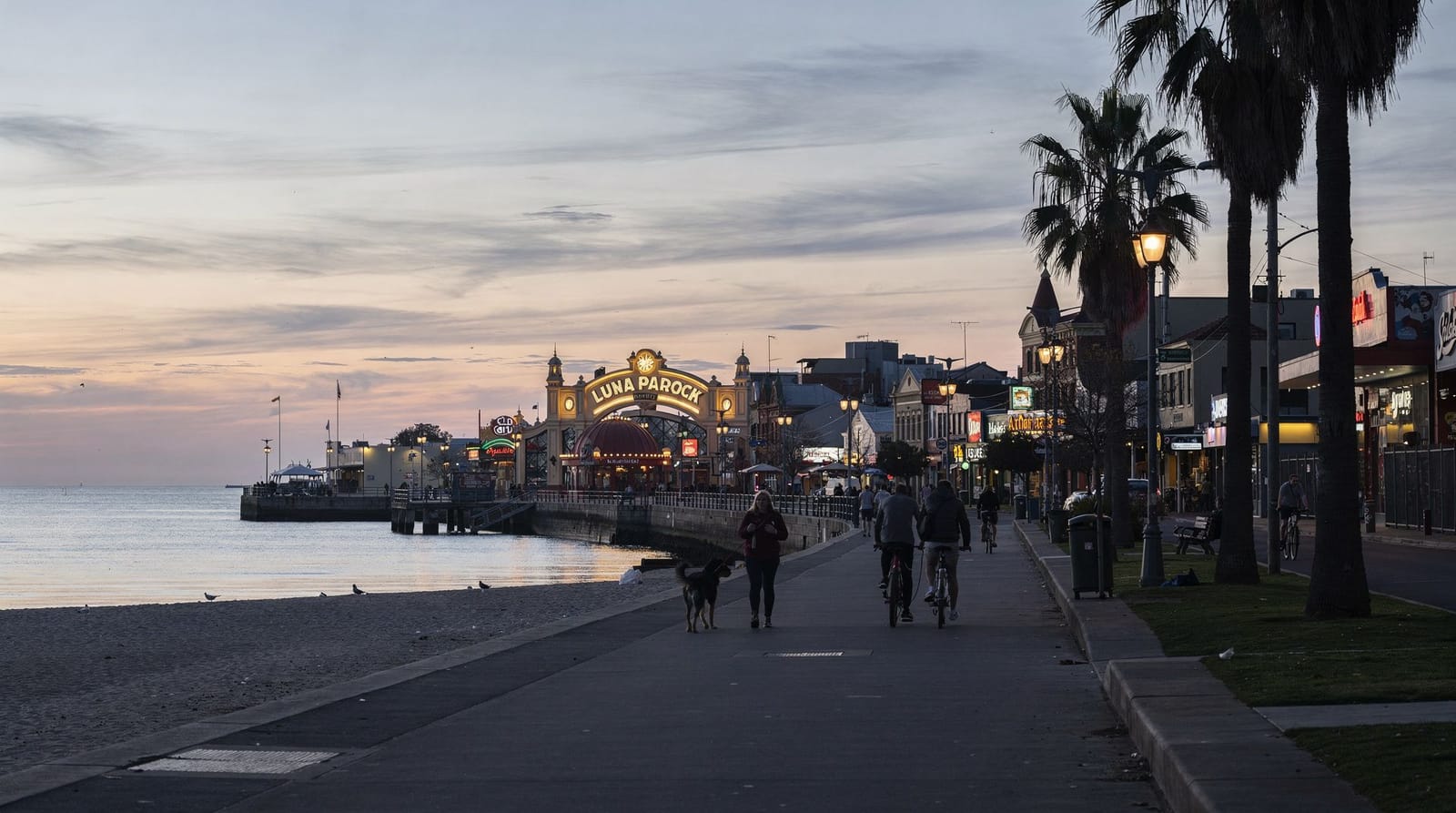
Luna Park St Kilda opened its gates in December 1912, and remarkably, it has operated continuously on the same foreshore site ever since, making it one of the oldest amusement parks still running anywhere in the world. Its giant, grinning “Mr Moon” entrance face is one of Melbourne’s most recognisable landmarks, and stepping through that mouth-shaped doorway into the grounds is a rite of passage for generations of Melbourne families, not just a novelty for visitors. The park sits directly on the St Kilda foreshore, an easy 20-25 minute tram ride from the CBD, making it one of the more accessible family attractions in the city without needing a car.
The history of the entrance face itself
Mr Moon’s giant grinning face entrance has been rebuilt and restored several times across the park’s history, following weathering and, in earlier decades, a couple of significant fires that damaged the structure. Each restoration has aimed to preserve the original 1912 design’s carnival-esque character rather than modernising the aesthetic, which is why the entrance still reads as distinctly vintage rather than looking like a contemporary theme park facade despite the practical necessity of periodic rebuilding. It’s a genuinely heritage-listed structure, reflecting its recognised significance to Victorian cultural history well beyond its function as a simple park entrance.
How the ticketing works
Entry to the grounds is free — there’s no gate fee just to walk in, browse the sideshow-style games and soak up the atmosphere. Rides are ticketed individually, or via an unlimited-rides wristband valid for the day, which works out considerably better value for anyone planning to ride more than three or four attractions. Families with a mix of ages, where not everyone wants to ride everything, sometimes find a combination of individual ride tickets and a wristband for the most enthusiastic riders makes more financial sense than buying wristbands all round.
The Scenic Railway — a genuine piece of living history
The park’s signature attraction is the Scenic Railway, a wooden rollercoaster dating to the park’s original 1912 construction and one of the oldest continuously operating rollercoasters anywhere in the world. It’s a genuinely different experience from a modern steel coaster — slower, rattlier, with wide sweeping curves through the park’s original wooden support structure rather than the tight inversions and high-speed drops of contemporary thrill rides.
That gentler character makes it accessible to a wider range of ages and comfort levels than its rollercoaster label might suggest, though the wooden structure’s age and character (the noise, the visible timber trestles) are part of what makes riding it feel like a genuine piece of amusement park history rather than a manufactured throwback.
The Scenic Railway’s engineering, explained simply
What makes the Scenic Railway mechanically distinctive, beyond its age, is that it uses a friction-based braking system rather than the electromagnetic or hydraulic braking common on modern steel coasters, contributing to its distinctive rattling sound and slightly less smooth ride compared with a contemporary rollercoaster. The wooden support structure itself requires ongoing, specialised maintenance to preserve both its safety and its heritage character, carried out by engineers with specific expertise in historic wooden coaster structures — a genuinely rare and specialised skill set globally, since so few operating examples remain anywhere in the world for engineers to train on.
This maintenance requirement is part of why Luna Park treats the Scenic Railway as a centrepiece asset worth the ongoing investment, rather than a liability to be quietly replaced with a modern equivalent.
Other rides and attractions
Beyond the Scenic Railway, Luna Park’s ride lineup spans classic amusement park staples — a carousel, dodgem cars, a ferris wheel and various spinning and swinging rides — alongside a handful of more modern additions aimed at older children and teenagers wanting a stronger thrill. Sideshow alley-style games line the main concourse, offering the traditional carnival mix of ring toss, shooting galleries and prize stalls that add to the park’s old-fashioned atmosphere alongside the rides themselves.
Height restrictions and suitability by age
Individual rides carry their own minimum height requirements, ranging from attractions suitable for young children with no restriction at all, up to adult-oriented thrill rides requiring roughly 130-140 cm. This spread means Luna Park genuinely works across a wide range of family compositions — very young children have plenty to enjoy on the gentler rides, while older children and teenagers can access the more intense options, all within the same visit. Checking specific ride requirements posted at each attraction on arrival is worth doing if travelling with children of noticeably different ages, so expectations are set before waiting in a queue.
What visitors sometimes get wrong on a first visit
First-time visitors occasionally arrive expecting a large-scale theme park on the order of somewhere like Movie World on the Gold Coast, and are surprised by Luna Park’s considerably smaller, more compact footprint — this is a heritage seaside amusement park, not a sprawling modern theme park, and setting expectations accordingly avoids disappointment. The park’s real strength lies in its historical character and the specific charm of rides like the Scenic Railway, rather than an extensive lineup of the latest thrill-ride technology, and visitors who understand this going in generally get considerably more enjoyment out of the visit than those expecting a different kind of park entirely.
Combining with St Kilda Beach and the foreshore
Luna Park’s location directly on the St Kilda foreshore makes it easy to combine with a broader St Kilda day — the beach itself sits immediately alongside the park, Acland Street’s well-known cake shops and cafes are a short walk away, and St Kilda Pier (with its little penguin colony visible at dusk, seasonally) extends a foreshore walk further along the coast. Many families structure a St Kilda day around a beach morning, lunch on Acland Street, and a Luna Park afternoon, using the tram to arrive and depart rather than driving and dealing with St Kilda’s busier weekend parking.
Comparing the wristband against paying per ride
Working out whether an unlimited-rides wristband beats individual ride tickets comes down to simple arithmetic based on how many rides each family member realistically wants to do. For a child planning to ride four or more attractions, or a group with mixed enthusiasm where some members want to ride repeatedly on a favourite like the Scenic Railway, the wristband typically wins out. For an adult accompanying children who only wants to ride once or twice, or isn’t interested in riding at all, buying individual tickets or simply not riding avoids paying for unlimited access that won’t be used. Staff at the ticket counter can generally advise on current per-ride pricing versus the wristband cost if the calculation isn’t obvious on arrival.
Seasonal opening hours
Luna Park operates year-round but with genuinely different opening patterns across the seasons — expect more limited operating days during Melbourne’s quieter winter months (June-August) and extended hours through the summer school holidays (December-January), when the park runs its fullest schedule to match peak visitor demand. Checking current opening hours before a visit is worth doing rather than assuming a fixed daily schedule applies year-round, particularly for a weekday visit outside school holidays.
Getting around on the way in and out
The tram is the simplest way to reach the foreshore, and a Myki card keeps the fares straightforward for the whole family. The Melbourne tram guide explains how the network works if you have not used it before, and the getting around Melbourne overview helps if you are combining St Kilda with other parts of the city on the same day.
Evening visits and lighting
Luna Park takes on a genuinely different character after dark, when the entrance face and ride lighting come into their own — many locals consider an evening visit, particularly in the warmer months when the park stays open later, a more atmospheric experience than a daytime visit, with the illuminated rides and Mr Moon’s lit-up face standing out dramatically against the night sky over the foreshore. Families with children who can manage a later bedtime occasionally prioritise an early-evening visit specifically for this reason, treating it as a different experience to a standard daytime family outing rather than simply a scheduling convenience.
Staying on for the penguins
If a late afternoon at the park leaves you with energy to spare, the pier is a natural next stop. Families who would rather see the little penguins with a bit of structure can look at a sunset cruise out of St Kilda to watch the penguins, which suits the end of a Luna Park day well. For a wider look at the species in Victoria, see our Penguin Parade guide and the Phillip Island wildlife overview.
Food and facilities
A range of kiosks and food stalls operate within the park grounds, alongside St Kilda’s wider selection of cafes and restaurants just outside the gates for a more substantial meal. Basic facilities including toilets and first aid are available on site, and the park’s compact layout means finding your way between rides, food and facilities is straightforward even on a first visit.
Safety standards and ride maintenance
Despite its historic character, Luna Park operates under the same modern Australian amusement ride safety standards and regular inspection regime as any contemporary park, meaning the Scenic Railway and other vintage attractions undergo the same rigorous, legally mandated safety checks as newer rides elsewhere. Parents sometimes assume a century-old rollercoaster carries inherently different risk to a modern one; in practice, the ride’s ongoing certification and maintenance programme means it’s held to the same current safety standard as any operating amusement ride in Victoria, with its age reflected in its engineering character rather than in any reduced safety oversight.
Accessibility
Luna Park’s main concourse is flat and accessible for prams and most wheelchairs, though individual rides have their own specific accessibility and safety requirements that vary by attraction — checking with staff at the entrance about which specific rides suit particular access needs is worth doing before queuing for anything ride-specific.
The park’s role in St Kilda’s cultural identity
Beyond its function as a family attraction, Luna Park has become genuinely woven into St Kilda’s broader cultural identity over its 110-plus year history — the Mr Moon face has appeared in countless films, television productions and photographs shot in Melbourne, and locals often use “meeting at the Moon” as a straightforward, universally understood landmark reference for arranging to meet somewhere in St Kilda. This cultural weight is part of why the park continues to draw repeat visits from Melburnians who grew up attending as children, now bringing their own children through the same gates their parents once walked them through, a continuity that few modern amusement parks can claim.
Ghost Train and other classic dark rides
Alongside the Scenic Railway, Luna Park’s Ghost Train is another long-standing attraction with genuine vintage character — a classic dark ride through a haunted-house-style indoor track, considerably tamer than a modern horror attraction but retaining an old-fashioned charm that appeals to both nostalgic adults and children experiencing this style of ride for the first time. It’s generally suitable for a broader range of ages than its “ghost” branding might suggest, though very sensitive younger children may find the darkness and sudden effects mildly startling, worth checking with staff about the ride’s specific content if uncertain.
Group bookings and school holiday programs
Luna Park runs group booking options for larger parties, including school groups and corporate events, alongside occasional themed events tied to specific school holiday periods or seasonal occasions. These special event days sometimes bring extended hours or additional entertainment beyond the standard ride lineup, worth checking the park’s current events calendar for if visiting during a school holiday period specifically and wanting to know whether anything beyond the standard offering is running.
Parking and getting there by car
While the tram is the more straightforward option given St Kilda’s often congested weekend parking, visitors driving to Luna Park can use the foreshore’s public parking areas, though availability tightens considerably on warm weekends and during summer school holidays when St Kilda’s beach and foreshore draw heavy general visitor traffic well beyond just those visiting the park itself. Arriving earlier in the day improves parking chances considerably compared with an afternoon arrival during peak periods.
Comparing Luna Park with other Melbourne family attractions
Luna Park’s specific appeal — genuine amusement park rides rather than museum-style exhibits or wildlife encounters — makes it a useful complement to Melbourne’s other major family attractions rather than a direct substitute for any of them. Families building a broader itinerary often pair a Luna Park visit with a beach morning at St Kilda and treat it as a distinct, higher-energy alternative to the more contemplative pace of somewhere like the Royal Botanic Gardens or Melbourne Museum on a different day of the same trip.
A realistic verdict for families
Luna Park St Kilda earns its enduring popularity less through cutting-edge thrill rides and more through genuine historical character — the Scenic Railway specifically is worth experiencing simply for what it represents, a rollercoaster that has been running in roughly its original form for well over a century. Combined with its beachfront location and easy tram access from central Melbourne, it’s one of the more straightforward half-day family additions to a Melbourne itinerary, particularly when paired with St Kilda’s beach and Acland Street on the same visit.
Building a full St Kilda day around Luna Park
Luna Park works best as one part of a fuller St Kilda day rather than a stand-alone destination requiring its own dedicated trip. A common structure: beach and foreshore walk in the morning, lunch on Acland Street, a Luna Park afternoon, then a stroll out along St Kilda Pier as the light softens toward evening — see our things to do in St Kilda guide for the fuller day plan, including the pier’s little penguin colony and other foreshore stops beyond the park itself. Families staying further along the bay in Brighton can reach St Kilda in a similar tram or short drive time, making a combined beach-and-Luna-Park day workable from either base.
Weekday versus weekend visits
Weekday visits, particularly outside school holidays, are noticeably quieter than weekends — shorter queues for the Scenic Railway and other popular rides, easier foreshore parking for anyone driving, and a generally more relaxed pace for families able to visit on a weekday morning or early afternoon. Weekend visits bring a livelier, more social atmosphere but also longer waits at the most popular attractions and busier surrounding St Kilda cafes and the beach itself. Families with flexible travel dates and young children who tire of queuing generally get more out of a weekday visit, while a weekend trip suits travellers who want to see St Kilda at its most lively.
Luna Park versus Melbourne’s other family attractions
Luna Park’s outdoor, ride-based format is a genuinely different style of day out to Melbourne’s indoor and wildlife-focused family attractions. For a wet-weather alternative, LEGOLAND Discovery Centre at Chadstone offers a comparable few hours of structured, indoor fun for a similar 3-10 age range, while rainy day Melbourne with kids covers the fuller set of indoor options if the forecast for your Luna Park day looks genuinely poor. Another dry option in the city is an indoor aquarium visit, and our SEA LIFE Melbourne guide and Melbourne Zoo family guide cover what to expect. See our broader Melbourne with kids guide for how a Luna Park visit fits alongside the city’s wildlife parks, museums and gardens across a longer family itinerary.
More tours on Viator
Top-rated experiences with verified reviews, bookable on Viator (a Tripadvisor company).


Frequently asked questions about Luna Park St Kilda
Does Luna Park charge entry, or do you pay per ride?
Entry to the grounds themselves is free — you only pay for rides, either individually or via an unlimited-rides wristband, which is generally better value for anyone planning to ride more than three or four attractions in a visit.What is the Scenic Railway and is it scary?
The Scenic Railway is a heritage wooden rollercoaster dating to 1912, one of the oldest continuously operating rollercoasters in the world — it's a gentler, slower ride than modern steel coasters, with a distinctive rattling, old-fashioned feel rather than intense speed or inversions, making it accessible to a broader range of ages than its rollercoaster label might suggest.Are there height restrictions on Luna Park's rides?
Yes, individual rides have their own minimum height requirements, ranging from rides suitable for young children with no restriction up to adult-oriented thrill rides requiring around 130-140 cm, so check specific ride requirements on arrival if travelling with children of varying ages.How does Luna Park fit with a day at St Kilda Beach?
Luna Park sits directly on the St Kilda foreshore, an easy walk from the beach itself, Acland Street's cake shops and the St Kilda Pier, making it straightforward to combine a beach morning with a Luna Park afternoon, or vice versa, without needing to change location.Is Luna Park open year-round?
Yes, though opening days and hours vary seasonally — it typically operates more limited days during quieter winter months and extended hours through summer school holidays, so checking current opening hours before visiting is worth doing rather than assuming a fixed daily schedule.Is Luna Park St Kilda good for very young children, or mainly older kids?
Both — the height-restriction spread across rides means very young children have plenty of no-restriction options (carousel, gentler spinning rides), while older children and teenagers can access the more intense attractions, all within the same visit and without either age group being left out.How does Luna Park compare with LEGOLAND Discovery Centre for a family day?
They suit different moods — Luna Park is outdoor, ride-based and higher-energy, best paired with a beach day, while LEGOLAND Discovery Centre at Chadstone is indoor, build-and-play focused and a better wet-weather choice. Families with time for both often treat them as separate days rather than combining them, given the distance between St Kilda and Chadstone.