Melbourne's street art scene, beyond Hosier Lane
Hosier Lane is the famous one, but it’s not the whole story
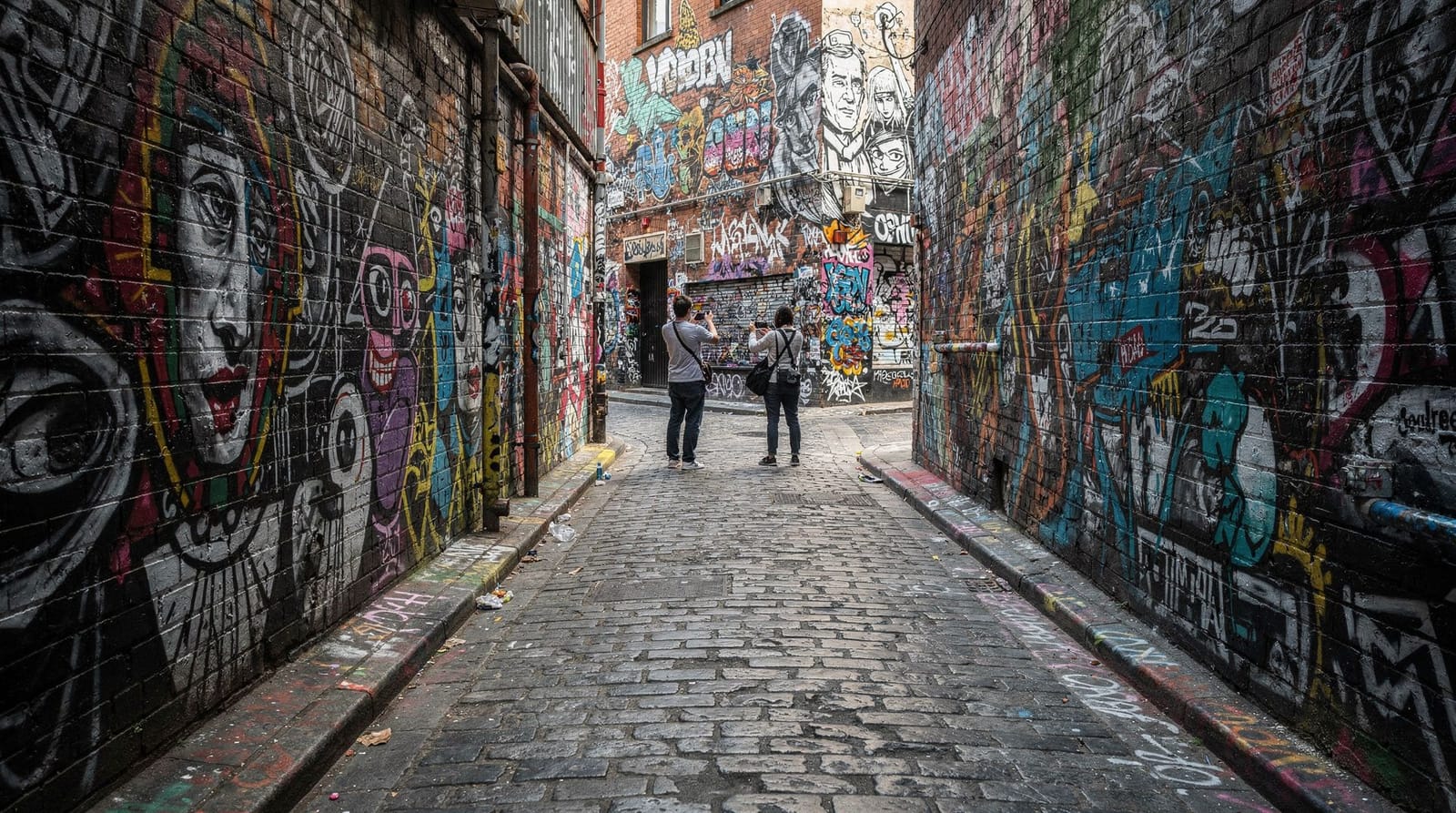
Hosier Lane, just off Federation Square, is where most visitors’ Melbourne street art photos come from, and it earns the reputation — a genuinely dense, constantly changing display of legally sanctioned work. But treating it as the entire scene misses most of what makes Melbourne’s street art culture distinctive: a citywide network of legal walls, informal artist communities, and neighbourhoods where the work is less curated for tourists and more embedded in daily life.
| Where | Hosier Lane, off Federation Square (CBD) |
| Cost | Free to wander; guided tours around 40-60 AUD |
| Time needed | 20-30 min self-guided, 1.5-2hrs with a tour |
| Best time | Early morning (before 9am) for empty lanes |
| Nearby | Federation Square, Flinders Street Station, Fitzroy/Collingwood |
What makes Melbourne’s scene different from other cities
Plenty of major cities have street art scenes, but few have gone as far as Melbourne in formally institutionalising it as tourism infrastructure — official council maps, guided tours run by former or current artists, and a genuine civic pride in the laneway network that goes beyond simple tolerance. Cities like Berlin or parts of London have comparably significant street art cultures, but Melbourne’s compact CBD concentrates a remarkable density of legally sanctioned work within walking distance of the main tourist core, which is unusual and part of why it travels so well in photographs and word of mouth.
Why Melbourne’s scene developed the way it did
Melbourne’s relationship with street art shifted from purely illegal graffiti toward a partially sanctioned, celebrated art form from the 1980s-90s onward, helped by the city council formally recognising certain laneways (including Hosier Lane) as legal painting zones rather than prosecuting the work as vandalism. This is genuinely unusual — most cities either heavily police street art or leave it entirely informal; Melbourne did neither, creating a hybrid where sanctioned laneways coexist with an ongoing, less formal scene elsewhere.
How Melbourne’s laneways became a canvas in the first place
Before street art became a celebrated feature, Melbourne’s laneway network was largely functional and neglected — service access behind the CBD’s main retail strips, used for deliveries and rubbish collection rather than foot traffic. The shift began gradually through the 1980s and accelerated through the 1990s and 2000s as artists began using the empty, ignored spaces, and the city council eventually recognised the cultural and tourism value of what had started as unsanctioned activity, formally designating certain lanes (Hosier among them) as protected, celebrated art zones rather than continuing to treat the work as simple vandalism.
That history matters because it explains why the scene feels genuinely organic rather than a manufactured tourist attraction — it grew from the bottom up before the city caught up and embraced it.
Where to go beyond Hosier Lane
Rutledge Lane, directly behind Hosier Lane, extends the same open-air gallery feel with less foot traffic. Fitzroy and Collingwood, particularly around Johnston Street and the Rose Street area, have a genuinely different character — larger-scale murals, more politically and socially engaged work, and considerably fewer tourists than the CBD laneways. AC/DC Lane, named for the band, is a smaller but worthwhile stop connecting Hosier Lane toward the Bourke Street end of the CBD.
a walking tour led by a working street artistFitting a street art walk into a wider itinerary
A Hosier Lane and CBD laneway walk pairs naturally with a broader first day in the city — it sits a short walk from Federation Square and Flinders Street Station, making it easy to fold into a morning that also covers Queen Victoria Market or the Southbank arts precinct. If you’re specifically interested in the Fitzroy and Collingwood side of the scene, that’s better treated as its own dedicated outing given the tram trip involved, and pairs well with a coffee stop in the same neighbourhood, covered in our Melbourne coffee culture guide.
Is it actually legal?
This is more nuanced than a simple yes or no. Certain laneways (Hosier Lane among them) are designated legal painting zones with council permission, meaning artists can paint there without breaking the law, and the work is expected to be painted over repeatedly — nothing here is permanent. Elsewhere in the city, unsanctioned graffiti remains illegal and is removed by the council, which is why the legal laneways concentrate so much visible activity in a few specific spots rather than spreading evenly across the CBD.
Notable artists and pieces to know about
While Hosier Lane’s works are anonymous and constantly changing by design, a handful of Melbourne street artists have gained genuine international recognition — names like Rone, known for large-scale, hauntingly beautiful portraits of women (some of his largest works have appeared on entire building facades around the CBD and inner north), and IIsl, whose stencil-based political and social commentary pieces are among the most photographed in the laneway network. Spotting a piece by an artist you recognise adds a different layer to a laneway walk than simply photographing whatever looks striking, and a knowledgeable guide can point out current pieces by well-known names that a casual visitor would otherwise miss entirely.
The line between street art and graffiti vandalism
It’s worth understanding that Melbourne’s celebrated legal street art scene and unsanctioned graffiti vandalism (tagging on private property, trains, or non-designated walls) are treated very differently by authorities, even though visually a first-time visitor might not immediately distinguish between them. Illegal tagging remains a genuine problem the city actively works to remove, particularly on heritage buildings and public transport infrastructure, while the sanctioned laneway network exists specifically to channel the same artistic energy into a legal, celebrated outlet — a deliberate policy trade-off that’s part of why Melbourne’s approach has been studied by other cities looking to manage graffiti culture more constructively.
A guided tour vs exploring alone
Wandering Hosier Lane and Rutledge Lane alone costs nothing and takes 20-30 minutes — genuinely worthwhile on its own. What a guided tour adds is context: who’s currently active in the scene, what specific pieces mean, and access to a working artist’s perspective on a culture that’s otherwise easy to walk past without understanding. If you’re specifically interested in street art as an art form rather than just a photo backdrop, the tour earns its cost; if you just want the photos, self-guided is entirely sufficient.
If you’d rather combine the murals with the neighbourhood’s other claim to fame, a guided walk through Fitzroy and Collingwood that mixes coffee stops with local history covers much of the same ground as the street art circuit. For a broader introduction to the inner city, the laneways walking tour guide and our Melbourne walking tours overview lay out the self-guided and guided options side by side.
More reading before you go
Hosier Lane is only one chapter of a wider story. The Hosier Lane street art guide and the broader Melbourne street art guide go deeper on the lanes themselves, while the CBD laneways destination page places them on the map. The best laneway cafés make natural pauses between murals, and the Melbourne arcades and laneways guide covers the more genteel side of the same network. If you’re planning the rest of the day, the Melbourne coffee guide, the Melbourne tram guide and the free tram zone guide help with getting around, and the one-day Melbourne itinerary shows where a street art stop fits into a first visit. For after dark, the laneway bars guide picks up where the daytime walk leaves off.
Street art beyond the inner city
While Fitzroy, Collingwood and the CBD carry the bulk of Melbourne’s best-known street art, pockets of significant work also appear further out — parts of Brunswick and Northcote in the inner north have their own mural traditions, often tied to local community projects and cultural festivals rather than the more commercially visited CBD laneways. These areas reward visitors with more time who want to see street art embedded in genuine neighbourhood life rather than concentrated in a tourist-facing precinct, though they require a slightly longer tram or train trip from the city centre.
Photography tips
Early morning (before 9am) gives the emptiest lanes for photography without other visitors in every shot; midday and afternoon are considerably busier, particularly on weekends. Because the art changes constantly — sometimes within days — there’s no “best time of year” to see specific pieces; whatever’s there when you visit is genuinely temporary.
Fitting it into a first day in the city
Hosier Lane sits close enough to Flinders Street Station and Federation Square that most visitors fold it into a broader first morning covering Queen Victoria Market or the Southbank arts precinct. If Fitzroy and Collingwood’s murals are the priority instead, treat that as a separate half-day outing, and pair it with the laneways guide for the CBD side of the walk.
How it compares with Melbourne’s other laneway culture
Street art and the hidden laneway bar scene grew up in the same physical spaces — the CBD’s service laneways — for related reasons: cheap, overlooked real estate that artists and small bar owners both found useful before the city recognised the cultural value of either. If you’re spending an evening in the laneways anyway, see our Melbourne nightlife guide for how to combine a daytime street art walk with an evening in the same network of lanes.
Where the CBD’s other legal walls sit
Beyond Hosier and Rutledge Lanes, Union Lane (running between Bourke Street Mall and Little Collins Street) is another sanctioned, heavily painted laneway worth a short detour, and it sits close enough to the Bourke Street Mall that it’s an easy add to a CBD shopping stop. Degraves Street, better known for its café strip, also carries pockets of sanctioned art among the outdoor tables, blurring the line between a coffee stop and a gallery walk in a way that’s fairly distinctively Melbourne.
Is Hosier Lane the only place to see street art in Melbourne?
No — it’s the most famous and most photographed, but Rutledge Lane, AC/DC Lane, and neighbourhoods like Fitzroy and Collingwood all have significant, less touristy street art scenes worth visiting.
Is Melbourne’s street art legal?
Certain laneways, including Hosier Lane, are officially designated legal painting zones with council sanction. Elsewhere in the city, unauthorised graffiti remains illegal, which is part of why legal activity concentrates in a handful of specific lanes.
Does the street art in Hosier Lane change often?
Yes, constantly — sometimes within days, sometimes weeks. Whatever you photograph is genuinely temporary, which is part of the appeal for repeat visitors.
Is a street art walking tour worth booking?
If you want context on the artists and the scene’s history, yes. If you just want photos, self-guided wandering through Hosier Lane and Rutledge Lane is free and entirely sufficient.
Who are Melbourne’s most famous street artists?
Rone, known for large-scale portrait murals across the CBD and inner north, and stencil-based political commentary artists like IIsl are among the names most associated with the current scene, though much of Hosier Lane’s work remains deliberately anonymous.
Is street art in Melbourne considered graffiti or vandalism?
Sanctioned laneways like Hosier Lane are legally designated painting zones and celebrated as public art. Unauthorised tagging elsewhere in the city remains illegal and is actively removed, so the two are treated very differently despite visual similarities.
Where can you see street art outside the CBD?
Fitzroy, Collingwood, and further out in Brunswick and Northcote all have significant mural and street art traditions, often more tied to local community projects than the CBD’s more visited, tourist-facing laneways.
How long should I spend on a Hosier Lane visit?
Twenty to thirty minutes covers Hosier and Rutledge Lanes at an unhurried pace. Add a guided walking tour or a wander through Fitzroy’s murals and budget closer to half a day.