Werribee Open Range Zoo: safari trucks and African wildlife near Melbourne
Melbourne: Werribee open range zoo entry ticket
What is Werribee Open Range Zoo and how is it different from Melbourne Zoo?
Werribee Open Range Zoo, about 32 km southwest of the CBD, is built around a guided safari truck ride through large open paddocks modelled on African and Asian savanna, where lions, giraffes, rhinos and zebras live in expansive shared enclosures rather than the smaller, separated exhibits at Melbourne Zoo's Parkville site. General admission with the safari included runs around 48-55 AUD for adults.
A safari drive, not a walking zoo
Werribee Open Range Zoo takes a genuinely different approach from a conventional zoo layout: rather than walking between individual enclosures, the core experience is a guided safari truck ride through large open paddocks modelled on African and Asian savanna landscapes, where species like giraffes, zebras, rhinos and various antelope roam across shared, expansive space rather than being separated into individual pens. It’s run by Zoos Victoria, the same not-for-profit body behind Melbourne Zoo and Healesville Sanctuary, and shares their conservation-first funding model, with ticket revenue supporting field research and breeding programs for threatened species.
| Where | Werribee, about 32km southwest of the CBD |
| Cost | Around 48-55 AUD adult general admission, incl. safari |
| Time needed | 3-4 hours; half/full day with Werribee Mansion |
| Getting there | Self-drive around 35-45 min; train to Werribee plus bus/rideshare is possible but slower |
| Best time | Spring or autumn; early safari slot in Dec-Feb heat |
Getting there and tickets
Werribee Open Range Zoo sits about 32 km southwest of central Melbourne, roughly a 35-45 minute drive via the Princes Freeway depending on traffic. Public transport is technically possible — train to Werribee station, then a local bus or short taxi/rideshare for the final stretch — but the site’s semi-rural location means most visitors find self-driving considerably more practical. General admission including the safari ride runs approximately 48-55 AUD for adults, with concession, senior and family pricing available.
The safari truck ride
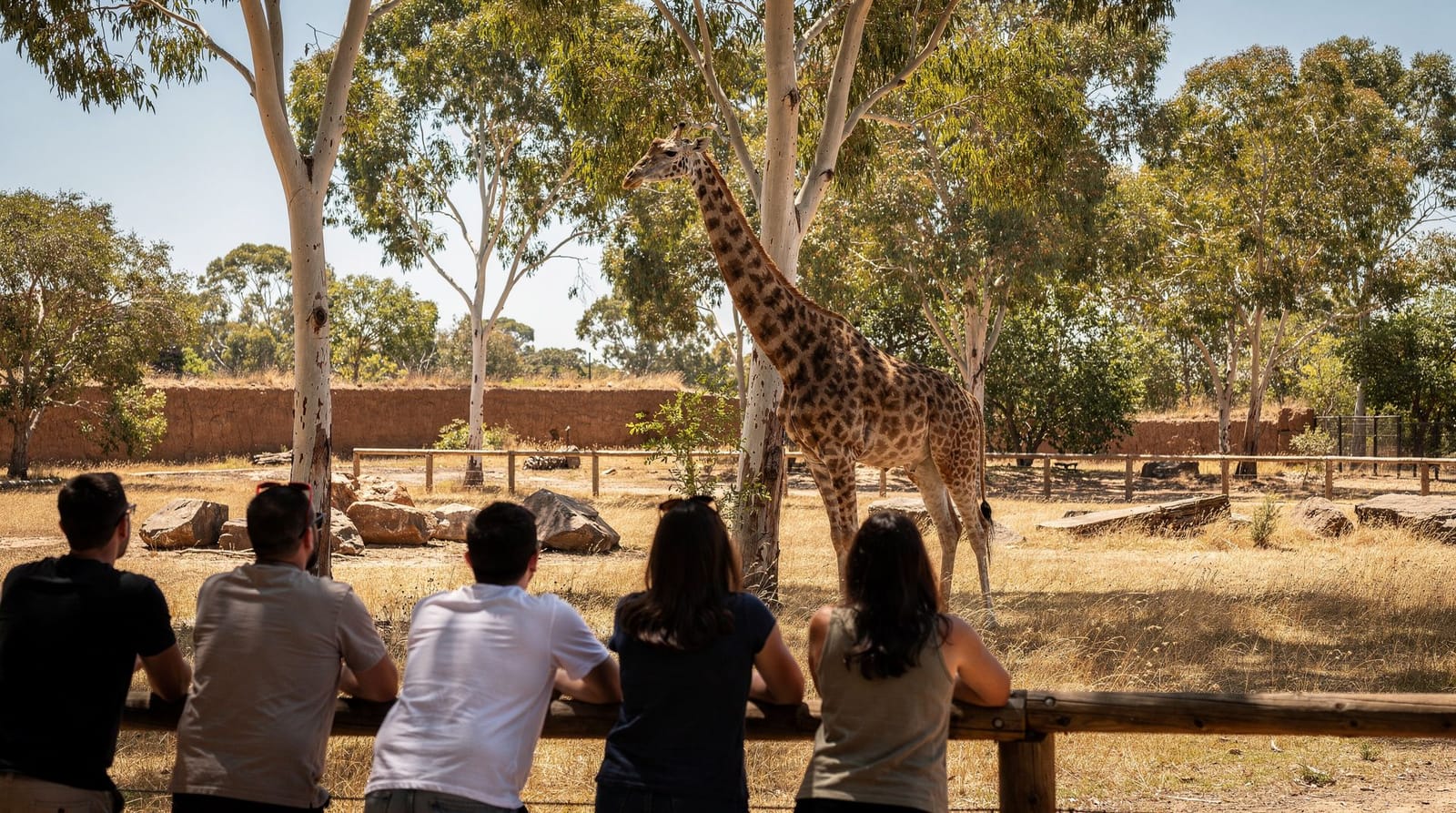
The guided open range safari, included in standard admission, is a roughly 45-minute drive through the main savanna paddocks aboard a purpose-built safari truck, with a guide narrating the species and conservation context as the vehicle moves between habitat zones. Species visible from the truck route typically include giraffes, zebras, various antelope, rhinos and hippos, sharing large shared paddocks rather than being fenced individually — the closest thing to an African safari experience available within a short drive of Melbourne. Lions are housed in a separate, secure viewing area rather than the open truck route, for obvious safety reasons, but remain a highlight of the wider visit.
Safaris run more or less continuously through opening hours, though during school holidays and weekends it’s worth arriving reasonably early, since truck capacity is limited per departure and popular time slots can mean a short wait for the next available ride.
Beyond the safari — the walking trail
Outside the main safari loop, a separate walking trail covers additional exhibits including meerkats, cheetahs and various smaller-scale enclosures, giving visitors a chance to see some species at closer, unhurried range on foot rather than from a moving vehicle. This section rounds out a visit nicely and is worth allowing an hour or more for on top of the safari itself.
Combining with Ballarat and Sovereign Hill
For travellers continuing further west toward the goldfields region, Werribee sits roughly on the route toward Ballarat, and some tours combine a Werribee Open Range Zoo visit with Werribee Mansion and a stop at Sovereign Hill, Ballarat’s recreated 1850s gold-rush town, into a single longer day. This suits travellers with a specific interest in combining wildlife and colonial history in one trip, though it makes for a genuinely long day given the distances involved between Werribee and Ballarat, and most visitors treat the two as separate day trips rather than a single combined outing unless time is tightly constrained.
For an even closer look — the off-road safari
For visitors wanting a more immersive, smaller-group experience than the standard safari truck, the off-road safari experience offers a different vehicle format with closer access to specific paddock areas — worth the upgrade for wildlife photography enthusiasts or anyone who’s already done the standard safari on a previous visit and wants a fresh angle.
Combining with Werribee Mansion
The zoo sits close to Werribee Park and its centrepiece, the heritage-listed Werribee Mansion, a grand 19th-century Italianate homestead surrounded by formal gardens, giving visitors an easy way to extend a Werribee day trip beyond just the zoo. The Werribee Open Range Zoo and Werribee Mansion tour bundles both into a single guided day, useful for visitors without a car who want to see more of the area than the zoo alone. Self-drivers can easily do both independently, since the mansion and its gardens sit only a few minutes’ drive from the zoo entrance.
How long to budget
Most visitors spend 3-4 hours covering the safari ride plus the walking trail sections at a comfortable pace. Adding Werribee Mansion and its gardens extends the outing to a genuine half-day or full-day trip west of Melbourne, worth considering for anyone without other firm plans on that side of the city.
Weather and seasonal notes
The safari trucks run regardless of weather, making this one of the more weather-resilient wildlife experiences near Melbourne, though the walking trail sections are fully exposed and more comfortable in mild conditions. Spring and autumn offer the best overall visiting weather; summer’s midday heat (December-February) can make some animals less visibly active during the hottest hours, so booking an earlier safari slot is worth prioritising in peak summer.
What a typical visit looks like
Most visitors begin with the walking trail sections (meerkats, cheetahs, the lion viewing area) before or after the safari ride, depending on when their booked or walked-up safari slot departs. A comfortable full visit runs roughly: arrival and a walk through the initial trail sections, the roughly 45-minute safari truck ride through the main paddocks, then a return to the remaining walking trail sections and a lunch break at the on-site cafe. Visitors extending the day with Werribee Mansion typically treat the zoo as a morning activity and the mansion and gardens as an afternoon add-on, given the mansion’s more leisurely, self-paced walking format compared with the timed safari component at the zoo.
Weekday versus weekend visiting
Weekday visits, particularly outside school holidays, see noticeably lighter crowds both in the walking trail sections and for safari truck departures, meaning shorter waits between rides during quieter periods. Weekends and school holidays bring heavier family traffic, and safari departures can run at higher capacity with shorter intervals to accommodate demand, though this can also mean a busier, more crowded truck for each individual ride. Visitors prioritising a quieter, more personal safari experience should consider a weekday visit outside peak periods, while those simply wanting a shorter overall wait between arrival and their safari slot may find weekends work fine given the increased frequency of departures during busy periods.
Combining a Werribee visit with the wider western suburbs
Werribee’s broader area includes several other attractions worth knowing about if extending a day trip beyond just the zoo and mansion — the Wyndham Cultural Centre and various parklands along the Werribee River offer additional options for visitors with a full day allocated to the region. Point Cook Coastal Park, a short drive further south, adds a coastal walking option for anyone wanting to extend the day with time along the bay rather than heading straight back to central Melbourne after the zoo and mansion.
Werribee versus Melbourne Zoo and Healesville Sanctuary
Where Melbourne Zoo offers a more conventional, compact zoo layout with excellent public transport access from the CBD, Werribee trades that convenience for a genuinely different, more immersive safari-style format focused specifically on African and Asian savanna species — there’s comparatively little native Australian wildlife here compared with Healesville Sanctuary, which is the better choice for platypus, Tasmanian devils and other distinctly Australian species.
Many longer Victoria itineraries include both, since they cover genuinely different ground; a Zoos Victoria membership covering all three sites is worth considering for visitors planning multiple wildlife stops across their trip.
What visitors sometimes get wrong about Werribee
A common assumption among first-time visitors is that Werribee Open Range Zoo offers a similar range of native Australian wildlife to Melbourne Zoo or Healesville Sanctuary — in practice, its focus is overwhelmingly on African and some Asian savanna species, with comparatively little native Australian wildlife represented on site. Visitors specifically hoping to see koalas, platypus or other distinctly Australian species during a Werribee visit are likely to be disappointed and should plan a separate stop at Healesville Sanctuary or Phillip Island for that purpose instead, or see our koala spotting in Victoria guide for where native wildlife is a more realistic focus.
Another common misconception is expecting close, guaranteed sightings of every species from the safari truck — as with any open-range format, animals move freely across the paddocks and aren’t guaranteed to be visible from the road at every point along the route, though guides are generally skilled at directing attention toward whatever is currently visible during the drive.
Membership value for repeat visits
As with Melbourne Zoo and Healesville Sanctuary, Zoos Victoria membership covering all three sites is worth considering for visitors planning repeat visits across a longer Victoria stay, particularly families based in Melbourne for an extended period who might otherwise pay separate general admission at each site individually. For a single Werribee visit as part of a broader one-off Victoria trip, standard general admission remains the simpler and more cost-effective choice.
Accessibility
The safari trucks are accessible, with space for wheelchairs on most vehicles (check current accessibility arrangements when booking). The walking trail sections use sealed, mostly flat paths suitable for prams and most wheelchairs, and accessible parking is available near the main entrance.
Food and facilities
An on-site café and kiosk serve meals and snacks, with picnic areas available across the grounds for visitors bringing their own food — a practical option for families extending the visit with a Werribee Mansion stop afterward. A gift shop near the entrance stocks the standard range of zoo merchandise and conservation-linked items. Baby-change facilities and accessible toilets are available at multiple points around the grounds, and a first-aid station is staffed during opening hours near the main visitor centre.
A brief history of the open range concept
Werribee Open Range Zoo opened in 1983, built specifically around the then-emerging open-range zoo philosophy that had proven successful at similar sites internationally — the idea that large, shared paddocks mimicking natural savanna landscapes produce better animal welfare outcomes and a more immersive visitor experience than traditional fenced enclosures. It represented a significant departure from the enclosure-based model still used at the older Melbourne Zoo, and remains one of relatively few zoos in Australia built around this safari-drive format rather than a walking-trail layout.
The site itself was chosen partly for its open, grassland character, which lent itself naturally to recreating African savanna conditions without extensive artificial landscaping.
Conservation work at Werribee
As with Melbourne Zoo and Healesville Sanctuary, Werribee Open Range Zoo funds active conservation work through Zoos Victoria, including breeding programs for critically endangered species held on site and broader field conservation partnerships tied to some of its African species, several of which face serious habitat pressure and poaching threats in the wild. The zoo’s interpretive signage throughout the safari route highlights specific conservation programs tied to individual species, and safari guides typically discuss current conservation status as part of the standard narrated commentary during the truck ride itself.
What the safari guides actually tell you
The narrated commentary during the safari truck ride covers considerably more than simple species identification — guides typically discuss each species’ natural behaviour, social structure within the shared paddocks, and specific conservation challenges facing their wild populations, along with occasional updates on individual animals within the zoo’s herds. First-time visitors sometimes underestimate how much genuine information the ride delivers, expecting a simple drive-past rather than a properly guided wildlife experience; in practice, the safari functions more like a guided tour than a passive ride, and asking questions during the drive is actively encouraged.
Lions — how they’re viewed differently to the rest of the safari
Because lions present an obvious safety consideration in an open-range format, Werribee houses its pride in a separate, secure viewing area rather than sharing the open paddocks used for herbivore species like giraffes and zebras. This viewing area is still included in the standard visit and typically forms part of the broader walking trail section rather than the safari truck route itself, giving visitors a chance to view the pride at closer, stationary range rather than from a moving vehicle. It’s worth allowing a few extra minutes here specifically, since lion activity, like most big cats, tends to be concentrated around particular times of day (often early morning or late afternoon) rather than constant throughout a visit.
Comparing the standard safari with the off-road experience
The standard included safari truck ride follows a fixed route through the main paddocks on a shared vehicle with other visitors, while the separately bookable off-road safari uses a different, smaller vehicle format that can access areas and vantage points closer to specific animal groups, in a smaller group setting with more opportunity for photography and closer guide interaction. For most first-time visitors, the standard included safari delivers a genuinely satisfying experience on its own; the off-road upgrade suits repeat visitors, wildlife photography enthusiasts, or anyone wanting a more personalised, less time-constrained experience than the standard shared-vehicle format allows.
Where Werribee fits in a wider Melbourne plan
Werribee works best as one chapter of a longer wildlife-themed stay rather than a stand-alone outing. The Melbourne wildlife and nature in 4 days itinerary shows how a safari day can sit alongside other animal-focused stops, and families building a trip around younger children will find more ideas in our Melbourne with kids guide.
If you are deciding how to get west, the driving in Victoria guide covers the basics of road rules and planning for self-drivers, while getting around Melbourne explains the wider transport picture for anyone leaning on trains and rideshares instead. Because Werribee is all savanna species, it pairs naturally with a stop focused on Australian animals: kangaroo spotting and Phillip Island wildlife both give you the local counterpoint, so the two kinds of safari end up complementing each other rather than repeating.
Practical tips
Bring a hat and sun protection regardless of season, since the safari trucks and walking trails both spend considerable time in open, unshaded terrain. Cameras are welcome throughout (unlike the strict no-photography rule at the Penguin Parade), making this a good stop for wildlife photography enthusiasts. Weekday mornings remain the quietest time to visit, before school groups and family day-trippers build up through the middle of the day.
Bring a zoom lens or binoculars if wildlife photography is a priority, since the safari truck’s fixed route means some species are viewed from a moderate distance across the paddocks rather than immediately alongside the vehicle. Layered clothing is worth packing regardless of season, since the safari trucks are open-sided and the wind chill on a moving vehicle can feel noticeably cooler than standing still on the walking trails, particularly in winter. Finally, checking the safari departure schedule on arrival rather than assuming a fixed frequency helps with planning the rest of the visit around a specific departure time, especially during quieter weekday visits when trucks may run less frequently than on busy weekends.
More tours on Viator
Top-rated experiences with verified reviews, bookable on Viator (a Tripadvisor company).


Frequently asked questions about Werribee Open Range Zoo
Do I need to book the safari truck ride separately?
The open range safari (a roughly 45-minute guided drive through the main savanna paddocks) is included in general admission and typically runs continuously through the day, though during peak periods it can be worth arriving earlier to avoid a wait for the next departure, since capacity per truck is limited.How far is Werribee Open Range Zoo from Melbourne?
About 32 km southwest of the CBD, roughly a 35-45 minute drive depending on traffic. Public transport is possible via train to Werribee station followed by a local bus or taxi/rideshare for the final stretch, though most visitors find driving considerably more convenient given the site's semi-rural location.What animals can you see at Werribee Open Range Zoo?
The main safari paddocks hold African species including lions (viewed from a separate, secure vantage rather than the open truck route), giraffes, zebras, rhinos, hippos and various antelope species, alongside a walking trail section featuring meerkats, cheetahs and other smaller enclosures outside the main safari loop.Is Werribee Open Range Zoo good for a full day out?
Yes, most visitors spend 3-4 hours covering the safari ride plus the walking trail sections, and it pairs well with a stop at nearby Werribee Mansion and its formal gardens if extending into a fuller half-day or full-day trip west of Melbourne.Is the safari suitable for young children?
Yes, the safari truck is an easy, seated experience suitable for all ages, and it's one of the more accessible ways for young children to see large African wildlife up close without the walking demands of a full walking-trail zoo visit.What's the best time of year to visit?
The zoo operates year-round and the safari trucks run regardless of weather, though spring and autumn offer the most comfortable conditions for the walking trail sections. Summer heat can make some animals less visibly active during the hottest part of the day, so a morning safari slot is worth prioritising in December-February.
Top experiences
Bookable activities with verified prices and instant confirmation on GetYourGuide.