Melbourne's laneways: a self-guided and guided walking route
Melbourne: Melbourne laneways tour w lunch
What is the best laneway walk in Melbourne?
A loop starting at Hosier Lane's street art, through Centre Place and Degraves Street's café strip, then the Block and Royal Arcades back toward Bourke Street covers Melbourne's laneway highlights in about two hours on foot, entirely free if you self-guide it, or with commentary and hidden-bar access on a paid guided tour.
Why the laneways are Melbourne’s real main attraction
Ask a local what to do in Melbourne and “the laneways” comes up before any single museum or landmark, and for good reason: the CBD’s narrow service lanes, originally cut through the 1837 Hoddle Grid for deliveries and rubbish collection, have been reclaimed over the past three decades as the city’s densest concentration of cafés, bars, boutiques and legal street art. There’s no single “the laneways” attraction to buy a ticket for — it’s a network, and this guide gives you a practical route to walk it yourself, plus notes on when a guided tour adds enough value to be worth booking.
| Where | Hosier Lane, Centre Place, Degraves Street, Block & Royal Arcades |
| Cost | Free to self-guide; guided tours from around 60-90 AUD |
| Time needed | About 2 hours at a relaxed pace, including a coffee stop |
| Getting there | Walk within the CBD, inside the Free Tram Zone |
| Best time | Early morning for clear photos, evening for a different atmosphere |
The self-guided route
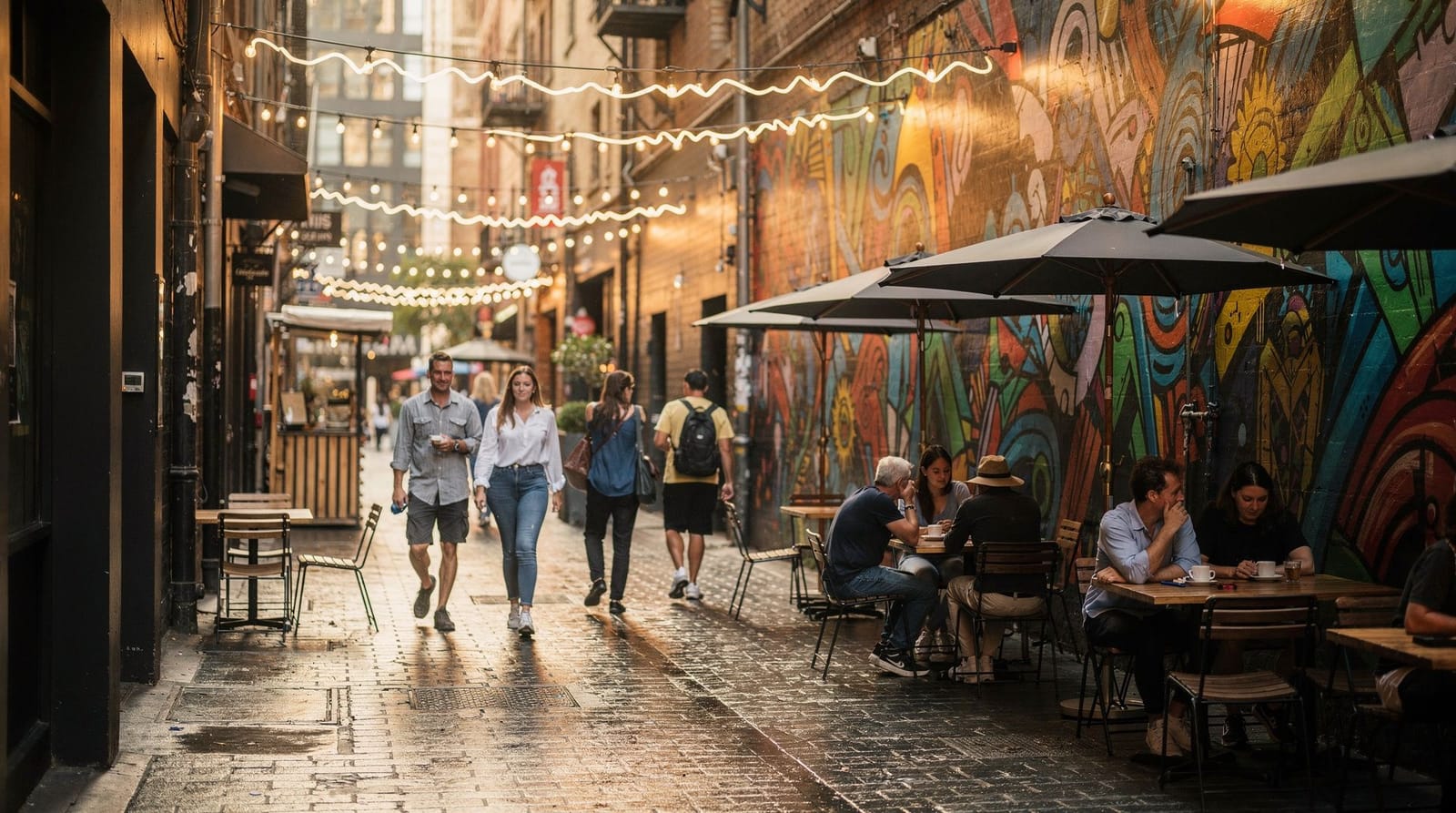
Start at Hosier Lane. Off Flinders Street opposite Federation Square, Hosier Lane is Melbourne’s most photographed laneway — a cobbled alley covered in constantly rotating street art. Because it’s designated legal space, artists paint over existing work regularly, so treat any photo you’ve seen online as a rough guide to the vibe rather than what you’ll actually find. Give this 15-20 minutes; it rewards a slow walk rather than a quick photo-and-leave.
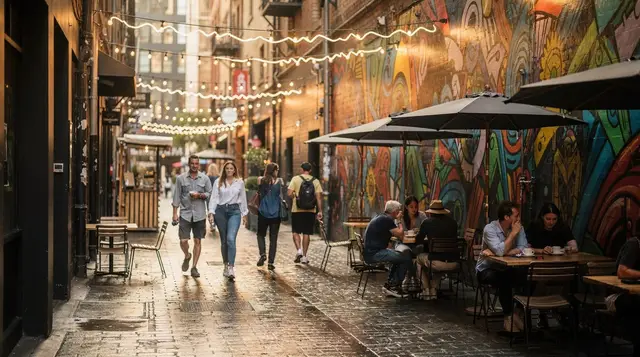
Walk to Centre Place. A short walk from Hosier Lane, Centre Place is a narrower, more café-dense laneway strung with fairy lights and small espresso bars — a good coffee stop and further street art without leaving the immediate area.
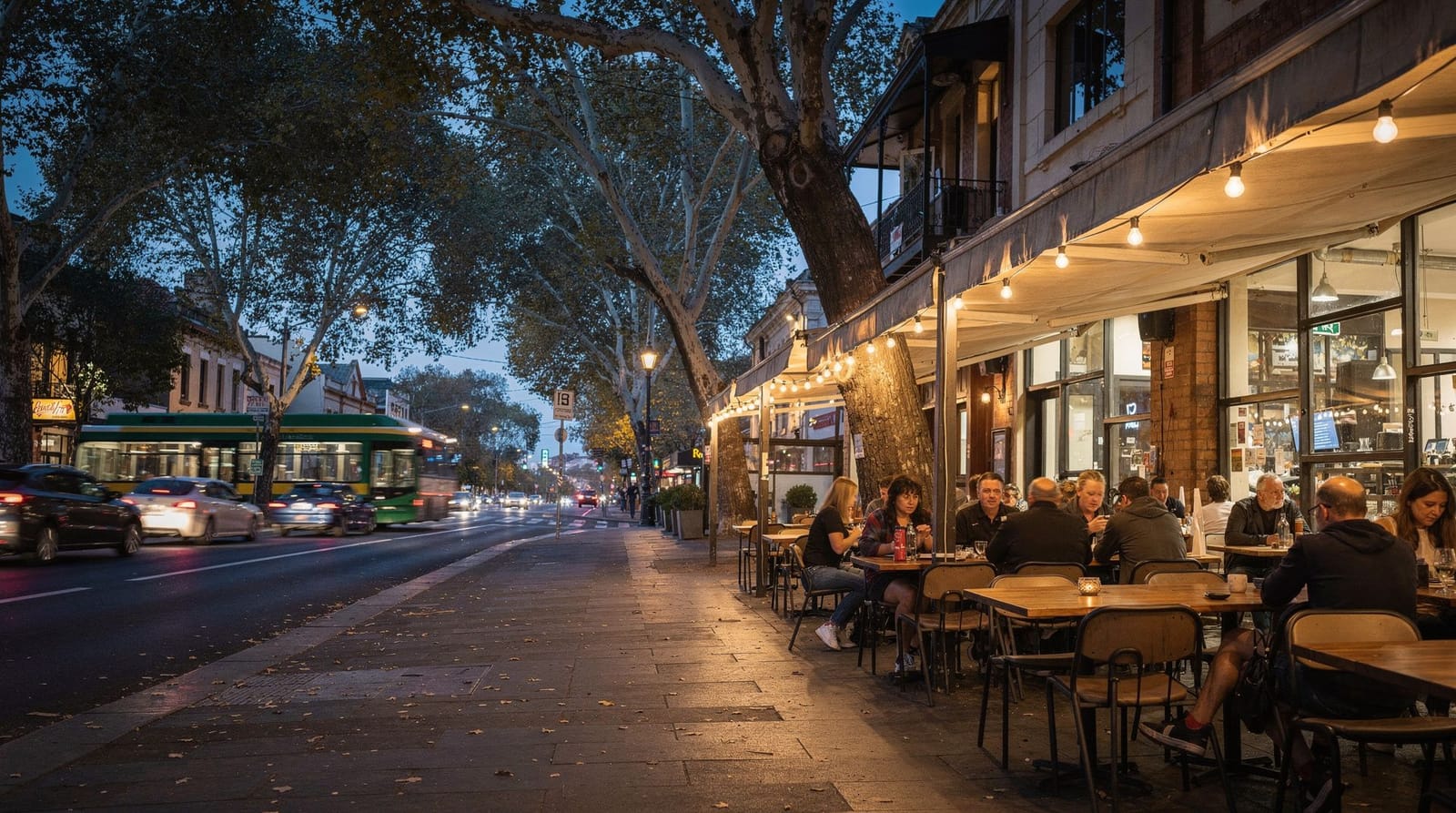
Continue to Degraves Street. One of the most recognisable laneway images in Melbourne tourism marketing: café tables spilling directly onto the cobblestones, striped awnings, and a genuinely good spot for a sit-down coffee or light lunch rather than a walk-through only. Expect it to be busy at any reasonable hour — this is not a hidden gem, it’s a deservedly popular strip.
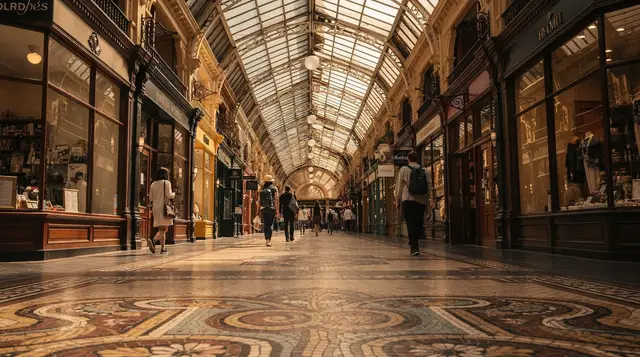
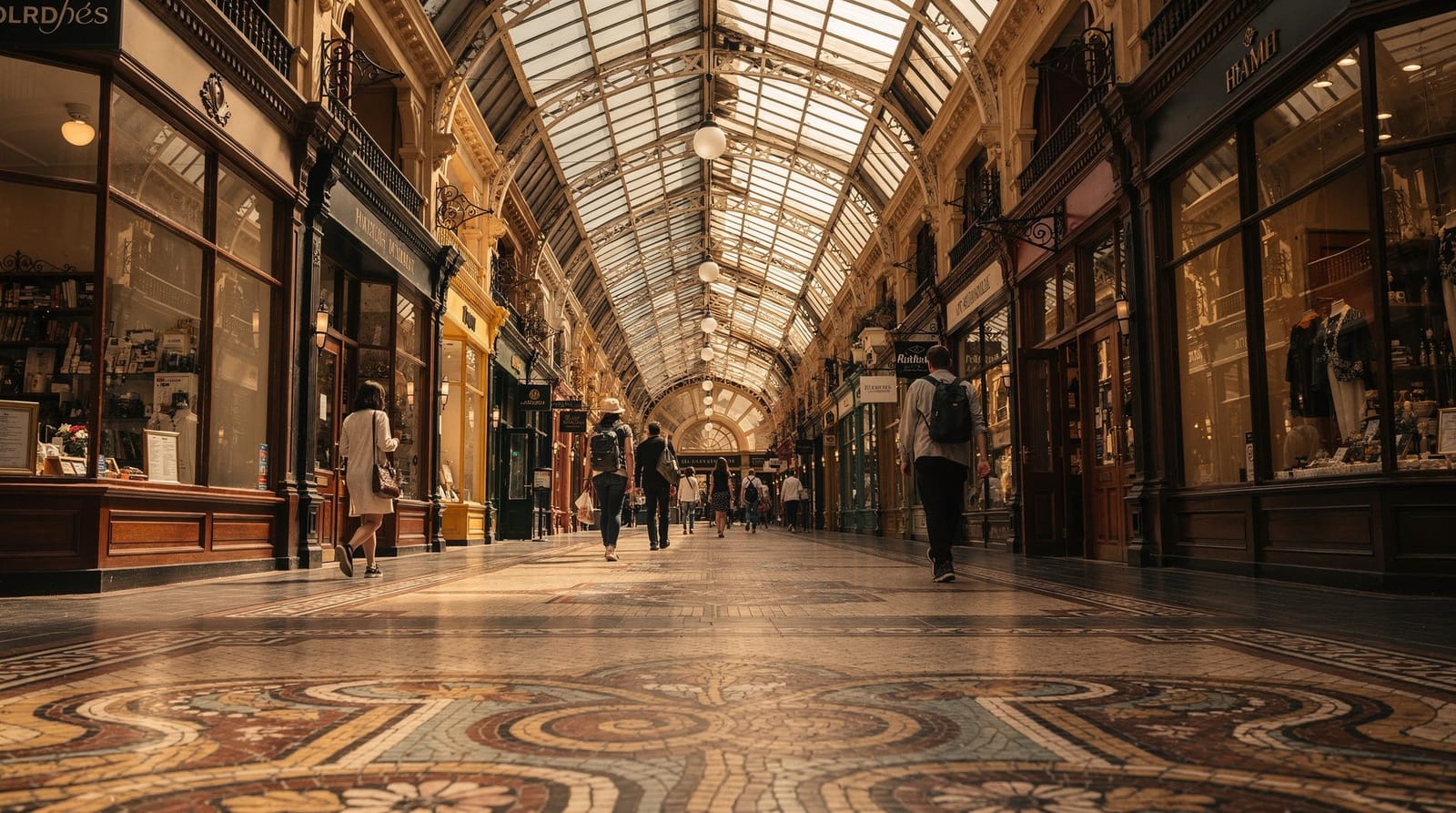
Head to the Block and Royal Arcades. A short walk brings you to the Block Arcade, an ornate 1891 Victorian-era covered arcade with mosaic tile floors and a glass-domed ceiling, connected via Block Place to the similarly grand Royal Arcade — both worth a slow walk-through even if you’re not shopping, purely for the architecture. Gay’s Bakery inside the Block Arcade has been trading continuously since the 1890s if you want a food stop with genuine history rather than just atmosphere.
Finish near Bourke Street Mall. The route naturally spits you out near Bourke Street, giving an easy connection point to continue toward Queen Victoria Market or back toward Flinders Street Station to close the loop.
Total walking time for this route, including a coffee stop, runs around two hours at a relaxed pace — extend it by detouring into AC/DC Lane (another street-art alley, named for the band) if you have extra time.
When a guided laneways tour is worth it
If you want lunch built in. A guided laneways tour with lunch included handles the logistics of finding a good, non-touristy spot to eat along the route, which can otherwise take real trial and error given how many mediocre options compete with the genuinely good ones in this dense area.
 Melbourne laneways tour w lunchCheck availability
If street art specifically is your focus. A tour led by a working street artist goes into technique, the legal-versus-illegal distinction in how the city treats different laneways, and points out specific pieces by internationally known artists a casual walker would miss entirely.
 Melbourne street art walking tour with a street artistCheck availability
If you want access to Melbourne’s hidden bar scene. Many of the city’s best small bars are deliberately unmarked or tucked behind unassuming doors in laneways and arcades — genuinely hard to find without local knowledge or a guide who knows exactly which door to push.
 Melbourne laneways larrikins and liquor tourCheck availability
Honest tourist-trap notes
Hardware Lane at lunchtime is overpriced for what it is. A popular laneway lined with restaurant tables, Hardware Lane does a brisk trade in tourists at lunch, and menu prices reflect that footfall more than food quality — treat it as a photogenic spot to walk through rather than your default lunch stop, and eat in Degraves Street, Fitzroy or Carlton instead for better value.
Not every laneway “hidden bar” is actually hidden anymore. Several of the most Instagrammed unmarked-door bars have become well-known enough that “hidden” is more branding than reality — expect a queue on weekend nights at the most famous ones, and consider a guided tour specifically if you want a genuinely lesser-known door.
A short history of how the laneways became Melbourne’s identity
It’s worth knowing that the laneways weren’t always celebrated the way they are today. Through much of the 20th century, Melbourne’s back lanes were genuinely neglected service corridors — rubbish collection routes and delivery access, not destinations — and it took a deliberate mix of council policy change, a wave of small bar licensing reform in the 1980s and 1990s that made tiny, unconventional venues economically viable for the first time, and an organically growing street-art culture to transform them into the city’s signature tourist drawcard.
The small bar reforms in particular were pivotal: before that regulatory shift, licensing rules effectively favoured large pubs and clubs, and it was only once small, characterful venues in laneway spaces became legally and financially viable that the current scene — hidden bars, tiny wine bars, laneway cafés — could really take hold.
Understanding this history reframes the laneways as a genuine, relatively recent urban planning success story rather than something that simply always existed this way.
What to actually look for in the street art
For visitors without a background in street art, it helps to know a few basic distinctions that deepen appreciation beyond “colourful wall.” Stencil work — spray paint applied through a cut template — produces crisp, repeatable images and is often used for political or satirical commentary, a technique associated internationally with artists like Banksy but with a strong independent Melbourne tradition of its own. Freehand pieces, built without a template, tend to be larger, more painterly, and take considerably longer to produce, often signalling a more established or confident artist since freehand work is harder to execute well at scale.
Paste-ups — printed or hand-drawn paper glued to a wall — are a faster, lower-cost technique often used by artists testing ideas or working without spray-paint access, and are typically the shortest-lived, painted over or replaced within weeks.
Genuinely understanding these distinctions, even at a basic level, changes a laneway walk from a photo backdrop into something closer to an outdoor gallery visit.
Practical food stops along the route
Since a laneways walk naturally invites a meal or coffee stop, it’s worth knowing a few specifics beyond the general Degraves Street recommendation. Centre Place’s small cafés tend to specialise in strong, quick espresso rather than sit-down brunch, suiting a mid-walk caffeine stop better than a leisurely meal. The Block Arcade’s historic Hopetoun Tea Rooms, trading since 1892, offers a genuinely old-world high-tea experience if you want to sit somewhere with real heritage rather than a modern café fit-out.
For a more substantial lunch without Hardware Lane’s inflated tourist pricing, walking the extra few minutes to Chinatown’s Little Bourke Street strip delivers better value and, for many visitors, better food, while staying close enough to the laneways route to fold in without a major detour.
Combining the laneways with other city-tours activities
The laneways route pairs naturally with a broader walking tour if you want historical context added to the same ground, or with a ghost tour in the evening for a different side of the CBD after dark. If your legs need a break partway through, the City Circle Tram loop connects near several laneway entry points, and a Yarra River cruise from nearby Southbank makes a relaxed follow-up activity after a couple of hours on foot.
Practical tips
Wear real shoes. Cobblestones and uneven laneway surfaces are genuinely unkind to thin sandals or heels; comfortable flat footwear makes the two-hour route far more enjoyable.
Go early or later in the day for photos without crowds. Hosier Lane and Degraves Street are busiest late morning through afternoon; an early-morning pass (before 9am) gives noticeably clearer photo opportunities.
Check current opening hours for arcades. The Block and Royal Arcades are lined with shops that follow standard retail hours, so an evening walk-through still works for the architecture but won’t include browsing.
Bring a phone charger or battery pack if you’re documenting the walk. Between street art photos and arcade architecture, this route is genuinely one of the most photographed in the city.
Extending the route: AC/DC Lane and beyond
If the core loop leaves you wanting more, a handful of additional laneways reward a detour for visitors with extra time. AC/DC Lane, named for the Australian rock band whose connection to Melbourne runs deep (guitarist Angus Young’s family emigrated here, and the band played early gigs in the city), runs a short distance from Hosier Lane and carries its own dense, rotating collection of street art with a slightly grittier, music-culture edge than Hosier’s more polished reputation. Rutledge Lane, tucked nearby, is a quieter, less-visited option for street art enthusiasts wanting to escape the crowds that gather at the two more famous laneways during peak hours.
Further from the immediate CBD core, Duckboard Place and Corrs Lane extend the same laneway character into slightly less touristed territory, worth exploring on a second visit once you’ve covered the essentials on your first laneways walk.
Laneways at night: a different atmosphere
While this guide focuses on a daytime walking route, it’s worth knowing the laneways transform meaningfully after dark. Restaurant and bar trade fills the same spaces that felt purely visual and pedestrian during the day, string lighting in spots like Centre Place creates a genuinely different, warmer atmosphere, and the street art in Hosier Lane and AC/DC Lane takes on a different character under artificial lighting rather than daylight. Many visitors find doing a version of this same route once in daylight for photography and history, and again after dark for dinner and drinks, gives two genuinely distinct experiences from the same physical streets rather than feeling repetitive.
Shopping in the laneways and arcades
Beyond street art and food, the laneways and arcades support a genuinely distinctive independent retail scene worth building into your walk. The Block and Royal Arcades house long-established jewellers, hat makers and specialty shops alongside newer boutiques, a different retail character from the CBD’s larger department stores on Bourke and Collins Streets. Centre Place and the smaller lanes running off it carry a rotating mix of small designer stores, vintage clothing and local craft, changing more frequently than the arcades’ longer-established tenants.
If independent shopping is part of your interest in Melbourne, budgeting an extra hour to browse rather than simply walking through gives a genuinely different sense of the laneways beyond their Instagram-famous visual appeal.
The bottom line
Melbourne’s laneways cost nothing to explore and reward unhurried walking more than almost any single paid attraction in the city — this self-guided loop covers the essentials in about two hours. Book a guided tour specifically when you want lunch, hidden-bar access, or artist-led street-art commentary rather than as a default; the laneways themselves are public space, and a map (or this guide) is often all you actually need.
A self-guided route variant if you have less time
If two hours isn’t realistic for your schedule, a condensed 45-60 minute version of the route still delivers most of the highlights: Hosier Lane (10 minutes), a quick coffee in Centre Place (10 minutes), and a walk-through of the Block Arcade (15-20 minutes) before rejoining Bourke Street Mall. This drops Degraves Street and the Royal Arcade, but still covers the two most distinctive stops — legal street art and Victorian-era arcade architecture — for visitors squeezing the laneways into a tighter CBD day alongside other sightseeing.
Accessibility along the route
Most of the core route is flat and manageable for prams and most mobility aids, though the laneways’ original cobblestones (particularly in Hosier Lane and parts of Centre Place) present a genuinely uneven surface that can be difficult for wheelchairs or anyone with significant mobility limitations. The Block and Royal Arcades, by contrast, have smoother, more consistent flooring throughout. If mobility is a firm constraint rather than a minor inconvenience, prioritising the arcades over the cobbled laneways, or choosing a guided tour that can advise on the smoothest available path, is a sensible adjustment to the standard route.
Rainy-day considerations
Melbourne’s famously changeable weather means it’s worth planning for rain even on a forecast-clear day. The Block and Royal Arcades offer genuine covered shelter partway through the route, and Centre Place’s narrower, partially-covered sections provide some relief too, but Hosier Lane and Degraves Street are fully open to the sky. A light rain layer and a plan to duck into a covered arcade or café if a shower rolls through keeps the route workable in all but the heaviest downpours — and light rain on cobblestones, while slippery underfoot, doesn’t meaningfully detract from the street art or architecture, some visitors even find the wet cobblestones photograph beautifully under the laneway string lighting.
Photography tips specific to this route
Because this route spans open-air street art, covered arcades and busy café strips, lighting conditions genuinely shift throughout the walk in a way a single set of camera settings won’t handle well. Hosier Lane’s narrow walls benefit from soft, indirect light — overcast conditions or early morning generally outperform harsh midday sun, which creates strong shadow contrast against the murals.
The Block and Royal Arcades’ domed glass ceilings flood the space with natural light through the middle of the day, making late morning to early afternoon the best window for arcade architecture shots specifically, the opposite timing preference to the street art stops earlier in the route. Degraves Street’s café tables photograph best from a slightly elevated angle if you can find one, capturing the striped awnings and cobblestone crowding that make the strip so recognisable in Melbourne tourism imagery.
Combining the walk with a coffee crawl
Because Melbourne’s coffee culture runs through the same laneway network as the street art and arcades, this route doubles naturally as a coffee crawl for visitors specifically interested in the city’s café scene. Centre Place and Degraves Street both hold some of the best laneway cafes in the CBD, and pacing the walk around two or three shorter coffee stops rather than one long sit-down meal keeps momentum through the full loop while still sampling the city’s coffee culture properly. For visitors with a genuine specific interest in coffee over street art or architecture, slowing the pace to treat this as a coffee-first walk rather than a street-art-first one is a reasonable variation on the core route.
Seasonal differences along the route
Melbourne’s laneways remain walkable year-round, but the experience shifts noticeably with the seasons. Summer’s long evenings extend the golden-hour photography window well past standard closing times, and outdoor café seating in Degraves Street and Centre Place spills further onto the cobblestones when the weather cooperates. Winter’s shorter days mean the route’s evening atmosphere — string lighting, warmly lit bars — arrives earlier in the afternoon, which some visitors actually prefer for photography, since it removes the need to linger until late evening for the same lit-up effect. Whatever the season, checking the best time to visit Melbourne guide alongside this one helps set realistic expectations for how weather might affect an outdoor walking route like this one.
Spring and autumn generally offer the most comfortable walking temperatures for a two-hour route on foot, without summer’s occasional heat spikes or winter’s shorter useable daylight hours cutting the afternoon short.
A version of the route for families with children
The core loop works reasonably well for families, since it’s flat, entirely on foot, and naturally punctuated by food stops that double as rest breaks, though the two-hour pace assumes adult walking speed and should be stretched longer with younger children in tow. The Block and Royal Arcades’ architecture tends to hold children’s interest better than an extended stretch of street-art viewing, and building in a stop at Melbourne Museum or a play break at a park near Bourke Street Mall partway through helps break up what can otherwise become a long stretch of adult-paced walking for younger legs.
More tours on Viator
Top-rated experiences with verified reviews, bookable on Viator (a Tripadvisor company).


Frequently asked questions about Melbourne's laneways
Are Melbourne's laneways free to walk?
Yes — every laneway and arcade covered in this guide is open public (or semi-public, in the case of arcades) space you can walk through at any time, free of charge. Paying only becomes relevant if you book a guided tour for commentary or hidden-bar access.What is Hosier Lane and why is it famous?
Hosier Lane is Melbourne's best-known street art laneway, a cobbled alley off Flinders Street covered floor to eye-level in constantly rotating spray-paint art. It's legal street art space (unlike graffiti elsewhere in the city), which is why the work changes so often — expect it to look different from photos you've seen even a few months old.How long does a laneways walk take?
A relaxed self-guided loop covering the main laneways and arcades takes about two hours including coffee stops; a focused guided tour typically runs 2-3 hours with more time spent on commentary at each stop.Is it safe to walk Melbourne's laneways at night?
Central Melbourne is generally very safe, and the laneways are well used in the evening for dining and bars, but as with any city, stick to well-lit, populated lanes after dark and treat quieter side streets with normal caution. Hosier Lane and the main arcade routes are busy and well-lit into the evening.What's the difference between a laneway and an arcade in Melbourne?
Laneways are open-air alleys (Hosier Lane, AC/DC Lane, Centre Place); arcades are covered, roofed passages built in the Victorian era with shopfronts on either side (Block Arcade, Royal Arcade, Centre Place partially covered). Both are part of the same pedestrian-shortcut network threaded through the CBD grid.Is a paid laneways tour worth it over walking it yourself?
If you want historical context, access to a hidden bar you wouldn't find alone, or simply prefer not to plan your own route, yes. If you're comfortable with a self-guided walk and a map, the laneways themselves cost nothing to explore and this guide's route covers the essentials.
Top experiences
Bookable activities with verified prices and instant confirmation on GetYourGuide.