Melbourne Zoo for families: prams, playgrounds and timing your day
Melbourne: Melbourne city highlights group tour by bus
Duration: 3.5 hours
Is Melbourne Zoo a good full day out for young children?
Yes — the walk-through Australian bush precinct, several playgrounds within the grounds and pram-friendly sealed paths throughout make it one of the more manageable full-day family outings in Melbourne, especially reached directly by train via the zoo's own Zoo railway station.
Why families need a different plan than solo adult visitors
| Time needed | A full day with children (vs 3-4 hours for adults alone) |
| Getting there | Zoo railway station (Upfield line) or tram route 58 |
| Best arrival | As close to opening as possible |
| Pram advice | Bring one even for children who don’t usually need one |
| Family favourite | The walk-through Australian bush precinct |
A childless adult visitor can cover Melbourne Zoo’s main precincts comfortably in 3-4 hours by walking at a steady, purposeful pace between exhibits. Families with young children need a fundamentally different approach, since the constraints aren’t really about how much ground there is to see, but about managing a young child’s walking stamina, attention span and need for regular breaks across a site that simply covers more physical distance than most other Melbourne family attractions. Treating a family zoo day as a leisurely full-day outing, rather than trying to replicate an efficient adult pace with children in tow, is the single biggest mindset shift that makes the difference between an exhausting day and an enjoyable one.
Built for a full family day, not a quick stop
Melbourne Zoo’s Parkville grounds cover considerably more ground than most CBD family attractions, and while the general visitor overview — precincts, ticket prices, getting there by train — is covered in Melbourne Zoo, the practical logistics of managing that scale with young children in tow deserve their own focus. Handled well, it’s a genuinely rewarding full family day; handled without a plan for pacing and breaks, the walking distance between precincts can wear young legs out faster than parents expect.
Choosing between pram, carrier and letting toddlers walk
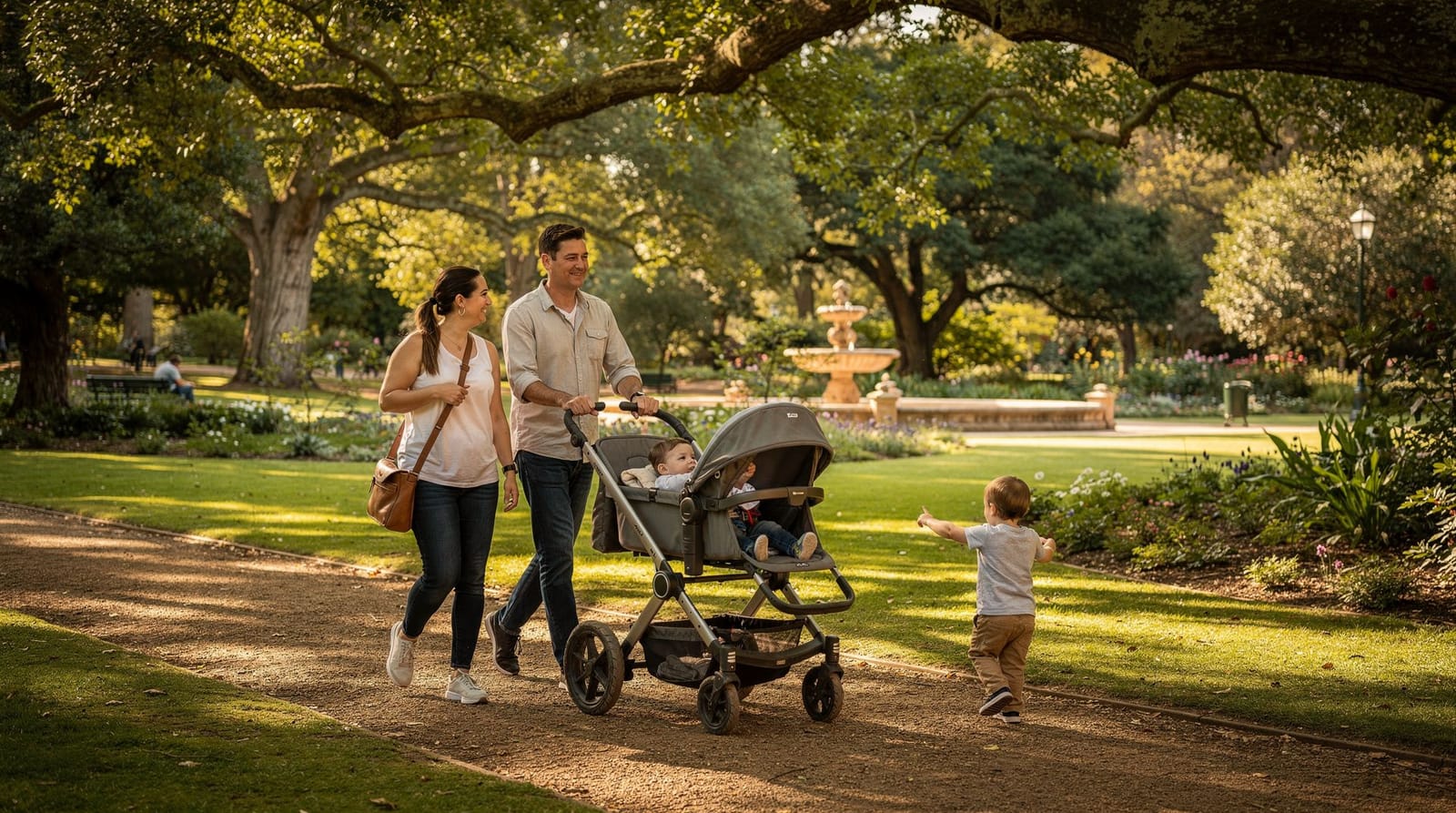
For children under about 3, a pram remains the most practical option across the full day, even for children who typically prefer to walk at home, simply given the cumulative distance involved. For children aged roughly 3-5 who want more independence but tire on longer stretches, a hybrid approach — walking through the more engaging, stimulating precincts and folding into a pram or carrier during longer connecting walks between exhibits — tends to work better than insisting on either fully walking or fully pram-bound for the entire day.
Bringing a pram even for children who’ve mostly outgrown needing one for daily errands is a reasonable precaution specifically for a full Melbourne Zoo day, given how much more ground it covers than a typical family outing.
Getting there is the easy part
Melbourne Zoo’s own dedicated Zoo railway station on the Upfield line puts the main entrance a short walk from the platform, meaning families without a car can reach the zoo directly without a bus transfer or long walk — genuinely one of the more convenient major attractions in the city for exactly this reason. Tram route 58 offers an alternative route via Royal Parade for families starting from the CBD’s western side.
If you are travelling without a car, it helps to understand the wider network before the day itself. Our Melbourne tram guide explains how the trams work, the Myki card guide covers paying for public transport, and getting around Melbourne puts the train and tram options side by side. With a pram in tow, it is worth deciding the route home before you leave the zoo, not when children are already tired.
Pacing the walk between precincts
The zoo’s mature, established layout, a genuine asset for atmosphere, does mean real distances between some of the more popular precincts — the Gorilla Rainforest, Lion Gorge, the Trail of the Elephants and the Australian bush precinct are spread across the grounds rather than clustered tightly together. Families with toddlers or children prone to tiring on longer walks are well served bringing a pram even if one isn’t normally needed for day-to-day outings, simply to manage the cumulative walking distance across a full zoo visit.
Playgrounds and rest breaks
Several playgrounds are spread across the grounds, giving children a genuine break from walking between exhibits and a chance to run around rather than simply observe animals from a path. Building at least one playground stop into the day, ideally timed around the point energy visibly starts to flag, tends to make the second half of a visit considerably smoother than pushing straight through to the exit.
The Australian bush precinct — often the family favourite
The walk-through Australian bush precinct, where kangaroos and wallabies roam at close range alongside the path, tends to be the single section that most reliably captivates young children, since it removes the barrier of fencing or glass that separates visitors from most other exhibits. Combined with the nearby wombat and echidna enclosures, it’s worth allowing extra time here rather than rushing through on the way to the bigger-name African and Asian precincts.
Timing around keeper talks and animal activity
Animal activity, and scheduled keeper talks at popular precincts like Gorilla Rainforest and Lion Gorge, tend to concentrate in the cooler morning hours, particularly during Melbourne’s warmer months (December-February), when many animals become noticeably less active once the day heats up. Arriving as close to opening as possible gives families the best chance of catching keeper talks and more active animal behaviour, on top of the general benefit of beating school holiday crowds that build steadily from mid-morning onward.
Snacks, meals and managing hunger-driven meltdowns
Bringing snacks for young children is worth doing regardless of plans to eat at the zoo’s cafes, since a hungry toddler mid-way between precincts, with the nearest food outlet still some distance away, is a common and avoidable source of a difficult moment during an otherwise good day. The zoo’s cafes are spread across the grounds rather than centralised in one location, meaning food is generally accessible without a long detour from wherever the family happens to be, but keeping a small snack supply on hand covers the gaps between planned meal stops.
Facilities for families
Baby-change facilities are available at several points around the grounds, and the zoo’s cafés offer quieter seating areas away from the busiest exhibit paths, useful for a feeding break or simply a sit-down rest partway through a long day. Picnic areas are also available for families bringing their own food, a cost-effective option for a full-day visit rather than relying solely on on-site cafés for every meal.
What to pack specifically for a family zoo day
Beyond the standard sun protection and water bottles, packing a small first-aid kit with basics like adhesive bandages and hand sanitiser is worth considering given the amount of walking and outdoor play involved, particularly around the more hands-on Australian bush precinct. A change of clothes for younger children is sensible given the general outdoor, sometimes dusty nature of the grounds, and having a fully charged phone or camera ready matters more here than at a smaller attraction, given how many genuinely photogenic moments — keeper talks, the walk-through kangaroo enclosure, the Gorilla Rainforest viewing windows — come up across a full day.
How long to plan for with children
Families managing a full precinct-by-precinct visit with young children, including playground breaks and a proper lunch stop, should budget a genuine full day rather than the 3-4 hours a childless adult visitor might need. Building in slack for unplanned rest breaks, rather than a tightly scheduled precinct-by-precinct itinerary, tends to produce a more enjoyable day for both children and accompanying adults.
Comparing a family Melbourne Zoo visit with Healesville Sanctuary or Phillip Island
Families deciding how to allocate limited time across Victoria’s wildlife attractions should weigh Melbourne Zoo’s specific family advantages — direct train access, multiple playgrounds, and a broad, varied roster including African and Asian species — against the longer drive but more distinctly Australian focus of Healesville Sanctuary, or the wild-colony evening spectacle of Phillip Island’s Penguin Parade.
For families with only city-based transport and limited time, Melbourne Zoo’s convenience makes it an easy first choice; for those with a car and more time who specifically want native Australian wildlife or the Penguin Parade’s evening spectacle, the longer excursions to Healesville or Phillip Island are worth the additional travel time and logistics.
Zoos Victoria membership for repeat visits
For families planning to visit more than one Zoos Victoria site — Melbourne Zoo, Healesville Sanctuary and Werribee Open Range Zoo are all run by the same not-for-profit organisation — an annual membership giving unlimited entry across all three can work out cheaper than separate general admission at each, worth considering for a longer Victoria stay involving multiple wildlife stops.
Sleep schedules and choosing a visit day
Families with a young child on a fixed nap schedule sometimes find splitting a zoo visit across two shorter mornings, rather than attempting one exhaustive full day, produces a considerably better overall experience — arriving for a couple of hours, returning to accommodation for a midday nap, and potentially returning for a second, shorter visit later if a Zoos Victoria membership or a same-day re-entry policy applies. This is a more flexible option for Melbourne-based families or longer-stay visitors than for a tightly scheduled one-off day trip, but worth considering for anyone whose itinerary allows the flexibility.
Weather planning for a family visit
Melbourne Zoo is almost entirely outdoors, making sun protection and water breaks a genuine priority for a full family day, particularly in summer. Winter visits (June-August) are quieter and cooler but still comfortable with proper layering, since most of the walking paths are exposed rather than sheltered — pack accordingly regardless of the season on the calendar, given Melbourne’s well-earned reputation for changeable weather within a single day.
What keeper talks add for children specifically
Keeper talks tend to hold children’s attention noticeably better than static exhibit signage, since they involve a real person narrating in real time, often with visible animal activity (feeding, enrichment activities) happening as they speak. For families with children who might otherwise move past an exhibit too quickly to absorb much information from reading panels, timing arrival at a precinct to coincide with a scheduled keeper talk can turn a brief glance into a genuinely engaged ten or fifteen minutes, making the talk schedule (available at the entrance or via the zoo’s app) worth checking before setting off around the grounds.
Combining with nearby family-friendly suburbs
Royal Park, surrounding the zoo, offers additional open space for children to run around before or after a visit, and the nearby inner-north suburbs of Fitzroy and Collingwood and Carlton both sit a short tram ride away, useful for a family lunch stop with a wider range of casual dining than the zoo’s own cafés offer.
Combining a zoo day with Royal Park downtime
Royal Park’s open lawns surrounding the zoo are worth building into the plan deliberately rather than treating them as an afterthought — a short pre- or post-visit stretch here gives children space to run freely without the structure of exhibit paths, which can help settle an overstimulated toddler before the tram or train trip back to accommodation. It’s also a practical spot for a picnic lunch on a mild day if the family prefers open grass to the zoo’s own café seating.
Planning the other days of a family trip
A zoo day is tiring, so it pairs best with gentler days around it. If the children still have energy for the city the following day, a relaxed group sightseeing tour of the city by bus lets little legs rest while you see the main landmarks. For families who like to stay active, a guided city bike tour suits older children who are comfortable cycling. For a day that mixes several family stops, the Melbourne with kids guide, the rainy-day ideas for children and the 4-day family itinerary are good starting points.
A suggested route for families with young children
Rather than trying to see every precinct in strict sequence, a family-friendly route often starts near whichever entrance is closest to the Zoo railway station, covering the Australian bush precinct and its walk-through kangaroo enclosure early while energy is highest, followed by a playground break, then the Trail of the Elephants and Lion Gorge (both popular for keeper talks worth timing around), a lunch stop, and finishing with the Gorilla Rainforest and Butterfly House in the afternoon when the pace naturally slows. This isn’t the only viable order, but it groups nearby precincts sensibly and builds in breaks at points where young children’s attention typically starts to flag.
Stroller-friendly shortcuts across the grounds
Because Melbourne Zoo’s mature, established layout wasn’t purpose-built with a strict grid in mind, some connecting paths between major precincts are more direct than others, and zoo maps (available at the entrance or via the zoo’s own app) highlight the more pram-friendly, flatter connecting routes rather than the most scenic but longer paths. Asking staff near the entrance for the most direct stroller-friendly route between two specific precincts can save meaningful walking distance compared with following a purely sequential, exhibit-by-exhibit path around the full grounds.
Managing meltdowns and overstimulation
A full day covering a genuinely large site inevitably brings moments where a young child becomes overtired or overstimulated, and Melbourne Zoo’s several playgrounds and quieter, shaded seating areas away from the busiest precincts (particularly around the Australian bush precinct’s edges) offer practical spots to pause and reset before continuing. Building slack into the day’s schedule specifically to accommodate an unplanned rest stop, rather than assuming every precinct will be covered exactly as planned, tends to produce a smoother overall family experience than a tightly timed itinerary.
Group visits and multi-generational family days
Melbourne Zoo’s combination of playgrounds, cafes with seating away from the main paths, and a largely flat, sealed path network makes it a genuinely workable destination for multi-generational family groups, including grandparents with more limited mobility. Splitting the group so that more energetic members explore further-flung precincts while others settle at a central cafe, before reconvening for a shared keeper talk or lunch, is a common and practical approach for larger family groups with a wide range of ages and energy levels.
What to expect on a very hot or very cold day
On a genuinely hot summer day, animal activity across most outdoor precincts drops noticeably by early afternoon as animals seek shade, meaning a family’s own comfort and the wildlife-viewing quality both point toward an earlier start and finish rather than pushing through the hottest hours. On a cold winter day, by contrast, several species remain surprisingly active and visible, and the grounds are noticeably quieter, though dressing children in genuinely warm layers rather than assuming a light jacket suffices matters more than first-time visitors sometimes expect, given how exposed most of the walking paths are to Melbourne’s winter wind.
Pram vs walking by age, at a glance
| Age | Recommended approach |
|---|---|
| Under 3 | Pram for the full day, even if they normally walk at home |
| 3-5 | Hybrid — walk the engaging precincts, pram for connecting stretches |
| 5+ | Mostly walking, with regular playground and snack breaks |
A realistic verdict for families
Melbourne Zoo works well as a full family day out precisely because of its scale and variety, provided the pacing accounts for young children’s walking stamina rather than treating it like a compact CBD attraction. Arriving early, using a pram even for children who don’t usually need one, and building in playground and food breaks are the practical adjustments that turn a potentially exhausting big-site visit into a genuinely enjoyable family day.
More tours on Viator
Top-rated experiences with verified reviews, bookable on Viator (a Tripadvisor company).


Frequently asked questions about Melbourne Zoo for families
How far do families need to walk at Melbourne Zoo?
The zoo covers a genuinely large area of mature parkland, more ground than a typical inner-city museum, so young children who tire on longer walks are better served by bringing a pram even if they don't usually need one, or planning rest breaks at one of the several playgrounds within the grounds.Are there playgrounds inside Melbourne Zoo?
Yes, several playgrounds are spread across the grounds, giving young children a break from walking between exhibits and a chance to burn off energy partway through a longer visit.What time should families with young children arrive?
As close to opening as possible, both to beat school holiday crowds and because animal activity, including keeper talks at precincts like Gorilla Rainforest and Lion Gorge, tends to be concentrated in the cooler morning hours before the day's heat sets in, particularly in summer.Does Melbourne Zoo have baby-change and feeding facilities?
Yes, baby-change facilities are available at several points around the grounds, and quieter seating areas near the cafés work well for a feeding break away from the busier exhibit paths.Is a Zoos Victoria membership worth it for a family visiting more than once?
Potentially, yes — a membership covering Melbourne Zoo, Healesville Sanctuary and Werribee Open Range Zoo gives unlimited entry to all three, which can work out cheaper than separate general admission tickets for families planning to visit more than one of the three sites during a longer Victoria stay.Is Melbourne Zoo stroller-friendly throughout?
Mostly, yes — the main paths are sealed and largely flat, though the mature, established layout means some connecting routes between precincts are longer or less direct than others. Zoo maps highlight the more pram-friendly routes, and staff near the entrance can point out the most direct stroller-friendly path between specific precincts.What's the best age range for a Melbourne Zoo family visit?
Most ages get something from it, but primary-school-age children tend to engage most consistently with the walk-through Australian bush precinct and keeper talks, while toddlers do best with a pram for the cumulative walking distance and frequent playground breaks built into the day.