What to eat at Queen Victoria Market: a food-first guide
Melbourne: Flavors queen victoria market food tour
What is the most famous food at Queen Victoria Market?
The cinnamon sugar doughnuts from the American Doughnut Kitchen's bright red van, parked in roughly the same spot at the market for decades, are the single most iconic single item — made fresh and served hot in a paper bag for a few dollars. Beyond that, the Deli Hall's cheese, cured meat and continental grocery stalls and the market's dim sims are the other two most-repeated recommendations from Melburnians themselves.
Queen Victoria Market’s food stalls are the real reason locals keep coming back to a market that could easily have been converted into a polished tourist food court — this guide is specifically about what to eat, where to find it, and how to time a visit around it.
| Where | Cnr Elizabeth & Victoria St, CBD edge (Free Tram Zone) |
| Cost | Doughnuts/dim sims around 3-6 AUD; Deli Hall lunch roughly 15-25 AUD/person |
| Open | Tue, Thu-Sun (closed Mon & Wed daytime) |
| Night market | Wed evenings, late Nov-Mar only |
| Best time | Weekday mornings for a quiet browse, Sat 8-10am for full atmosphere |
A market that has survived redevelopment pressure
It’s worth appreciating that Queen Victoria Market’s food offering exists today partly because of sustained community pushback against redevelopment proposals over the decades that might have converted parts of the site into something more polished and less genuinely working-market in character. Traders, heritage advocates and everyday shoppers have, at various points, organised against plans seen as risking the market’s authentic, slightly ramshackle food culture in favour of a more commercially optimised, tourist-facing redesign.
That history is part of why a visit here in 2026 still feels like stepping into a genuine, slightly chaotic produce market rather than a curated food hall built for Instagram — a meaningfully different experience from some “historic market” attractions elsewhere that have been more thoroughly commercialised.
Why the market is Melbourne’s most honest food destination
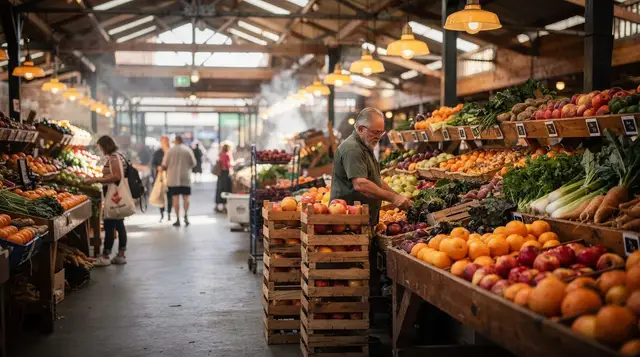
Queen Victoria Market has traded on the same site at the northern edge of the CBD since 1878, and unlike most “historic market” attractions in major cities, it hasn’t been substantially converted into a food-hall-for-tourists — it remains, first and foremost, a working produce and grocery market for people who live in inner Melbourne. That’s precisely what makes its food worth building a visit around: prices reflect a genuine local market rather than a tourist premium, and the stalls that have survived decades of trading (rather than churning over every year or two) have done so because locals keep coming back.
For the fuller history and layout of the market itself, see our companion Queen Victoria Market guide; this piece is specifically about what to eat.
Why the market’s food stalls have such staying power
Many of the specific stalls and businesses named throughout this guide have operated at the market for multiple decades, in some cases passed down within the same family across two or three generations. This longevity isn’t an accident — the market authority’s leasing structure has historically favoured continuity over rapid turnover, giving established, high-quality operators the security to invest in their stall and their reputation over the long term rather than treating a market tenancy as a short-term, high-turnover retail experiment.
The practical upside for visitors is a genuinely lower risk of disappointment than at a market with rapid stallholder churn — a stall that’s survived decades of daily trading in front of a discerning, repeat-visiting local customer base has, almost by definition, been doing something right.
The doughnut van everyone mentions
The American Doughnut Kitchen, a bright red van that’s occupied roughly the same spot at the market for generations, makes fresh cinnamon-sugar doughnuts to order, served hot in a simple paper bag. It’s the single most name-checked food item at the market across decades of write-ups, and it earns the reputation — the doughnuts are made continuously through the day rather than pre-made and reheated, and the queue (rarely more than five minutes even on a busy Saturday) moves fast. A bag costs only a few dollars, making it one of the cheapest genuinely excellent things to eat in central Melbourne.
The Deli Hall: cheese, cured meat and continental groceries
The market’s Deli Hall houses dozens of stalls specialising in cheese, cured meats, olives, spices and continental groceries, many run by families who’ve traded at the market for multiple generations, reflecting Melbourne’s postwar Italian, Greek and Eastern European immigration waves as directly as anywhere in the city. This is the best place in the market for building a picnic — a wedge of good cheese, some prosciutto, olives and fresh bread can be assembled here for a fraction of what an equivalent grazing board would cost at a CBD restaurant, and several stalls will happily slice and wrap to order.
 Melbourne multicultural markets culinary culture tourCheck availability
A note on the market’s cheese specialists
Within the Deli Hall, several stalls specialise specifically in cheese, some run by cheesemongers with decades of experience importing and ageing product, distinct from the more general continental grocers nearby. These specialists are worth seeking out if cheese is a genuine interest rather than a side note to your visit — staff at the better stalls will happily talk through the difference between a young and aged version of the same cheese, or suggest a pairing based on what else you’re buying that day. Prices for genuinely well-aged or imported cheese can run higher than supermarket equivalents, but remain considerably below what an equivalent CBD specialty cheese shop would charge for the same product.
Bakery stalls and bread
Beyond the doughnut van, the market has several bakery stalls selling fresh bread, pastries and European-style baked goods, an underrated part of the food offering that many visitors walk past focused on the more famous individual items. A fresh sourdough loaf or a bag of pastries makes a good addition to a Deli Hall picnic, and several of these bakery stalls have supplied the same recipes for decades, another example of the market’s genuine, long-running specialist character rather than rotating trend-driven stalls.
Dim sims: Melbourne’s own dumpling
Dim sims are worth calling out specifically because they’re a genuinely Melbourne-specific food, distinct from the Cantonese dim sum they’re named after — larger, heartier, and typically sold either steamed or deep-fried from stalls scattered through the market’s food section. They predate Melbourne’s current food scene by decades (the dish has been part of Melbourne’s Chinese-Australian food culture since at least the mid-20th century) and remain a cheap, filling, unpretentious snack that most visiting food writers single out precisely because it doesn’t fit any current trend — it’s just been quietly good the whole time.
Meat and fish halls: for self-caterers, not casual visitors
The market’s dedicated Meat Hall and Fish Hall are genuinely excellent if you’re self-catering during your stay (an Airbnb with a kitchen, say), with butchers and fishmongers selling at prices well below CBD supermarkets. For a casual visitor without cooking facilities, these halls are more interesting to walk through and observe than to shop in, but they’re worth a look for the sheer scale and theatre of a proper wholesale-adjacent produce market still operating in a modern CBD.
a guided early-access food tourThe Wednesday night market (summer only)
From late November through March, the market runs a separate Wednesday evening night market: food trucks, bars, a stage with live music, and general stalls selling crafts and clothing, running into the evening in a way the daytime market never does. It’s a markedly different experience from the produce-market atmosphere of the daytime — younger crowd, drinks in hand, closer to a street-food festival than a grocery run — and if your dates overlap with a Wednesday in the summer window, it’s genuinely worth prioritising over a daytime visit for the food-and-atmosphere combination specifically.
the ultimate Queen Victoria Market foodie tourSeasonal produce worth timing a visit around
Because Queen Victoria Market is a genuine working produce market rather than a curated food hall, what’s on the tables shifts meaningfully with Victoria’s growing seasons. Summer (December-February) brings the best stone fruit — cherries, apricots, peaches and nectarines from regional Victorian orchards — along with tomatoes at their sweetest. Autumn (March-May) is mushroom and apple season, with a genuinely wide range of apple varieties from nearby growing regions appearing on the produce stalls. Winter (June-August) shifts toward citrus, root vegetables and the market’s heartier, warming prepared foods. Spring (September-November) brings asparagus and the first of the new season’s stone fruit.
If cooking during your stay is part of your plan, timing a market visit around what’s actually in season gets both better flavour and better prices than buying imported or hot-house produce out of season.
Cooking classes and market-based food experiences
Beyond the guided food tours already covered, some operators run hands-on cooking classes that start with a market shopping trip before moving to a nearby kitchen to prepare a meal from what you’ve bought — a genuinely good option if you want to take a piece of the market experience home in the form of a skill rather than just a photograph. These tend to run for three to four hours and are worth booking a few days ahead given limited class sizes.
Sustainability and reducing food waste
Queen Victoria Market has, in recent years, been more visible about reducing food waste than a typical retail environment, including stalls that sell “imperfect” produce (cosmetically blemished but perfectly good fruit and vegetables) at a discount, and end-of-day discounting on some perishable stock, particularly at the Deli Hall and bakery stalls, as trading hours wind down. If budget matters and you’re visiting in the market’s final trading hour of the day, it’s worth asking directly whether a stallholder is discounting anything rather than assuming full price is fixed.
Budgeting a market meal
For a realistic sense of cost: a doughnut bag from the American Doughnut Kitchen runs a few dollars, a dim sim similarly, and a proper Deli Hall picnic lunch (cheese, cured meat, olives, fresh bread for two people) typically comes to well under 30 AUD total, noticeably cheaper than an equivalent CBD café lunch for the same two people. Budgeting roughly 15-25 AUD per person for a genuinely satisfying grazing lunch across two or three stalls is realistic, making the market one of the better value food destinations in central Melbourne on any budget.
Practical details: days, hours and getting there
Queen Victoria Market’s general trading days are Tuesday, Thursday, Friday, Saturday and Sunday, with the market closed Monday and Wednesday (Wednesday evenings excepted, for the seasonal night market). Trading hours run roughly 6am to 2-3pm on weekdays it’s open, extending later on Saturdays and into the evening on night market Wednesdays. The market sits at the corner of Elizabeth and Victoria Streets, a 10-15 minute walk from Flinders Street Station or a short tram ride up Elizabeth Street from the CBD’s Free Tram Zone, making it easy to combine with a laneway coffee stop beforehand — see our Melbourne coffee guide for CBD café recommendations en route.
A first-timer’s suggested route through the food stalls
If this is your first visit and the scale feels overwhelming, here’s a sensible order that avoids backtracking and paces the eating properly. Start at the American Doughnut Kitchen van near the market’s edge for a warm doughnut while everything’s still fresh from opening. Move into the Deli Hall next, while you’re not yet full, and take your time — ask a couple of stallholders for recommendations rather than grabbing the first cheese or cured meat you see, since staff genuinely enjoy talking through their specialties with an interested visitor. From there, head toward the general food stalls for a dim sim or a savoury snack, treating it as a mid-morning top-up rather than a full second meal.
Finish at one of the market’s bakery stalls with a pastry or a piece of fresh bread to take with you, which also doubles as a practical snack if you’re heading straight into an afternoon of further sightseeing without a proper lunch stop planned.
Vegetarian and vegan options at the market
The market’s food stalls handle vegetarian requirements comfortably, with the Deli Hall’s cheese and vegetable-based offerings, plenty of fresh produce, and several prepared-food stalls offering clearly vegetarian dishes. Vegan options require slightly more care — check ingredients on prepared foods specifically, since traditional recipes for items like dim sims typically contain meat, but the market’s fresh produce and a growing number of plant-based prepared-food stalls make putting together a satisfying vegan meal or snack entirely realistic with a little basic label-reading.
Combining a market food visit with a coffee crawl
Before or after your market visit, the CBD’s laneway café strips are only a short walk away — see our Melbourne coffee guide and best laneway cafés guides for specific recommendations. A common, efficient pattern among visitors staying centrally is a coffee at a laneway café first, then the market once it’s properly open and busy (from around 9am), rather than trying to do both cold and hungry in the wrong order.
What to do if the market is closed
If you arrive on a Monday or Wednesday to find the general market closed, don’t despair — several standalone cafés and a handful of shopfront businesses around the market’s perimeter remain open even on the market’s closed days, and South Melbourne Market or Chinatown are both reasonable alternative food destinations if your schedule genuinely only allows a visit on one of QVM’s closed days.
Common mistakes to avoid
Going on a Monday or Wednesday daytime expecting the full market to be open. Both days see reduced or no trading for the general market — check the calendar before making a special trip, especially if you’ve built a whole morning around it.
Eating beforehand and arriving full. The market rewards arriving hungry; between the doughnut van, dim sims, Deli Hall tastings and a Meat Hall butcher’s sausage roll, there’s realistically a full meal’s worth of grazing available across the sheds.
Treating it purely as a tourist photo stop. The market’s food value comes specifically from it being a real, working local market — buy something, talk to the stallholders, and it rewards engagement far more than a walk-through-and-photograph visit.
Skipping the Deli Hall because it looks like “just a grocery store.” It’s the single best stop in the market for assembling a genuinely good, cheap picnic lunch, and several stalls have been trading multiple generations — worth asking what they’d recommend.
QVM compared with Melbourne’s other food markets
If your trip only allows time for one market, this comparison helps decide which one earns the visit.
| Market | Best for | Trading days | Distance from CBD |
|---|---|---|---|
| Queen Victoria Market | Widest range, historic Deli Hall, doughnuts | Tue, Thu-Sun (+ Wed nights, summer) | Walking distance / short tram |
| South Melbourne Market | Dim sims rival, calmer crowds | Wed, Sat, Sun | Short tram from CBD |
| Prahran Market | Fresh produce, high-end butchers | Tue, Thu-Sun | Train or tram, inner-south |
| Rose Street Artists’ Market (Fitzroy) | Crafts and light food stalls, not a grocery market | Sat, Sun | Tram to Fitzroy |
For more on how these compare beyond food, see our Melbourne markets guide.
A note on Elizabeth Street’s café strip
Elizabeth Street itself, running past the market’s main entrance, has its own run of no-frills cafés and lunch bars that predate Melbourne’s laneway coffee boom and still serve some of the cheapest sit-down meals in the CBD. They’re a useful fallback if the market sheds are packed on a Saturday, and pair naturally with a stop at Flinders Street Station or a walk down toward Chinatown afterwards.
Getting there without a car
The market sits just outside the CBD’s Free Tram Zone boundary on some routes, so check your specific tram before assuming the ride is free; walking from Flinders Street Station takes 10-15 minutes through the CBD grid. If you’re combining the market with a wider first day in the city, our 1-day Melbourne itinerary and getting around Melbourne guide cover the practicalities of stitching stops together on public transport.
Payment, cash and dietary labelling
Most stalls now accept cards and tap payments, but a meaningful minority of the smaller, longer-running Deli Hall stalls still prefer or only take cash, particularly for small purchases like a single dim sim or a coffee — carrying some cash smooths the visit. Dietary labelling is inconsistent across the sheds since many stalls are small family operations rather than chains with standardised signage; if you have a serious allergy, ask directly rather than relying on a label, especially for prepared foods in the Deli Hall where cross-contact between cheeses, meats and other allergens is realistic given the shared counters and knives.
A sample budget for a half-day food visit
For planning purposes, a realistic half-day budget covering a doughnut, a dim sim, a Deli Hall picnic lunch for one and a coffee comes to roughly 30-40 AUD per person, noticeably less than an equivalent CBD café-and-lunch combination would cost. Add a guided food tour on top and budget accordingly — tours typically run a few hours and include tastings across several stalls, useful if you’d rather have a local do the stall-picking for you on a first visit.
Where this fits in a Melbourne itinerary
Queen Victoria Market pairs naturally with a CBD morning: laneway coffee first, then the market for a late-morning lunch, followed by an afternoon at Federation Square or the Southbank arts precinct. On a first 1-day itinerary, the market is one of the highest-value single stops precisely because it delivers food, shopping and genuine local atmosphere in one place.
For a broader look at Melbourne’s other markets — South Melbourne, Prahran, the Rose Street Artists’ Market in Fitzroy — see our Melbourne markets guide, and if you’re building a full food-focused day, pair the market with a stop in Chinatown or a Lygon Street Italian dinner (see our Lygon Street guide) to round out the day.
More tours on Viator
Top-rated experiences with verified reviews, bookable on Viator (a Tripadvisor company).
 Viator
Yarra Valley Wine Tour w Exclusive Gin, Cider & Chocolate Tasting
FromAUD 115Check availability → Viator
Melbourne: Yarra Valley Wine, Gin, Whisky and Chocolate Tour
FromAUD 115Check availability → Viator
Melbourne: Epic Yarra Valley Wine Tour & Lunch - Gin/Beer Upgrade
FromAUD 179Check availability →Frequently asked questions about What to eat at Queen Victoria Market
Is Queen Victoria Market open every day?
No — it's closed Mondays and Wednesdays for the general market (though Wednesday evenings run the separate seasonal night market, summer only), and open Tuesday, Thursday through Sunday for regular trading. Food stalls and the Deli Hall generally keep to the same days; always check current hours before a special trip, since some sheds trade slightly different days to others.What are Queen Victoria Market dim sims?
Dim sims are a Melbourne-specific take on the Cantonese dim sum dumpling, larger and more robustly flavoured than the Hong Kong original, sold both steamed and deep-fried from stalls throughout the market. They're a genuine only-in-Melbourne food item that predates most of the city's current food trends by decades.Is the Queen Victoria Market night market worth visiting?
Yes, if your dates align — the night market runs Wednesday evenings from roughly late November through March (Southern Hemisphere summer), with food trucks, bars, live music and market stalls creating a genuinely different atmosphere from the daytime produce trading. It draws a younger, more social crowd than the morning market and is one of Melbourne's better warm-weather evening outings.Can I get a full meal at Queen Victoria Market, or just snacks?
Both — the Deli Hall and surrounding stalls sell full lunches (Polish, Italian, Middle Eastern, Australian), not just grazing snacks, and several sit-down cafés operate within and around the market sheds. Budget for a proper lunch stop rather than treating it purely as a snacking detour.Is the market food expensive?
No — it's one of the better-value food destinations in central Melbourne precisely because it's a working produce market, not a tourist food court. A dim sim costs a few dollars, a doughnut bag similarly, and a Deli Hall lunch plate typically runs well under what an equivalent CBD café would charge.What time should I go to get the best food and avoid crowds?
Saturday mornings from 8-10am are the busiest and most atmospheric, with the widest stall selection; Tuesday and Thursday mornings are noticeably quieter with the same core food stalls trading. Arrive hungry rather than eating beforehand — most visitors underestimate how much good food is packed into the sheds.
Top experiences
Bookable activities with verified prices and instant confirmation on GetYourGuide.