Queen Victoria Market: the complete visitor guide
Melbourne: Melbourne multicultural markets culinary culture tour
Duration: 2.5 hours
How old is Queen Victoria Market?
Queen Victoria Market has traded on its current site at the northern edge of Melbourne's CBD since 1878, making it one of the oldest continuously operating markets in the Southern Hemisphere. Part of the site was previously Melbourne's original cemetery, and some unmarked graves are believed to remain beneath the car park area, a piece of history the market openly acknowledges.
Queen Victoria Market is Melbourne’s largest and oldest market, and there’s more to a good visit than knowing it exists — this guide covers the history, the shed layout, opening hours and the practical details that make a first visit run smoothly.
| Where | Cnr Elizabeth & Victoria St, CBD edge |
| Cost | Free entry; budget for food and shopping separately |
| Time needed | Around 1-2 hours for a proper walk-through |
| Open | Tue, Thu-Sun (closed Mon & Wed daytime) |
| Getting there | Free Tram Zone or 10-15 min walk from Flinders Street |
The market’s role in Melbourne’s food culture more broadly
Beyond its own stalls, Queen Victoria Market has functioned as a genuine training ground and launchpad for several Melbourne food businesses that later expanded well beyond the market itself — Market Lane Coffee’s story, starting from a single kiosk before expanding across the city, is one well-known example of this pattern, though it began at Prahran Market rather than QVM specifically.
This kind of market-to-standalone-business pipeline reflects the low barrier to entry a market stall offers compared with a full standalone shopfront lease, letting a new food business test and refine a concept before committing to bigger overheads — part of why Melbourne’s markets more broadly are worth thinking of as a genuine incubator for the city’s food scene rather than simply a retail venue.
Why the market matters beyond a shopping stop
Queen Victoria Market functions as something closer to a piece of civic infrastructure than a retail attraction, in the sense that generations of Melburnians have done their weekly grocery shop here rather than treating it as an occasional novelty. That ongoing local use is precisely what preserves its character — prices, produce quality and stallholder relationships are all shaped by a genuine local customer base that would simply stop coming if the market drifted too far toward a purely tourist-facing model, which is a meaningfully different dynamic from many “historic market” attractions elsewhere that have become almost entirely visitor-dependent.
A market with 150 years of continuous history
Queen Victoria Market has traded on the same site at the northern edge of the Queen Victoria Market district since 1878, making it one of the oldest continuously operating markets in the Southern Hemisphere and a genuine working institution rather than a heritage attraction dressed up for visitors. Its scale is part of the appeal: multiple large sheds spread across several city blocks, housing produce, meat, fish, deli goods and general merchandise side by side, all under a single market authority that’s kept the site trading through economic downturns, wars and, more recently, redevelopment pressure that’s occasionally threatened parts of the site over the decades.
Photography at the market
Photographing the market’s stalls, produce displays and general atmosphere is entirely normal and expected — it’s one of Melbourne’s most photographed everyday scenes — though the same basic courtesy of asking before photographing an individual stallholder up close applies here as at any working market. Most stallholders are used to visitors photographing their displays and are generally relaxed about it, provided it doesn’t interfere with actual customers being served.
A note on bargaining
Unlike some produce markets internationally, bargaining over marked prices is not standard practice at Queen Victoria Market’s food and general merchandise stalls — prices are generally fixed and displayed, and haggling over a clearly marked price is likely to be met with polite but firm refusal rather than a negotiated discount. The exception is toward the end of a trading day, when some stallholders (particularly at the general merchandise sheds) may be more open to a modest discount on remaining stock, though this is closer to informal end-of-day flexibility than an expected bargaining culture.
Comparing a visit across different times of year
The market’s fundamental character stays consistent year-round, but a few seasonal differences are worth knowing. Summer (December-February) visits benefit from the widest range of fresh stone fruit and the liveliest general atmosphere, though the outdoor produce aisles can get genuinely hot with limited shade at midday. Winter (June-August) visits are quieter and cooler, with a shift toward heartier prepared foods and citrus produce, and the market’s undercover sections become more appealing relative to any outdoor lingering.
Whatever the season, the market’s famously unpredictable weather exposure (much of it sits under permanent roofing, but some sections are more open-air) means checking the forecast and dressing in a layer, consistent with Melbourne’s broader “four seasons in one day” reputation, remains sound advice regardless of which month you visit.
| Season | Months | What’s good | Crowds |
|---|---|---|---|
| Summer | Dec-Feb | Stone fruit, Wednesday night market | Busiest, hot midday sun on open aisles |
| Autumn | Mar-May | Mushrooms, apples, mild weather | Moderate |
| Winter | Jun-Aug | Citrus, heartier prepared food | Quietest, coolest |
| Spring | Sep-Nov | Asparagus, first stone fruit | Building toward summer crowds |
First-timer versus repeat-visitor priorities
A first-time visitor generally gets the most out of a full lap: general merchandise sheds, Meat and Fish Halls for the theatre of it, the Deli Hall for a slow browse, and the open-air produce aisles to finish. A repeat visitor with limited time is usually better served heading straight to whichever shed matches that day’s actual need — the Queen Victoria Market food guide covers exactly which food stalls are worth prioritising if you’re short on time. Either way, avoid trying to properly cover every shed on a rushed 20-minute stop; the market rewards at least an hour.
The market’s role during difficult economic periods
Through Melbourne’s various economic downturns over the past 150 years — including the depression of the 1890s, the Great Depression of the 1930s, and more recent cost-of-living pressures — Queen Victoria Market has functioned as a genuinely important affordable food source for the city’s less wealthy residents, precisely because its produce, meat and general goods pricing has historically undercut CBD retail and supermarket pricing.
This social function is easy to overlook amid the market’s current tourist appeal, but it’s part of why the market has retained such strong community backing against redevelopment proposals over the decades — it isn’t just a heritage curiosity, but genuine working infrastructure that many Melburnians rely on for their weekly shop.
The cemetery beneath the car park
One of the market’s more unusual pieces of history: part of its footprint was originally Melbourne’s early cemetery, established before the city had a dedicated burial ground elsewhere, and while most graves were formally exhumed and relocated as the market expanded through the late 19th and early 20th centuries, some unmarked graves are believed to remain beneath sections of the current car park. The market has been openly transparent about this history rather than downplaying it, and it’s a genuinely interesting detail worth knowing before you park there for a Saturday shop.
A shed-by-shed walking order
For a first-time visitor, a logical walking order helps avoid backtracking across the market’s considerable footprint. Starting at the Elizabeth Street entrance, the general merchandise sheds sit closest, making them a reasonable first stop if shopping is a priority before you’re laden with produce bags. Moving further in, the Meat and Fish Halls occupy their own dedicated, temperature-controlled sheds, distinct in character from the more open-air produce aisles. The Deli Hall sits toward the Franklin Street side of the site, and is worth treating as a deliberate, unhurried stop rather than a quick walk-through, given how many individually interesting stalls it contains.
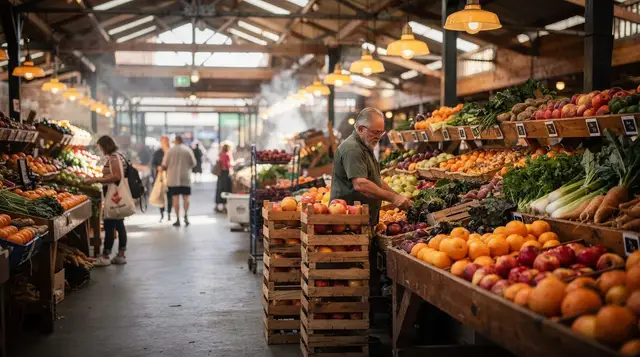
The open-air produce section, running along much of the market’s Victoria Street frontage, is best visited with a reusable bag already in hand, since impulse purchases of fruit and vegetables are almost inevitable once you see the range and pricing on display.
Toilets, seating and rest stops
The market provides public toilets at several points across the site, along with a handful of casual seating areas and café-style stalls where you can sit briefly rather than eating standing up or on the move. Given the market’s genuine scale — easily an hour or more to properly cover if you’re not rushing — knowing where these rest points are before you start helps pace a longer visit, particularly if you’re visiting with young children, older relatives, or on a hot summer day when a brief indoor, air-conditioned break becomes more valuable.
The sheds: what’s where
The Deli Hall houses cheese, cured meat, olives and continental grocery stalls, many run by multi-generational family businesses — see our dedicated Queen Victoria Market food guide for specific recommendations. The Meat Hall and Fish Hall operate as genuine wholesale-adjacent butchers and fishmongers, better value for self-caterers than casual browsers, though worth a walk-through for the scale and theatre alone.
The general merchandise sheds, covering a substantial area on the market’s southern side, sell clothing, souvenirs, leather goods, jewellery and homewares — a legitimate shopping stop distinct from the food-focused sheds, though quality is more variable here, so inspect items carefully rather than assuming uniform standards across every stall.
 Melbourne multicultural markets culinary culture tourCheck availability
Opening hours and trading days
The market trades Tuesday, Thursday, Friday, Saturday and Sunday, with Monday and Wednesday as general closure days (Wednesday evenings from late November through March run the separate seasonal night market covered below). General trading hours run roughly 6am to 2-3pm on trading days, extending later on Saturdays. Always check the current published calendar before a special trip — specific stall hours can vary within the broader market hours, and some sheds close earlier than others on any given day.
The Wednesday night market (summer only)
From late November through March, the market runs a distinct Wednesday evening event — food trucks, bars, live music and a younger, more social crowd than the daytime produce-market atmosphere. It’s a genuinely different experience from a standard visit and, if your dates overlap with a summer Wednesday, arguably the single best evening to visit the market rather than a daytime trip.
a guided foodie tour of the marketGetting there and parking
The market sits at the corner of Elizabeth and Victoria Streets, a 10-15 minute walk from Flinders Street Station, or a short tram trip up Elizabeth Street within the CBD’s Free Tram Zone, meaning no fare is required if your whole journey stays within the zone boundary. A dedicated multi-level car park serves drivers, with a discounted rate for market customers who validate their ticket with a minimum spend, though weekend traffic and competition for spaces generally make tram or a short walk the more efficient option if you’re already staying centrally.
Queen Victoria Market versus Melbourne’s other markets
Queen Victoria Market is Melbourne’s largest, most central and most historically significant market, making it the right first choice if you only have time for one. For a broader comparison against South Melbourne Market, Prahran Market and the smaller specialty markets scattered across the inner suburbs, see our Melbourne markets guide — the honest short version is that Queen Victoria Market rewards a longer, more thorough visit given its scale, while the smaller markets suit a quicker, more targeted stop.
Redevelopment history and community debate
Queen Victoria Market has faced periodic redevelopment pressure over the decades, including proposals in recent years to modernise parts of the site, improve underground infrastructure, and reconfigure some of the car park areas — plans that have drawn genuine community debate given the market’s heritage status and the strong local attachment to its current, slightly ramshackle character. Traders and market advocates have generally pushed back against changes seen as risking the market’s authentic, working character in favour of a more polished, tourist-oriented redesign, and the market authority has, for the most part, pursued a more incremental renewal approach as a result.
It’s a useful piece of context for understanding why the market still feels genuinely historic rather than recently renovated, despite ongoing infrastructure investment behind the scenes.
Cultural festivals and events at the market
Beyond the regular Wednesday night market, Queen Victoria Market hosts periodic cultural festivals and themed events through the year, often tied to specific cultural calendars (Lunar New Year celebrations, multicultural food festivals) or seasonal moments (a Christmas-themed market run-up in December). These add a genuinely different flavour to a standard visit if your dates happen to align, and it’s worth checking the market’s current events calendar if you have flexibility in your visit dates and want to catch something beyond the everyday trading experience.
Visiting with children
Queen Victoria Market is a genuinely manageable, low-pressure destination for families, with wide (if sometimes crowded) aisles, no admission cost or ticket queue to manage, and plenty of small, inexpensive food items — a doughnut, a piece of fruit, a small treat from the Deli Hall — that make natural, easy rewards for children exploring alongside adults doing a bigger shop. Pram access is reasonable across most of the site, though Saturday crowds can make manoeuvring a full-size pram through the busiest aisles slower than on a quieter weekday visit.
Practical tips for a good visit
Come with a plan rather than wandering aimlessly — the market’s scale (multiple large sheds across several blocks) can be disorienting on a first visit; decide whether you’re prioritising food, general shopping, or both before you arrive.
Bring a reusable bag. Produce and deli purchases add up quickly, and while some stalls provide bags, bringing your own is both more sustainable and more practical for a larger shop.
Check Monday and Wednesday closures before planning a special trip. This is the single most common visitor mistake related to the market.
Arrive early on Saturdays if crowds bother you. The market is at its busiest from mid-morning through early afternoon on Saturdays; an 8am arrival gets a noticeably calmer experience across every shed.
Accessibility at the market
The market’s main pathways between sheds are flat and generally wheelchair and pram accessible, though surfaces vary between the more polished indoor halls and the outdoor produce aisles, which can be uneven in wet weather. Accessible toilets are available on-site, and staff at the market’s information points can help direct visitors with specific mobility needs to the most accessible route between sheds.
Nearby attractions worth combining with a visit
The market’s CBD-edge location puts several other stops within easy walking or short-tram range. Flinders Street Station and the CBD’s laneway network sit a short walk south, while Carlton’s Lygon Street is a short tram ride east for an Italian dinner once the market’s stalls close. If you’re travelling with kids and want a rainy-day backup nearby, see our rainy day Melbourne with kids guide for indoor options a short trip from the market.
Why the name “Queen Victoria”
The market takes its name from Queen Victoria, reigning British monarch at the time much of the current site was established in the late 19th century — a naming convention shared with plenty of other Victorian-era infrastructure across the state of Victoria itself, which is also named for her. It’s a small piece of context that explains why the market’s name doesn’t reference its location or founder the way many newer markets do.
Wet-weather visits
Melbourne’s weather is genuinely unpredictable, and a market visit on a wet day is still perfectly workable given how much of the site sits under permanent roofing — the Deli Hall, Meat Hall, Fish Hall and general merchandise sheds are all fully covered, and only the open-air produce aisles along Victoria Street get properly exposed to rain. A light rain jacket rather than an umbrella is the more practical choice given how tight some of the aisles get on a busy day, since an open umbrella is genuinely awkward to manage among other shoppers and stalls. Wet-weather visits also tend to be noticeably quieter than a sunny Saturday, which can work in your favour if you’re prioritising a relaxed, uncrowded browse over ideal weather for photos.
Where this fits in a Melbourne itinerary
Queen Victoria Market is one of the highest-value single stops in the city, combining food, shopping and genuine historical depth in one place, and it pairs naturally with a CBD morning: a laneway coffee first (see our Melbourne coffee guide), then the market for late morning, followed by an afternoon at Federation Square or the Southbank arts precinct. On a first 1-day itinerary, it’s a strong anchor for the late morning to early afternoon block, and on longer stays it’s worth a second visit specifically for the Wednesday night market if your dates fall in the summer window.
If you’re staying nearby, the market also makes a logical starting point for exploring the CBD’s laneways on foot, or for a short tram trip out to Carlton’s Lygon Street for dinner once the market’s own stalls have closed for the day.
More tours on Viator
Top-rated experiences with verified reviews, bookable on Viator (a Tripadvisor company).


Frequently asked questions about Queen Victoria Market
What are Queen Victoria Market's opening hours?
The market trades Tuesday, Thursday, Friday, Saturday and Sunday, closed Monday and Wednesday for general trading (Wednesday evenings run the separate seasonal night market, summer only). Hours run roughly 6am to 2-3pm on weekdays it's open, later on Saturdays, and always check the current calendar since specific hours shift seasonally.What can I buy at Queen Victoria Market besides food?
Beyond the food halls, the market has extensive general merchandise sheds selling clothing, souvenirs, leather goods, jewellery and homewares at prices generally lower than CBD retail — a legitimate shopping stop, not just a food destination, though quality varies more here than in the food halls, so it pays to look carefully before buying.Is Queen Victoria Market really built on an old cemetery?
Yes, partially — the site includes part of Melbourne's original 19th-century cemetery, and while most remains were exhumed and relocated over the decades as the market expanded, some unmarked graves are believed to remain beneath parts of the car park. The market has been open about this history rather than hiding it, and it's a genuinely interesting piece of context for visitors.How do I get to Queen Victoria Market?
The market sits at the corner of Elizabeth and Victoria Streets, a 10-15 minute walk from Flinders Street Station, or a short tram ride up Elizabeth Street within the CBD's Free Tram Zone, making it easy to reach without a car and without any transport cost if you stay within the free zone boundary.Is there parking at Queen Victoria Market?
Yes — the market has its own multi-level car park, typically offering a discounted rate for market customers with a minimum spend and validated ticket, though driving into this part of the CBD on a Saturday morning, when the market is busiest, is rarely faster than tram or a short walk from nearby CBD accommodation.Should I visit Queen Victoria Market or South Melbourne Market?
Queen Victoria Market is larger, more central and more historically significant, making it the better choice for a first visit or if time is limited. South Melbourne Market is smaller, slightly less crowded, and worth adding on a longer stay if you want a second, less tourist-visited market experience — see our broader Melbourne markets guide for the full comparison.
Top experiences
Bookable activities with verified prices and instant confirmation on GetYourGuide.