Flinders Street Station: Melbourne's iconic meeting point
Melbourne: Melbourne city highlights walking tour
Why is Flinders Street Station famous?
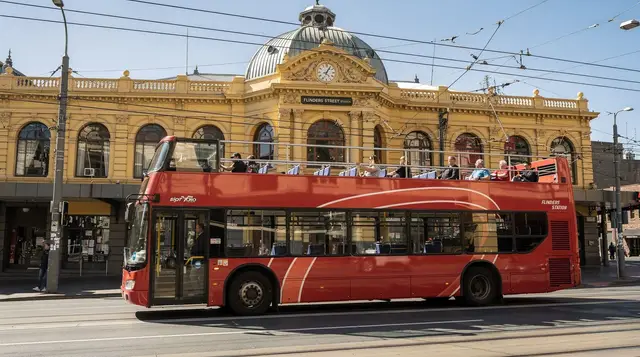
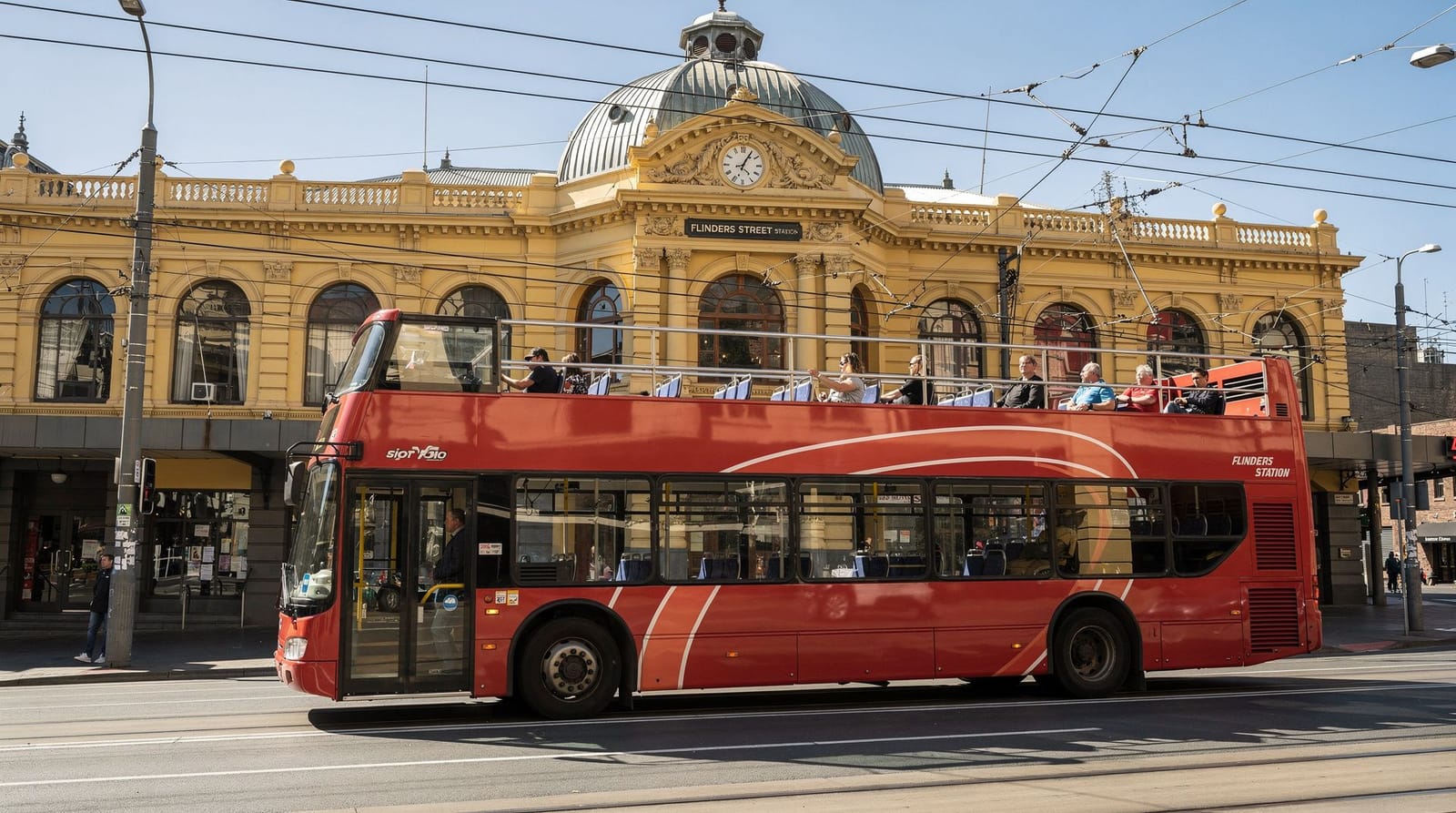
Flinders Street Station is Melbourne's oldest and busiest train station, opened in 1854 and rebuilt in its current French Renaissance-style form by 1910. Its row of clocks above the main Swanston Street entrance gave rise to the enduring Melbourne tradition of 'meet me under the clocks,' and its yellow-and-cream facade is one of the city's most photographed landmarks.
Melbourne’s front door since 1854
Flinders Street Station sits at the corner of Flinders and Swanston streets, directly opposite Federation Square and a short walk from Hosier Lane, making it the single most central and most photographed transport building in the city. It has operated as a railway station since 1854, just 19 years after Melbourne’s founding, making it one of the world’s oldest continuously operating train stations — remarkable given how young the city itself was at the time.
| Where | Corner of Flinders & Swanston streets, CBD |
| Cost | Free to visit and photograph; Myki fare only if boarding a train |
| Time needed | 15-20 minutes for a look; longer if photographing |
| Getting there | Central CBD landmark, on multiple tram routes |
| Not to confuse with | Southern Cross Station (regional/interstate/airport services) |
The building most visitors recognise today — the yellow-and-cream French Renaissance facade, the green copper dome above the main entrance, and the row of station clocks — dates from a major rebuild completed in 1910, following an 1899 architectural design competition. The winning design, by architects James Fawcett and H. P. C. Ashworth, was notable for its scale and ambition at a time when Melbourne’s post-gold-rush wealth (see our gold rush history guide) was still funding grand civic and commercial building projects across the CBD.
”Meet me under the clocks”
The row of analogue clocks above the main Swanston Street entrance is Flinders Street Station’s most enduring cultural export. Each clock traditionally displayed the next departure time for a different train line, giving generations of Melburnians a precise, unmissable, always-open city-centre meeting point long before mobile phones made “I’ll call when I’m close” the default arrangement. “Meet me under the clocks” became such an ingrained phrase in local vernacular that it survived the smartphone era largely intact — locals still use it, half out of habit and half because it remains a genuinely useful, unambiguous spot in a busy intersection where verbal directions can otherwise get complicated.
The clocks have occasionally been switched to digital displays in past decades, provoking enough public objection each time that the traditional analogue faces were restored — a small but telling sign of how much affection Melburnians hold for this specific detail of an otherwise purely functional transport building.
 Melbourne city highlights walking tourCheck availability
The ballroom most visitors never see
One of Flinders Street Station’s lesser-known features is a genuinely grand ballroom on the building’s third floor, built as part of the 1910 rebuild for staff social functions, dances and meetings. It fell out of regular use decades ago as staff amenities modernised and social norms shifted, and today sits largely closed to the public, opened only occasionally for special heritage tours, art exhibitions or one-off public events. Its existence surprises even many long-term Melburnians, who’ve walked past the building’s exterior thousands of times without ever knowing there’s a dance hall sitting largely unused three floors up.
If you’re specifically interested in seeing inside, check current listings for heritage open days or special exhibitions rather than expecting standard access — this isn’t part of any regular ticketed tour of the building.
Flinders Street versus Southern Cross Station
Visitors new to Melbourne sometimes confuse the city’s two major stations. Flinders Street Station handles Melbourne’s entire suburban and metropolitan train network — every metro line terminates or passes through here, making it the busiest station in the Southern Hemisphere by some measures of daily passenger movements. Southern Cross Station, a 10-15 minute walk west along Collins Street toward Docklands, handles regional V/Line services (including trains to Ballarat and Geelong) and interstate and airport coach connections, plus the SkyBus service to Melbourne Airport.
Getting this distinction right matters practically: if you’re heading to Sovereign Hill, the Great Ocean Road region via Geelong, or catching the SkyBus to the airport, you need Southern Cross, not Flinders Street — a mix-up that costs a confused 15-minute walk (or a short tram hop) if you arrive at the wrong one.
| Flinders Street Station | Southern Cross Station | |
|---|---|---|
| Handles | Metro suburban trains | V/Line regional, interstate, airport coach |
| Use it for | Getting around Melbourne itself | Ballarat, Geelong, Great Ocean Road region, SkyBus |
| Location | CBD corner, Flinders & Swanston | ~10-15 min walk west, toward Docklands |
| Landmark status | Yes — clocks, dome, iconic facade | Functional, less photographed |
Photographing the station
The best vantage point is directly across Flinders Street at Federation Square’s forecourt, which frames the full facade, the dome, and Princes Bridge over the Yarra in a single shot — the classic postcard angle used in almost every “things to do in Melbourne” article, including this one’s hero image. Early morning and early evening give the most flattering light on the yellow-and-cream stonework, while the building’s exterior lighting after dark creates a different, warmer photo opportunity if you’re walking past post-dinner.
The station’s interior — the main concourse beneath the dome, with its heritage tiled flooring and the famous clock row — is equally worth a few minutes, and unlike many working transport hubs, photography inside is generally unrestricted for personal, non-commercial use.
book a guided history and laneways walking tourThe design competition and the building that almost was
The 1899 architectural competition that produced Flinders Street Station’s current design attracted more than a dozen serious entries, reflecting how much civic pride and gold-rush-era wealth Melbourne was willing to invest in a mere transport building at the turn of the century. Fawcett and Ashworth’s winning French Renaissance design, with its prominent dome, was chosen partly for its visual ambition — the brief effectively asked for a building that would announce Melbourne’s civic confidence to every visitor arriving by train, not just move passengers efficiently.
Construction proceeded in stages between 1901 and 1910 rather than as a single continuous build, which is why some elements of the finished station reflect slightly different detailing depending on which construction phase produced them, a subtlety mostly invisible to casual visitors but noted in the building’s heritage listing documentation.
It’s worth noting the design competition happened during a brief economic downturn following the 1890s depression that hit Melbourne hard after its 1880s gold-rush boom years — the fact that the city still committed to a building this grand during a comparatively leaner period says something about how central rail infrastructure and civic image had become to Melbourne’s self-conception by the turn of the 20th century.
The station in Melbourne’s cultural identity
Beyond the clocks tradition, Flinders Street Station shows up constantly in Melbourne’s visual and cultural self-image — it’s a recurring backdrop in local film and television production, a default “establishing shot” for anything set in the city, and a fixture of tourism marketing precisely because its silhouette (dome, clocks, that specific yellow-cream colour) is instantly recognisable in a way few other Australian buildings are.
Local sports and cultural events sometimes use the station’s forecourt as an informal gathering or celebration point — Australian Football League grand final celebrations and New Year’s Eve crowds have both spilled into the surrounding intersection in past years, cementing the building’s status as something closer to a civic gathering symbol than a purely functional transport hub.
There have been periodic public debates over the decades about redeveloping or significantly altering the station, including a controversial international design competition in 2013 that proposed radical modernisation; none of the more dramatic redesign proposals proceeded, and the heritage-listed facade has instead been maintained and restored rather than replaced, reflecting how strongly Melburnians have pushed back against anything that would meaningfully change the building’s familiar silhouette.
Using the station practically
For visitors, Flinders Street Station is primarily useful as the departure point for Melbourne’s metro (Metro Trains) network — services to St Kilda (via the Sandringham line, technically to nearby stations rather than St Kilda directly, which is better reached by tram), Richmond, and outer suburbs all run from here. Trams stop directly outside on both Flinders Street and Swanston Street, connecting to the Free Tram Zone that covers most of the CBD, so many visitors use the station purely as a landmark and orientation point rather than actually boarding a train from it.
The station underwent a significant renovation completed in the 2010s addressing structural and amenity issues, alongside ongoing heritage-conscious restoration work on the facade and dome — worth knowing if you visit during a period of scaffolding or partial cladding, which happens periodically as the more-than-a-century-old structure requires continuous maintenance.
What’s inside beyond the concourse
Beyond the main concourse and platforms, the station building has historically housed a range of retail tenancies, a fitness gymnasium at one point occupied part of an upper floor, and various administrative offices for the state’s rail operators over its long operational history. Ground-floor retail along the Flinders Street frontage today includes a mix of convenience food outlets and small shops serving the heavy daily commuter footfall — useful to know if you need a quick coffee or snack before continuing on to Federation Square or across to Southbank, rather than a dedicated dining destination in its own right.
The main concourse itself, directly beneath the dome, retains much of its early-20th-century character in its flooring and signage details, even amid the practical realities of a modern transport hub — digital departure boards sit alongside the analogue clock row outside, a small but visible reminder of how the building has layered new function onto old form for well over a century rather than being wholly modernised or wholly preserved as a museum piece.
The clocks up close: how they actually work
For visitors curious about the mechanics behind Melbourne’s most photographed timepieces, the row of clocks above the Swanston Street entrance historically displayed the next scheduled departure for a specific train line rather than the current time — a detail that surprises many first-time visitors who assume they’re simply decorative station clocks. Over the decades the exact operational setup has evolved alongside the station’s broader modernisation, but the row’s visual format and civic symbolism have remained deliberately unchanged, precisely because past attempts to alter them (switching to digital displays, for instance) provoked enough public pushback that the traditional analogue faces were restored each time.
A short history of the site before 1854
Before the railway, the site had a less glamorous history: it sat on swampy, flood-prone ground near the Yarra’s original course, and the river itself ran a noticeably different, more meandering path through this part of the city before 19th-century engineering works straightened and deepened it for shipping and flood control. The station’s construction was itself part of that broader reshaping of the riverbank, and it’s worth knowing, when you look at Flinders Street Station and Federation Square sitting neatly across from each other today, that neither the river’s current course nor the flat, buildable ground either sits on was simply “natural” — both are the product of substantial 19th and 20th-century engineering.
A landmark for first-time orientation
For visitors on their first day in Melbourne, Flinders Street Station works well as a mental anchor point for the rest of the CBD grid — Federation Square sits directly opposite, Swanston Street’s tram spine runs north through the shopping district, and the Yarra River promenade toward Southbank starts immediately alongside the station building. Using it as a fixed reference point, the way generations of Melburnians have used “meet under the clocks,” genuinely helps orient a first walk through the city centre rather than relying purely on a map app for every turn.
Practical tips
Don’t confuse it with Southern Cross Station if you’re heading to the airport, Ballarat, Geelong or the Great Ocean Road region — those services depart from Southern Cross, a separate station a short walk or tram ride away.
Photograph from Federation Square’s forecourt for the classic full-facade shot, ideally early morning or early evening for the best light on the stonework.
Use it as your default meeting point if you’re travelling with a group and want a single, unambiguous CBD landmark — the clocks tradition exists for a reason, and it still works.
Check for scaffolding. As a heritage-listed, more-than-century-old building in continuous use, the facade periodically undergoes restoration work that can partially obscure photos — worth a quick check if a specific unobstructed shot matters to your trip.
Where this fits in your Melbourne trip
Flinders Street Station anchors the southern edge of the CBD grid and sits within a few minutes’ walk of Hosier Lane, Federation Square, the Eureka Skydeck and Southbank’s arts precinct — making it a natural starting or ending point for almost any CBD walking loop rather than a dedicated destination in its own right.
Combined with a look at Melbourne’s Victorian architecture more broadly and the arcades and laneways a few streets north, it’s one of the easiest pieces of Melbourne’s built heritage to fold into a first day in the city, requiring no ticket, no booking and no detour from routes you’ll likely already be walking.
More tours on Viator
Top-rated experiences with verified reviews, bookable on Viator (a Tripadvisor company).


Frequently asked questions about Flinders Street Station
What does 'meet me under the clocks' mean?
It refers to the row of analogue clocks above Flinders Street Station's main Swanston Street entrance, each showing departure times for a different train line. Before mobile phones, Melburnians would arrange to meet 'under the clocks' as an unambiguous, always-there city-centre landmark, and the phrase and tradition persist today even though everyone now carries a phone.Can you visit inside Flinders Street Station's ballroom?
The station's third-floor ballroom, once used for staff social functions and dances, closed to regular public access decades ago and has been used only occasionally for special events and exhibitions since. It's not part of a standard station visit — check current event listings if you want a rare chance to see inside.Is Flinders Street Station the same as Flinders Street?
No — Flinders Street is a major CBD road running along the Yarra River, while Flinders Street Station is the specific train station building that sits on it, at the corner of Flinders and Swanston streets. The station is also distinct from Southern Cross Station, Melbourne's other major rail hub, used mainly for regional and interstate services.How old is Flinders Street Station?
The site has operated as a railway station since 1854, making it one of the world's oldest continuously operating train stations. The current dome-and-facade building most visitors recognise was completed in 1910, following an architectural design competition held in the 1890s.Is Flinders Street Station worth photographing?
Yes — its yellow-and-cream French Renaissance facade, green dome and row of clocks make it one of Melbourne's most photographed buildings, especially from across the road at Federation Square, where you get the full building in frame with the Yarra River and Princes Bridge nearby.Is Flinders Street Station wheelchair accessible?
Yes, the station has lifts connecting the concourse to platforms, though as a more-than-century-old heritage building some older sections have less straightforward step-free routes than a purpose-built modern station — staff are generally available to help direct visitors with specific accessibility needs toward the most manageable route.Can I get food or coffee at Flinders Street Station?
Yes, the ground-floor Flinders Street frontage has a mix of convenience food outlets and small cafés serving the heavy daily commuter footfall, useful for a quick coffee or snack, though it's not a dedicated dining destination — the surrounding CBD and Federation Square area, a short walk away, have far more substantial options.
Top experiences
Bookable activities with verified prices and instant confirmation on GetYourGuide.