Melbourne's arcades and laneways: a walking guide
Melbourne: Melbourne laneways tour w lunch
What's the difference between Melbourne's arcades and its laneways?
Arcades are covered, Victorian-era shopping passages built in the 1800s (Block Arcade, Royal Arcade) with ornate glass roofs and heritage-listed interiors; laneways are open-air service alleys that became coffee, bar and street-art strips in the 2000s (Degraves Street, Centre Place, Hosier Lane). Both sit inside the same CBD grid and a single walking loop of 60-90 minutes covers the best of each.
| Where | CBD grid — Collins, Bourke, Elizabeth and Flinders Streets |
| Cost | Free to walk; pay only for coffee, food or shopping |
| Time needed | 60-90 minutes for the full loop |
| Best time | Weekday mornings for arcades; avoid 12-2pm rush at Degraves Street |
| Weather | Works in any weather — arcades are fully covered |
Two different centuries, one connected grid
Melbourne’s CBD holds two distinct kinds of hidden street, built roughly 120 years apart, that visitors often lump together as “the laneways” without realising they’re separate stories. The arcades — Block Arcade, Royal Arcade, the Causeway, the Australia Arcade — are covered Victorian-era shopping passages dating from the gold-rush wealth of the 1880s and 90s, built with glass-domed roofs, mosaic tile floors and ornate ironwork explicitly to rival Europe’s grand shopping galleries.
The laneways — Degraves Street, Centre Place, Hardware Lane, Hosier Lane — are open-air service alleys that sat mostly ignored until a wave of small-bar licensing reform and independent coffee culture in the 1990s and 2000s turned them into the city’s most distinctive dining and drinking strips.
Both threading through the same compact CBD grid means a single well-planned walk of 60-90 minutes covers the best of both eras, without needing a car, a ticket, or more than comfortable shoes.
Block Arcade: the grandest survivor
Block Arcade, running between Collins Street and Little Collins Street with an Elizabeth Street entrance, opened in 1893 and remains Melbourne’s most intact Victorian shopping arcade — a glass-domed, mosaic-floored passage modelled partly on Milan’s Galleria Vittorio Emanuele II. It survived a mid-20th-century period when many similar arcades elsewhere were demolished or gutted for modern retail, and today houses a mix of heritage tenants (the Hopetoun Tea Rooms has operated inside since 1892) alongside contemporary boutiques and chocolate shops.
The tessellated tile floor alone is worth stopping for — it’s original, restored rather than replaced, and one of the largest intact examples of its kind still in daily commercial use anywhere in Australia. Look up as well: the glass barrel-vault roof floods the arcade with natural light in a way that fluorescent-lit modern shopping centres never manage.
Royal Arcade: Melbourne’s oldest
A block away, Royal Arcade (1870, extended 1902) claims the title of Melbourne’s oldest surviving shopping arcade, connecting Little Collins Street to Bourke Street Mall. Its signature feature sits above the Bourke Street end: statues of Gog and Magog, mythological giants that strike a bell on the hour, a detail most rushed shoppers walk straight underneath without noticing. The arcade’s ironwork and glass roof predate Block Arcade’s by two decades and show a slightly more restrained, less ornate Victorian style as a result.
Both arcades remain functioning retail spaces rather than museum pieces — a genuinely rare thing for 19th-century commercial architecture this intact, most of which elsewhere in the world has been converted to office space, demolished, or preserved as a static heritage site rather than a working shopping strip.
Degraves Street and Centre Place: the coffee laneways
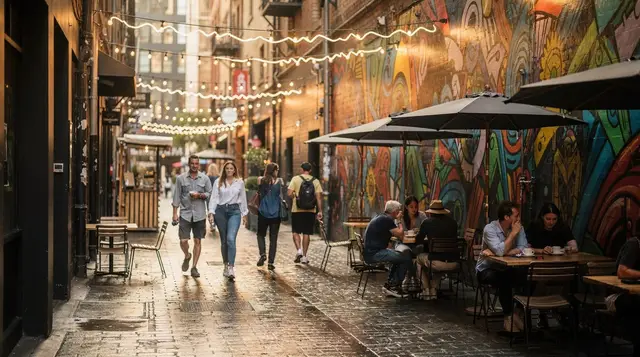
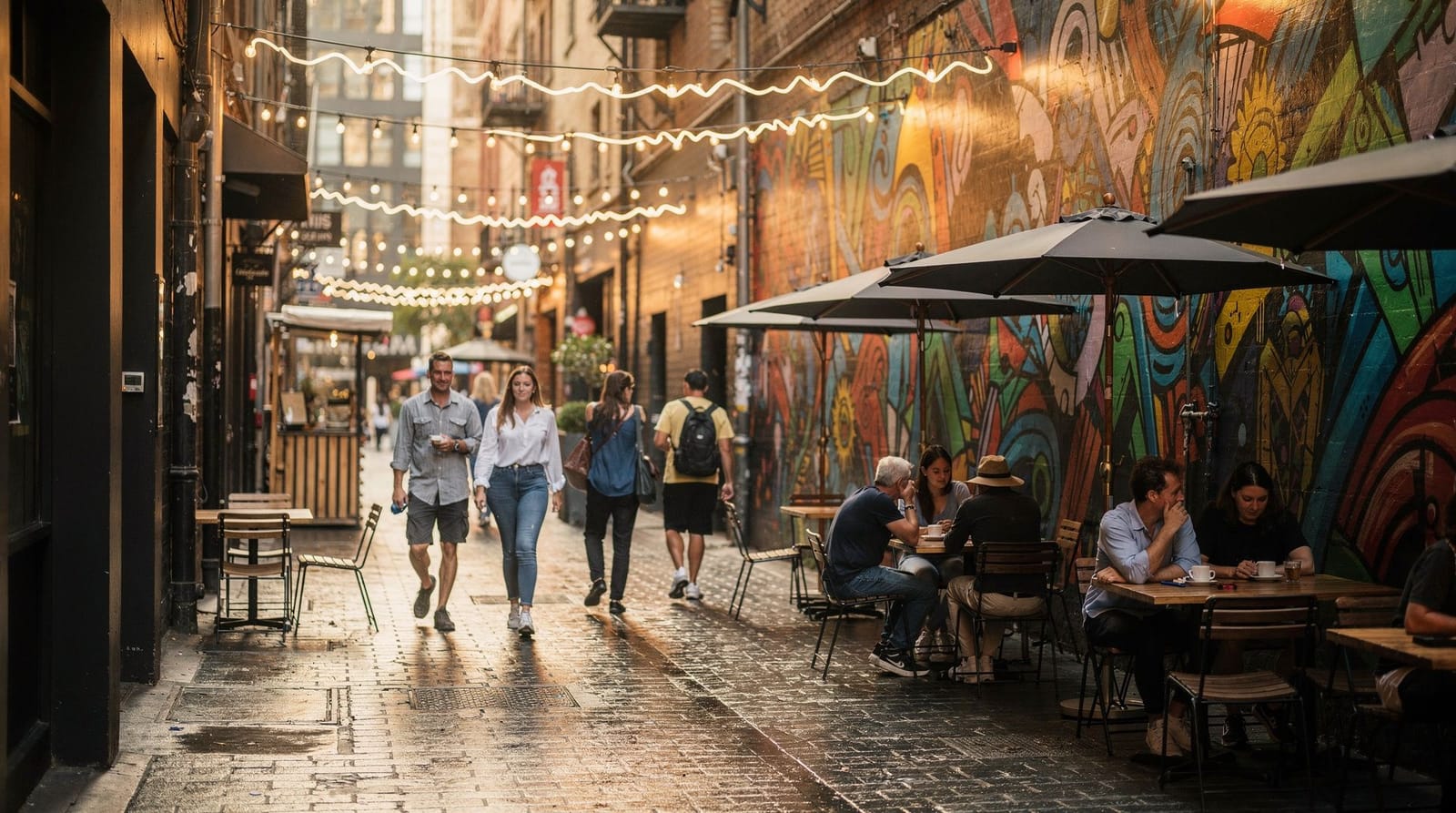
Where the arcades represent formal Victorian retail architecture, Degraves Street and Centre Place represent Melbourne’s other laneway story: cafes spilling tables and umbrellas into narrow, graffiti-tagged alleys that would be considered too cramped and unglamorous for outdoor dining almost anywhere else, yet have become some of the most photographed and imitated streetscapes in Australian hospitality.
Degraves Street, running from Flinders Street underneath the railway viaduct toward Collins Street, is lined wall-to-wall with cafes whose seating fills the entire laneway width during peak breakfast and lunch hours — arrive before 8am or after 2pm on weekdays if you want a table without a wait. Centre Place, a narrower connecting lane just off Collins Street, packs a similarly dense run of small cafes and bars into an even tighter space, with string lights and layered signage overhead adding to the sense of controlled chaos.
 Melbourne laneways tour w lunchCheck availability
Hardware Lane and the CBD’s other laneways
Hardware Lane, running parallel to Elizabeth Street, took the Degraves Street model (cafe tables spilling into a pedestrianised laneway) and applied it at larger scale, with restaurants rather than cafes lining both sides. It’s worth knowing this one skews toward tourist-trap pricing and overly aggressive lunchtime touting at midday — waitstaff calling out set-menu deals to passersby is common here in a way it isn’t in Degraves Street or Centre Place, a genuine honest-planner flag if you’re choosing where to eat rather than just where to photograph.
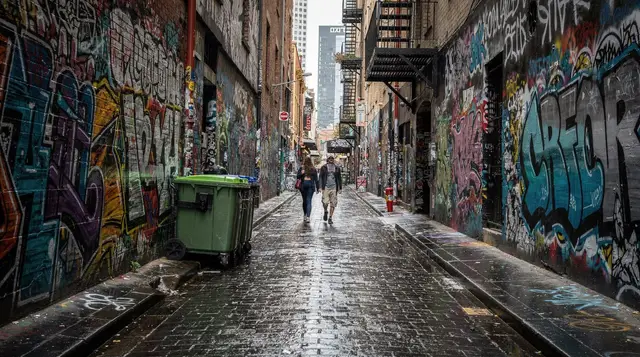
For street art specifically rather than food, Hosier Lane and its continuation Rutledge Lane sit a few minutes’ walk south toward Flinders Street, while AC/DC Lane and Union Lane carry smaller pockets of the same legal-wall art scene closer to the shopping core.
A suggested 90-minute walking loop
- Start at Block Arcade (entrance on Collins Street or Elizabeth Street) — 15 minutes, including the Hopetoun Tea Rooms if you want a stop.
- Cross to Royal Arcade via Little Collins Street — 10 minutes, don’t miss Gog and Magog above the Bourke Street exit.
- Head south through Centre Place off Collins Street — 10 minutes, narrow and atmospheric, good for photos any time of day.
- Continue to Degraves Street — 20-30 minutes if you stop for coffee, otherwise a 10-minute walk-through.
- Detour to Hosier Lane, a five-minute walk from Degraves Street toward Flinders Street Station, for the street-art contrast — 15-20 minutes.
- Optionally finish at Hardware Lane if you want a sit-down lunch, though expect the touting mentioned above.
This loop covers roughly 2km of walking, entirely flat, entirely free bar whatever you spend on coffee or lunch, and works in any weather since much of the arcade portion is covered.
book a laneways and suburbs tourWhy Melbourne has this many laneways in the first place
Melbourne’s CBD was laid out on the Hoddle Grid in 1837, a rigid rectangular street pattern with unusually wide main boulevards (Collins Street, Bourke Street) split by a secondary grid of narrower “little” streets (Little Collins, Little Bourke) originally intended for service access, stables and rear-of-building deliveries.
That secondary grid, further subdivided again into even narrower laneways, gave the city an enormous stock of small-footprint urban space that sat mostly derelict through the mid-20th century — used for parking, rubbish collection and little else — until licensing reforms in the 1990s (specifically, changes that made small individual liquor licences viable rather than requiring large venue capacity) allowed tiny bars and cafes to open directly into these spaces.
The result is a CBD with two layers of street life stacked on top of each other: the grand Victorian boulevards and arcades built for gold-rush-era civic pride, and a laneway scene built forty years ago from what used to be service alleys nobody wanted to be seen using. Few other Australian or even world cities retain this much of both layers simultaneously and in active daily use.
Practical tips
Weekday mornings (8-10am) suit the arcades, when shops are opening and foot traffic is lightest — Block Arcade and Royal Arcade are both quietest for photography before 10am.
Weekday lunch (12-2pm) is Degraves Street and Centre Place’s busiest window; if you want a table rather than a takeaway coffee, arrive by 11:30am or wait until after 2pm.
Weekends bring heavier crowds throughout, particularly Bourke Street Mall’s arcade entrances, but also a livelier, more social atmosphere in the laneway cafes.
Wet weather is actually a good excuse to prioritise the arcades — Block Arcade and Royal Arcade are both fully covered, making them a reliable rainy-day fallback that most visitors don’t think to use that way.
The small-bar reform that created the modern laneway scene
The laneway cafe and bar culture didn’t emerge purely from grassroots creativity — it was substantially enabled by a specific piece of Victorian liquor licensing reform in the mid-1980s and refined through the 1990s, which created a lower-cost, lower-capacity liquor licence category aimed at exactly this kind of small, informal venue. Before that reform, opening a licensed venue in Australia generally required the kind of capital and floor space that made a tiny 20-seat laneway bar commercially unviable; afterward, entrepreneurs could open a genuinely small space — sometimes no larger than a shipping container — profitably.
Melbourne leaned into this reform harder and faster than most other Australian cities, and the result three decades later is the CBD’s now-signature laneway bar and cafe density, something urban planners from other cities regularly visit Melbourne specifically to study. It’s a rare case of a licensing policy decision directly and visibly reshaping a city’s physical character within a single generation.
Shopping in the arcades: what to expect
Both Block Arcade and Royal Arcade mix genuine heritage retail (long-established chocolate shops, the Hopetoun Tea Rooms, specialist boutiques that have traded from the same address for decades) with more generic contemporary tenants that could be found in any shopping centre. The arcades are worth visiting for the architecture and atmosphere first, the shopping second — if dedicated retail therapy is your goal, the Queen Victoria Market district and Bourke Street Mall’s larger department stores offer more variety and better prices than the boutique arcade shopfronts.
Getting there
The entire loop sits inside the Free Tram Zone, so if you’re coming from Southbank or Docklands, a short tram ride drops you within a block or two of Collins Street without a fare. On foot, Flinders Street Station is the natural starting point for the Degraves Street and Hosier Lane end of the loop, while Melbourne Central station sits closer to the Bourke Street Mall end near Royal Arcade.
Where this fits in your Melbourne trip
The arcades-and-laneways loop is one of the easiest half-days to fit into any Melbourne itinerary, since it requires no bookings, works in most weather, and threads directly through the CBD core most visitors are already staying near or passing through. It pairs naturally with a Hosier Lane street art stop, a Flinders Street Station photo, and — if you want the broader architectural context — a wider look at Melbourne’s Victorian-era buildings beyond just the arcades themselves.
For visitors staying in the CBD, this loop is genuinely walkable from most hotels; for those based in Fitzroy, Carlton or St Kilda, it’s a short tram trip in rather than a dedicated excursion, and works well as a first-morning orientation walk before heading further out to day trips like the Great Ocean Road or Yarra Valley later in the week.
The arcades’ near-death and rescue
It’s worth knowing that Melbourne’s arcade heritage was nearly lost. Through the 1950s and 60s, as car-oriented shopping centres became the dominant retail model across Australia, several of the CBD’s original Victorian arcades were demolished or gutted beyond recognition, and Block Arcade itself came close to being sold for redevelopment in the 1970s before a concerted heritage campaign — backed by the National Trust and sympathetic city planners — secured its protection.
The Causeway and the smaller Australia Arcade survive in reduced or altered form as a result of that same era’s redevelopment pressure, which makes Block Arcade and Royal Arcade’s near-complete original condition considerably more remarkable than a casual walk-through suggests.
That near-miss history is part of why the City of Melbourne has been comparatively protective of the laneway network more broadly since the 1990s revival — having watched one layer of the city’s small-scale urban fabric almost disappear, planners were more willing to actively encourage the next one (small bars, laneway cafes, sanctioned street art) rather than let market pressure flatten it again.
Combining arcades with a broader architecture walk
If Victorian-era buildings interest you beyond just the two main arcades, the same CBD blocks hold a denser concentration of intact 19th-century commercial architecture than almost anywhere else in Australia — bank facades on Collins Street’s “Paris end,” the old Melbourne Stock Exchange building, and civic buildings within a few minutes’ walk of both arcades. A dedicated look at Melbourne’s Victorian architecture covers this ground in more depth than a single laneway walk allows, including buildings you’d otherwise walk straight past without knowing their history.
A guided alternative if you’d rather not self-navigate
For visitors who’d prefer a narrated version of this loop rather than following the self-guided route above, a dedicated history and culture walking tour covers the arcades and laneways with a local guide explaining the small-bar licensing reform, specific building histories and street-art context in more depth than a self-guided walk allows.
book a guided history, laneways and culture walking tourPhotographing the arcades and laneways well
Both arcades photograph best around mid-morning on a weekday, when natural light through the glass roofs is strong but foot traffic hasn’t yet built to its lunchtime peak — Block Arcade’s tessellated floor and Royal Arcade’s Gog and Magog statues are the two most-photographed details, and arriving before 10am generally means having both mostly to yourself. Hosier Lane, by contrast, photographs well at almost any time of day given its consistently changing street art, though avoiding the middle of a weekend afternoon sidesteps the heaviest crowds jostling for the same shots.
Shoulder-season and event-time crowding
Outside the general weekday-lunch and weekend crowding patterns already covered, major CBD events — the Australian Open in January, Melbourne Fashion Week, or a Grand Final week in September — can noticeably thicken foot traffic through the arcades and laneways even on an otherwise ordinary weekday, since visitors in town for the event tend to fold a laneways walk into their own itinerary. If your trip overlaps with a major citywide event, doing the loop first thing in the morning avoids the compounding effect of both the event crowd and the laneways’ own regular lunchtime rush.
More tours on Viator
Top-rated experiences with verified reviews, bookable on Viator (a Tripadvisor company).


Frequently asked questions about Melbourne's arcades and laneways
Are Melbourne's arcades free to walk through?
Yes — Block Arcade, Royal Arcade and the smaller connecting arcades are public thoroughfares lined with private shops, so walking through costs nothing. You only pay if you buy something from one of the boutiques, chocolate shops or the Hopetoun Tea Rooms.What is the oldest arcade in Melbourne?
Royal Arcade, opened in 1870 and extended in 1902, holds the title of Melbourne's oldest surviving shopping arcade. Block Arcade followed in 1893 and is generally considered the more architecturally grand of the two, but Royal Arcade came first.Why do Gog and Magog strike a bell in Royal Arcade?
Gog and Magog are mythological giant figures, styled after a London Guildhall tradition, installed above Royal Arcade's Bourke Street entrance to strike a bell on the hour — a piece of Victorian-era civic theatre that still draws a small crowd of onlookers at busy times of day.Is Degraves Street worth the queue for breakfast?
On weekday mornings between roughly 8am and 10am, yes, if you're prepared to wait 10-15 minutes for a table — the laneway's dense run of cafes has genuine character and consistently good coffee, a fair reflection of Melbourne's wider reputation. Arriving before 8am or after 2pm avoids the wait almost entirely.Should I eat in Hardware Lane?
It's fine for a meal, but go in with clear eyes — waitstaff actively touting lunch specials to passersby is more aggressive here than in Degraves Street or Centre Place, and pricing tends to run higher for comparable quality. Treat it as a photogenic laneway to walk through rather than a can't-miss dining destination.Can I do the arcades-and-laneways walk in the rain?
Yes, and it's actually a smart rainy-day choice — Block Arcade and Royal Arcade are both fully covered by their original glass roofs, giving you 25-30 minutes of dry, architecturally interesting shelter in the middle of an otherwise wet CBD day.Is a guided laneways tour worth it over doing the walk yourself?
The self-guided loop in this guide covers the highlights perfectly well on your own, but a guided tour adds context and stories (the small-bar licensing reform, specific building histories) that aren't visible just from walking past, and removes any planning effort — worth it for visitors who prefer a narrated experience over a self-directed one.What should I skip if I only have 30 minutes?
Prioritise Block Arcade and a quick walk through Degraves Street over Royal Arcade and Hardware Lane — Block Arcade is the more architecturally grand of the two arcades, and Degraves Street delivers the classic laneway-café atmosphere fastest without needing the fuller loop.
Top experiences
Bookable activities with verified prices and instant confirmation on GetYourGuide.