Victorian-era architecture in Melbourne: a walking guide
Melbourne: Melbourne city highlights walking tour
Where can I see the best Victorian architecture in Melbourne?
Collins Street's 'Paris end' and the Block Arcade/Royal Arcade precinct hold the densest concentration of grand 1880s commercial buildings, while Carlton's Lygon Street area and Fitzroy's residential streets show the era's cast-iron lacework terrace houses. All are free to view and walkable within a single CBD-and-inner-suburbs day.
| Where | Collins Street’s Paris end, the arcades, Carlton, Fitzroy |
| Cost | Free to walk; guided tours available |
| Time needed | Half day for the CBD core, full day with Carlton’s terraces |
| Getting there | All on foot or short tram hops within the Free Tram Zone |
| Best time | Weekday mornings for quieter streets and better light |
”Marvellous Melbourne” and how it got its buildings
Melbourne’s density of intact 19th-century Victorian-era architecture is unusual by world standards, and it exists for one specific, concentrated reason: gold-rush wealth flowing through the city between the 1850s and 1890s funded an extraordinarily ambitious building boom in a comparatively short window. By the 1880s, the city had earned the nickname “Marvellous Melbourne,” reflecting a period when it briefly ranked among the wealthiest cities in the world per capita — wealth that translated directly into grand banks, arcades, civic buildings and terrace housing built with a level of architectural ambition rarely matched by cities of comparable size and age elsewhere.
Unlike many world cities where 19th-century commercial architecture was substantially demolished for 20th-century redevelopment, a meaningful share of Melbourne’s Victorian-era core survived — not entirely by accident, but through a mix of economic slowdown after the 1890s depression (which reduced redevelopment pressure for decades) and, later, deliberate heritage protection once the value of what remained became clear.
Collins Street’s Paris end
The eastern stretch of Collins Street, running toward Spring Street and Parliament House, carries Melbourne’s most concentrated run of grand 19th and early 20th-century commercial facades — informally nicknamed the “Paris end” for its boulevard-like grandeur, tree-lined footpaths and (in later decades) upmarket boutique shopfronts drawing a loose comparison to a European avenue. Former bank headquarters, ornate stone facades and decorative ironwork line this stretch in a density rarely matched elsewhere in the CBD grid.
 Melbourne city highlights walking tourCheck availability
The arcades: commerce as architectural statement
Block Arcade (1893) and Royal Arcade (1870) remain Melbourne’s best-preserved examples of Victorian-era retail architecture, both built explicitly to rival grand European shopping galleries with glass-domed roofs, mosaic tile flooring and ornate ironwork. They’re covered in depth in our dedicated arcades and laneways guide, but worth flagging here as the clearest single example of how gold-rush wealth translated directly into architectural ambition even for purely commercial buildings — retail arcades weren’t typically built with this level of grandeur elsewhere in the world during the same period.
Flinders Street Station and civic grandeur
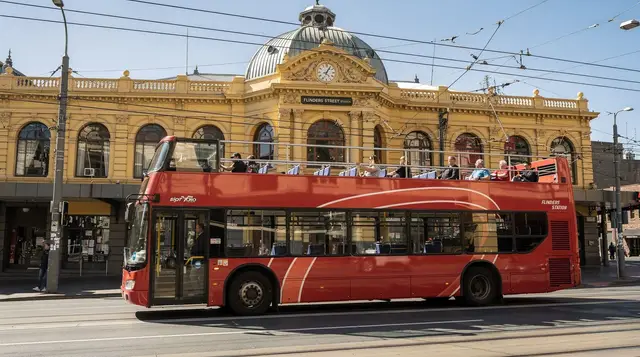
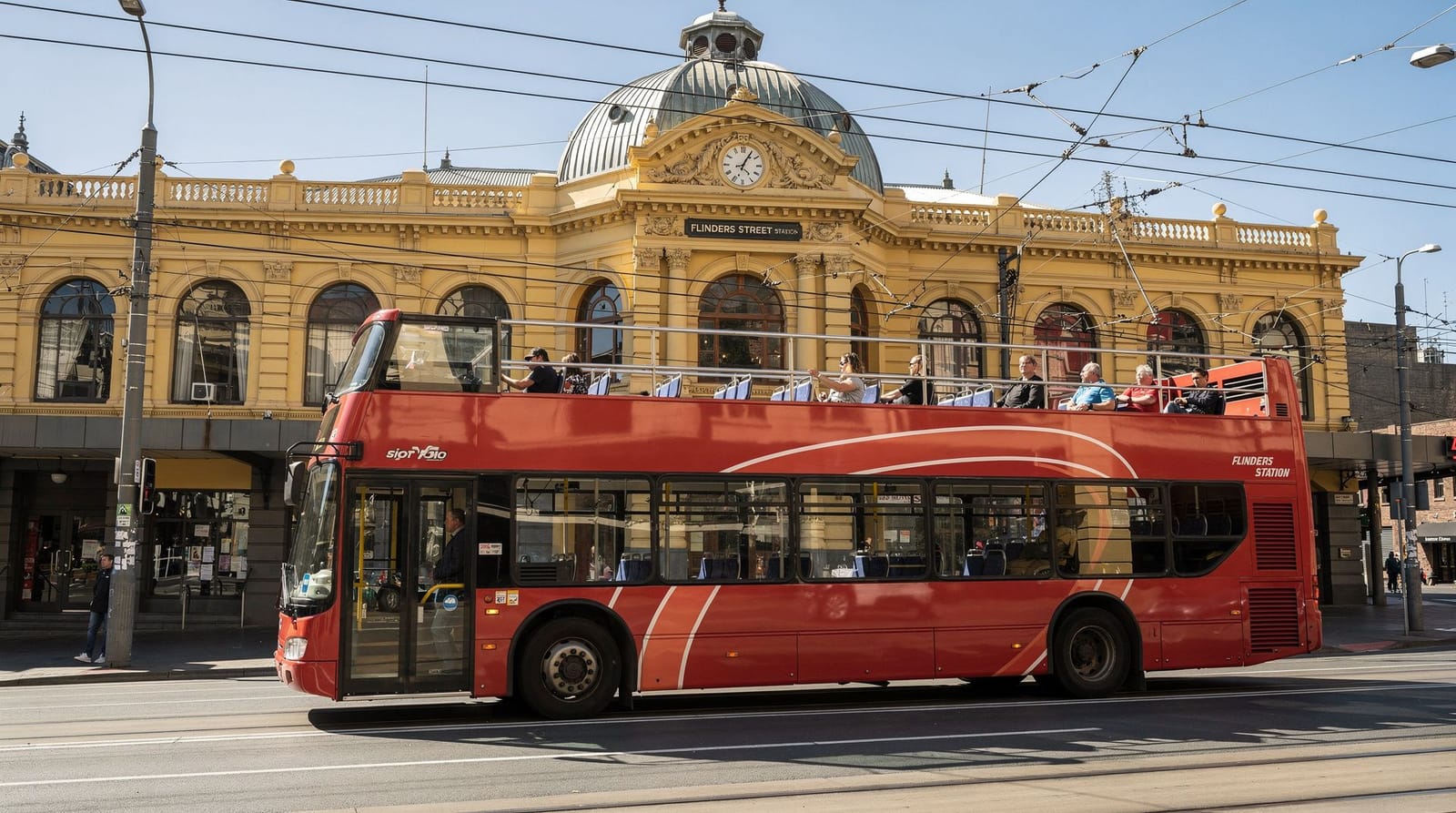
Flinders Street Station, completed in its current French Renaissance-style form in 1910, represents a slightly later but related wave of Victorian and Edwardian civic ambition — a mere transport building designed with enough architectural statement to announce the city’s confidence to every arriving passenger. Its green dome and yellow-cream facade remain one of the clearest single images of Melbourne’s built heritage, and its 1899 design competition (covered in more detail in our dedicated station guide) reflects how seriously the city took even functional infrastructure as an opportunity for architectural display.
The Royal Exhibition Building: Australia’s only UNESCO-listed building
Completed in 1880 for Melbourne’s International Exhibition, the Royal Exhibition Building in Carlton Gardens is the single grandest surviving example of Melbourne’s gold-rush-era architectural ambition, and remains the only building in Australia individually inscribed as a UNESCO World Heritage Site. Its blend of Byzantine, Romanesque and Italian Renaissance influences, designed by architect Joseph Reed (also responsible for the State Library of Victoria’s original reading room), reflects the era’s confident architectural eclecticism at its most extravagant.
book a guided Victorian architecture and laneways walking tourBeyond the arcades: other landmark Victorian buildings
The Paris end of Collins Street and the arcades aren’t the only standout examples. The ANZ Gothic Bank building on Collins Street, completed in the 1880s, carries an ornate Gothic Revival banking chamber considered one of the finest surviving 19th-century interiors in Australia — a working bank branch that still operates behind a facade and interior largely unchanged since the boom years. Melbourne Town Hall, on Swanston Street, dates to the 1870s and remains the city’s civic centrepiece, its clock tower a recognisable feature of the CBD skyline from a lower, older era before high-rise towers dominated the view.
Parliament House, at the eastern end of Collins Street’s Paris end stretch, began construction in the 1850s and remains, technically, architecturally unfinished — its grand front steps and portico were completed, but a planned dome above the central chamber was never built, a detail most visitors walk past without noticing.
The State Library of Victoria, founded in 1854 directly from gold-rush-era colonial wealth and civic ambition, holds one of the most striking interior spaces from this period: its domed reading room, completed in 1913 (slightly later than the initial gold-rush boom but built on the same institutional momentum), remains one of the most photographed library interiors in the world, its reinforced concrete dome an engineering achievement notable for its era.
When Melbourne nearly lost this heritage
It’s worth knowing that Melbourne’s Victorian-era streetscape survived partly by economic accident rather than pure foresight. The 1890s depression that followed the gold-rush boom sharply reduced redevelopment pressure for several decades, effectively freezing much of the CBD’s built form in place while other growing cities elsewhere in the world were demolishing and rebuilding.
That reprieve wasn’t permanent: the mid-20th century brought a fresh wave of redevelopment pressure, and several significant Victorian-era buildings were lost or substantially altered through the 1950s and 60s before a organised heritage protection movement — bolstered by the near-loss of Block Arcade itself in the 1970s — led to stronger heritage listing laws and a more protective planning culture from the 1970s onward.
That history matters because it means what survives today isn’t simply “what was always there” — it’s what narrowly avoided a mid-20th-century wave of demolition that claimed a meaningful share of comparable buildings elsewhere in Australia, making Melbourne’s remaining Victorian-era density more historically fragile, and more deliberately protected today, than a casual walk might suggest.
Cast-iron lacework: the residential side of the story
Beyond the CBD’s grand commercial and civic buildings, Melbourne’s inner suburbs carry an equally significant but different Victorian-era architectural legacy: rows of terrace housing decorated with cast-iron “lacework” verandahs and balcony railings, produced cheaply and in bulk once Australia developed local iron-casting capacity through the 1870s and 80s. Carlton, Fitzroy, Richmond and East Melbourne all retain extensive intact rows of this housing style, among the best-preserved examples of Victorian-era residential ironwork architecture anywhere in Australia.
Carlton’s terrace houses along and around Lygon Street show the style at its most ornate, often combined with elaborate parapet detailing and decorative rendering, while Fitzroy and Collingwood’s slightly more modest workers’-cottage-scale terraces reflect the same era’s architecture built for a different, less wealthy social class — worth comparing directly if you want to understand how Victorian-era Melbourne’s architecture varied by wealth and social status rather than assuming uniform grandeur across the whole city.
East Melbourne and Richmond’s quieter terrace streets
While Carlton and Fitzroy get most of the attention for lacework terrace housing, East Melbourne — tucked between the CBD and the MCG precinct — retains some of the city’s most intact and least-disturbed Victorian-era residential streets, largely because its proximity to Parliament House and the established professional class kept redevelopment pressure low for over a century. Streets like Hotham Street and Simpson Street carry rows of grand, well-preserved terrace housing rarely photographed by visitors simply because they sit slightly off the more obvious tourist paths through Carlton and Fitzroy.
Richmond, by contrast, developed as a more working-class Victorian-era suburb tied to the same industrial and manufacturing growth that shaped Collingwood, and its surviving terrace housing tends toward smaller, simpler cottages rather than the grander Carlton style — a useful comparison if you want to see how the same architectural era produced genuinely different building types depending on the original residents’ wealth and occupation.
What to look for: a short field guide
Ornamental parapets — decorative stone or rendered detailing along a building’s roofline, often carrying a construction date or building name, common on both commercial and residential Victorian buildings.
Cast-iron lacework — the filigree ironwork verandahs and balcony railings distinctive to Australian Victorian-era terrace housing, rarely seen at this density anywhere else in the world.
Polychrome brickwork — decorative patterns created using different coloured bricks (often cream, red and blue-black) in the same facade, a hallmark of high-Victorian civic and commercial buildings across the CBD.
Glass-domed arcade roofs — the defining feature of Block Arcade and Royal Arcade, designed to flood covered retail spaces with natural light decades before electric lighting made this less structurally necessary.
A suggested walking route
Start at Flinders Street Station, walk north up Swanston Street to Collins Street, then east along Collins Street through the Paris end toward Parliament House. Detour via Block Arcade and Royal Arcade off Collins and Bourke streets, then continue north to Carlton Gardens and the Royal Exhibition Building. Finish with a walk through Carlton’s terrace-house streets around Lygon Street for the residential lacework contrast. The full loop covers roughly 3-4km and 2-3 hours at an unhurried pace, entirely on foot or with short tram hops if you want to save your legs for the Carlton stretch.
Honest take: is this a full day or a half day?
For most travellers, a well-planned half-day covers the CBD’s commercial highlights (Paris end, arcades, Flinders Street Station) comfortably, with the Royal Exhibition Building and Carlton’s terraces better added as a separate half-day or combined with a Melbourne Museum visit given the distance involved. Architecture enthusiasts wanting real depth — building facades, ironwork detail, historical context on each stop — should budget a full day and consider a guided tour, since self-directed walking tends to miss the historical context that turns “nice old buildings” into a genuinely informative narrative about how gold-rush wealth reshaped an entire city within a single generation.
Where this fits in your Melbourne trip
Victorian-era architecture is one of the connective threads running through several of Melbourne’s most distinctive cultural offerings — the arcades, the gold rush history that funded it all, and the contemporary street art now painted onto many of the same laneway walls built during this era. It’s a free, flexible theme that layers naturally onto almost any CBD-focused day, and pairs well with a look at Aboriginal heritage sites for the fuller, more complete picture of how colonial-era wealth and history shaped modern Melbourne.
For visitors staying in the CBD or Southbank, this walk requires no transport at all; from Carlton or Fitzroy, you’re already based in the residential half of the story, making a short walk into the CBD the natural way to complete the loop.
Commercial versus residential Victorian architecture, compared
| Commercial (CBD) | Residential (Carlton/Fitzroy) | |
|---|---|---|
| Style | Grand facades, glass-domed arcades, banking chambers | Cast-iron lacework terraces |
| Built for | Wealthy gold-rush-era businesses | Mixed — from grand to workers’ cottages |
| Best examples | Block Arcade, Royal Exhibition Building | Lygon Street terraces, East Melbourne streets |
| How to see it | Free walking route | Free walking route |
A note on how the buildings are used today
One detail that surprises first-time visitors: most of these Victorian-era buildings aren’t preserved museum pieces sitting empty — Flinders Street Station is a fully functioning transport hub, the ANZ Gothic Bank chamber is a working bank branch, and many of Carlton and Fitzroy’s terrace houses are ordinary private homes. That continued everyday use is part of what makes Melbourne’s Victorian architecture feel alive rather than embalmed, though it also means some interiors (private terraces, working offices) aren’t accessible beyond the street-facing facade.
More tours on Viator
Top-rated experiences with verified reviews, bookable on Viator (a Tripadvisor company).


Frequently asked questions about Victorian-era architecture in Melbourne
What does 'Marvellous Melbourne' mean?
It's a nickname coined in the 1880s, during Melbourne's gold-rush-funded building boom, when the city briefly ranked among the wealthiest in the world per capita. The grand Victorian-era commercial buildings, arcades and boulevards built during this roughly decade-long window are what the nickname still refers to today.What is cast-iron lacework and where can I see it?
Cast-iron lacework refers to the ornamental ironwork verandahs and balcony railings common on Victorian-era terrace houses, produced cheaply and in bulk once Australia developed local iron-casting capacity in the 1870s-80s. Carlton, Fitzroy, Richmond and East Melbourne all retain extensive rows of lacework terrace housing, among the best-preserved examples in Australia.Is Melbourne's Victorian architecture as good as Sydney's?
Melbourne generally has a denser, more intact concentration of 19th-century commercial and civic Victorian-era buildings than Sydney, largely because gold-rush wealth funded a shorter, more concentrated building boom in Melbourne specifically, while Sydney's growth was steadier and less singularly gold-driven. Sydney has its own strong colonial-era heritage, but Melbourne's claim to being Australia's 'Victorian architecture capital' is well-founded.Can I tour Melbourne's Victorian buildings for free?
Yes — walking Collins Street's Paris end, the Block and Royal arcades, and the terrace-house streets of Carlton and Fitzroy costs nothing beyond your own time, since all are public streets or freely accessible arcades rather than ticketed attractions.What is the 'Paris end' of Collins Street?
It's the informal nickname for the eastern end of Collins Street (toward Spring Street), known for its grand 19th and early 20th-century bank and commercial facades plus a later run of elegant boutique shopfronts, drawing a loose comparison to a European boulevard rather than a typical commercial strip.Do I need a guided tour to appreciate Melbourne's Victorian architecture?
No, but it adds real value — the buildings are freely walkable and viewable on a self-guided route, but a guide typically supplies the historical context (who built what, why, and what nearly didn't survive) that turns a pleasant walk into a genuinely informative one.
Top experiences
Bookable activities with verified prices and instant confirmation on GetYourGuide.