Hosier Lane: Melbourne's street art alley, explained
Melbourne: Melbourne street art walking tour with a street artist
What is Hosier Lane and is it worth visiting?
Hosier Lane is a graffiti-strewn cobblestone laneway off Flinders Street where street art is legally sanctioned, meaning the walls are painted over constantly and no two visits look the same. It's free, takes 15-20 minutes to walk, and is worth doing any time of day, though early morning gives the best light and fewest people in your photos.
Why one laneway became Melbourne’s most photographed street
Hosier Lane runs one short block between Flinders Street and Flinders Lane, directly opposite Federation Square, and every centimetre of its walls — cobblestones included, some visitors report — carries paint. It didn’t happen by accident or overnight: Melbourne’s laneways were mostly service alleys, back entrances and fire escapes until the late 1990s and 2000s, when street artists began using the city’s grid of hidden lanes as a canvas the council chose to tolerate rather than scrub clean.
Hosier became the flagship because of its location (a two-minute walk from Flinders Street Station), its scale (three- and four-storey walls giving artists real canvas), and a level of council and building-owner buy-in that turned “tolerated” into “actively protected.”
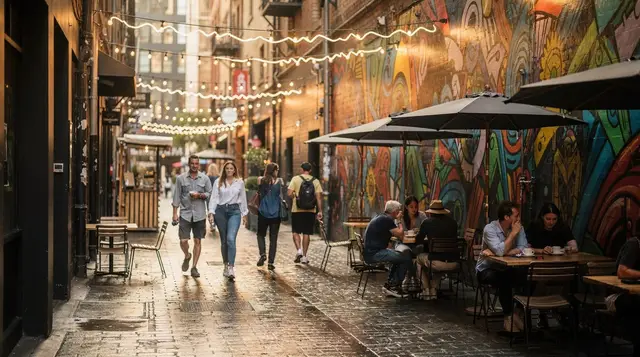
Today it functions less like a tourist attraction and more like a living gallery with no curator — a self-renewing wall of stencil work, large-scale murals, political commentary, wheat-paste posters and tags, all stacked on top of each other in a way that rewards a slow walk rather than a five-minute dash-through. It connects directly into Rutledge Lane, its narrower continuation, which carries the same open-slather ethos and is often quieter for photos.
| Where | Off Flinders Street, opposite Federation Square |
| Cost | Free |
| Time needed | 15-20 minutes alone, up to an hour with the nearby laneways |
| Getting there | 2-minute walk from Flinders Street Station |
| Best time | Early morning (7-9am) for soft light and fewer crowds |
Is it actually “legal” graffiti?
This is the detail most visitors get wrong. Hosier Lane isn’t a lawless free-for-all — spraying paint on private property without consent is still a criminal offence in Victoria, same as anywhere else. What makes Hosier different is that the City of Melbourne and the building owners along the lane have, over roughly two decades, arrived at an informal and in some cases formal arrangement: this stretch of wall is understood to be available for street art, so artists paint over each other’s work constantly, and nobody calls the police over a fresh piece appearing overnight.
That arrangement is specific to a handful of recognised laneways (Hosier, Rutledge, AC/DC Lane, Duckboard Place, Union Lane) rather than a blanket city policy — walk two streets over and the same act is vandalism, prosecuted like anywhere else. It’s a genuinely unusual model worldwide: an entire government-tolerated ecosystem for street art turnover, rather than a fixed set of murals protected as heritage.
What you’ll actually see
Because the walls change so often, describing specific current pieces is close to pointless — anything written today may be painted over within a week. What stays consistent is the texture of the place: large-scale figurative murals sitting beside political stencil work, quick tags layered over painstaking multi-day pieces, wheat-pasted posters peeling at the edges, and the odd piece that’s clearly been up for months because nobody’s chosen to paint over it yet.
Look up as much as you look at eye level — some of the most striking work sits two and three storeys up, visible only if you actually crane your neck rather than photographing straight ahead. The cobblestones underfoot often carry paint too, spilled or deliberately applied, adding to the sense that literally every surface is fair game.
 Melbourne street art walking tour with a street artistCheck availability
When to visit for the best experience
Early morning (7-9am) is genuinely the best window: soft light reaches into the narrow lane without the harsh overhead glare that hits around midday, and you’ll largely have the walls to yourself before tour groups and the lunch crowd from nearby Degraves Street cafes arrive.
Midday brings the heaviest foot traffic — school groups, coach tours and casual walk-throughs from Federation Square all converge here, which makes photography harder but people-watching more interesting; there’s a reliable trickle of amateur photographers and the occasional actual street artist mid-piece.
Evening shifts the mood entirely. Rutledge Lane in particular backs onto small bars and restaurants, so after dark the laneway becomes as much about the drinks and dining crowd as the art, lit by a mix of shopfront glow and whatever streetlight reaches in.
There’s no bad time to visit given it’s free and takes only 15-20 minutes for a proper look, but if photography without crowds in the shot matters to you, go before 9am.
A short walking loop beyond Hosier Lane
Hosier alone is a 15-minute stop, but it’s the anchor of a genuinely worthwhile hour-long laneway loop that most visitors rush through in ten minutes flat, missing half of what’s there:
- Start at Hosier Lane (off Flinders Street, opposite Federation Square).
- Walk through into Rutledge Lane, its direct continuation, generally quieter for photos.
- Head north into the CBD grid toward AC/DC Lane off Flinders Lane — renamed in 2004 in honour of the band’s Melbourne roots, and still carrying music-themed and general street art.
- Continue to Duckboard Place, a smaller lane with rotating pieces and less foot traffic.
- Finish in Union Lane, just off Bourke Street Mall, for a busier, more central finale before rejoining the main shopping strip.
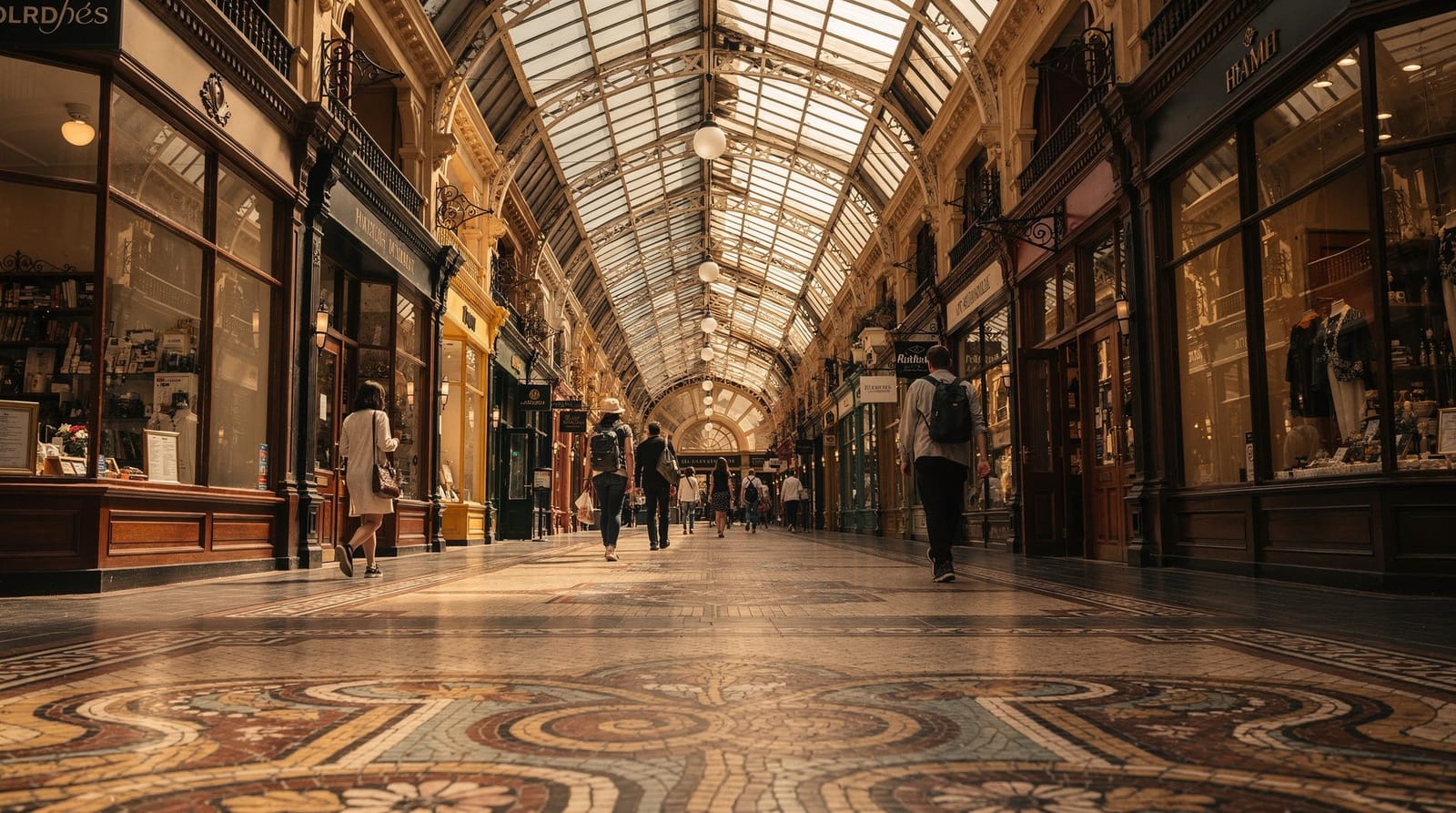
This loop pairs naturally with the Melbourne arcades and laneways guide if you want the retail-arcade side of the laneway network (Block Arcade, Royal Arcade) as well as the street-art side, and it sits a short walk from the CBD neighborhood hub if you’re staying nearby.
Budget the full hour rather than rushing it. Each of these five laneways has a genuinely different character once you slow down: Rutledge Lane tends toward large figurative murals because its walls are wider and flatter; AC/DC Lane leans music-themed and rougher-edged; Duckboard Place is small enough that a single artist can dominate it for weeks at a time; Union Lane, being the busiest and closest to the retail core, cycles fastest of all because so many artists want that particular high-visibility wall.
What the street art scene means for local artists
Melbourne’s legal-laneway system is unusual because it gives working street artists a genuine, ongoing public platform without requiring gallery representation or council permits for every single piece — a rare arrangement compared with most world cities, where street art remains permanently illegal regardless of subject matter or skill. That’s produced a visible career pipeline: several Melbourne street artists who built a name for themselves on Hosier’s walls have gone on to gallery shows, commissioned murals on private buildings elsewhere in the city, and international festival invitations.
It’s also created tension. Not every artist who paints in the recognised precincts is thrilled about having their multi-day work covered within 48 hours by someone else’s tag, and there’s an ongoing, mostly good-natured debate within Melbourne’s street-art community about respect, seniority and who “deserves” a fresh wall. None of that is visible to a first-time visitor walking through with a phone camera, but it’s worth knowing that what looks like chaotic overpainting is, underneath, a working social economy with its own informal rules.
book a laneways tour with lunch includedGuided tours versus going alone
Walking Hosier Lane solo costs nothing and takes 15 minutes — there’s no barrier, no ticket, no opening hours to work around, since it’s a public laneway. A guided tour adds genuine value in one specific way: context. Most visitors can’t tell a stencil piece by a recognised local artist from an overnight tag, and a guide who works with or knows the local street-art scene can point out whose work is whose, which pieces have unusually survived months of turnover, and why certain walls get repainted faster than others (sun exposure, foot traffic, and simple popularity with other artists wanting that particular canvas all play a role).
A street art walking tour with an actual street artist goes further still, sometimes including a live demonstration or a chance to add your own small piece under supervision — worth it if you want more than photos. Food-focused laneway tours are the other common option, bundling Hosier and its neighbours into a broader laneway-and-lunch walk that also covers Melbourne’s coffee culture and arcade history.
Photography tips that actually help
Shoot wide, then shoot detail. A single wide shot rarely captures the density of layered work; take one establishing shot of the whole lane, then move close for individual pieces that catch your eye.
Avoid including other photographers if you can. Hosier is popular enough that any shot taken between 10am and 4pm will likely have someone else in frame — either embrace it as part of the scene’s honest character or come earlier.
Check for wet paint. Fresh work is sometimes still drying, and stepping close to touch a wall for a “cool textures” close-up can genuinely smudge someone’s just-finished piece — give it space if it looks freshly painted.
Don’t add your own tag. Despite the “anything goes” reputation, adding graffiti as a visiting tourist without any connection to the local scene is generally frowned upon by the community that actually maintains this ecosystem, and can draw pointed comments from nearby artists or shop staff.
Getting there
Hosier Lane sits directly opposite Federation Square, a two-minute walk from Flinders Street Station across Swanston Street, and equally close to Federation Square’s tram stops on the Free Tram Zone’s southern edge. If you’re coming from Southbank or the arts precinct, it’s a five-minute walk over Princes Bridge. There’s no parking on the laneway itself (it’s pedestrian-only in practice, though technically shared with occasional service vehicles), so arriving on foot or via tram is the only realistic option, which suits its location dead in the middle of the CBD.
Honest take: does it live up to the hype?
Mostly, yes, with one caveat. Hosier Lane appears on almost every “things to do in Melbourne” list and Instagram feed, which sets an expectation of something more polished or curated than what’s actually there — it’s a working, changeable, sometimes-messy laneway, not a manicured outdoor gallery with placards. If you arrive expecting a museum-quality experience you may be mildly underwhelmed by the grime, the occasional overlapping tags that read as clutter rather than art, and the crowds during peak hours.
If instead you go in understanding it as a living, contested, constantly-repainted public artwork with no single author or curator — closer to a communal mural wall than a gallery — it delivers exactly what it promises, for free, in under twenty minutes, in the middle of the city. Combined with a stop at Hosier Lane’s near neighbour sites in Fitzroy and Collingwood, it’s a genuinely worthwhile half-day for anyone interested in how a city can turn graffiti policy into a tourism asset rather than a problem to police away.
One honest note on expectations: the lane is short — genuinely a single city block — so if street art is a major draw for your trip rather than a pleasant half-hour stop, treat Hosier as the introduction to a bigger theme rather than the whole story. Fitzroy and Collingwood’s back streets carry far more square metres of sanctioned and semi-sanctioned wall art than the CBD laneways combined; Hosier is simply the most concentrated, most central, and easiest sample to fit around everything else on a first visit.
Where this fits in your Melbourne trip
Hosier Lane is one of the few genuinely free, genuinely quick, genuinely worthwhile stops in central Melbourne, which makes it easy to fold into almost any itinerary regardless of how you’re spending your time. Pair it with the Eureka Skydeck for a contrast between street-level grime and 285-metre views, or with a Queen Victoria Market morning and a laneway coffee crawl through the CBD’s arcades for a full day that covers food, art and history without needing a car or a booked tour.
For visitors staying in Fitzroy or Carlton, it’s a 15-20 minute tram ride into the CBD rather than a dedicated excursion, easy to slot in on the way to or from dinner. And if you’re building a longer trip around Melbourne’s arts and culture layer, it connects naturally to Victorian-era architecture walks, the NGV, and the city’s broader live music scene, all of which draw on the same inner-city creative energy that keeps Hosier’s walls in constant motion.
Weather and seasonal considerations
Hosier Lane is entirely outdoors and uncovered, so it’s exposed to whatever Melbourne’s notoriously changeable weather is doing on the day — the city’s Four seasons in one day reputation applies here as much as anywhere. Rain doesn’t stop the art from being visible, but wet cobblestones underfoot are slippery and camera gear needs protecting if you’re stopping for more than a quick look. Summer brings the longest daylight hours for photography and the heaviest crowds during school holidays; winter’s shorter days mean the early-morning light window shifts later, but the lane is noticeably quieter given fewer tourists braving the cold for an outdoor laneway. There’s no bad season to visit — it’s simply a matter of dressing for whatever the sky is doing that particular hour, since forecasts here are notoriously unreliable more than a few hours out.
Combining Hosier Lane with a full laneways and coffee morning
Hosier pairs naturally into a longer CBD morning built around Melbourne’s laneway culture more broadly. Start with the street art loop described above, then continue into the CBD’s café laneways — Melbourne’s coffee culture runs through the same grid of hidden alleys, with some of the best laneway cafes a five-minute walk from Hosier itself. Finish with a wander through the retail arcades (Block Arcade, Royal Arcade) covered in the laneways walking tour guide for the full contrast between street art grit and Victorian-era architectural polish, all within a single unhurried morning and without needing a car or a booked ticket for any of it.
Etiquette beyond “don’t add your own tag”
Beyond leaving the walls to the artists who work in this ecosystem, a few smaller courtesies keep the lane pleasant for everyone sharing it. Keep voices down early in the morning, since Rutledge Lane backs onto apartments above some of the bars and restaurants. Give working artists space if you see someone actively painting — a quiet “can I take a photo” is generally well received, but crowding someone mid-piece isn’t. Watch your step around the laneway’s uneven cobblestones, especially if distracted by looking up at the higher murals, and be mindful of service vehicles that occasionally need to pass through despite the lane’s pedestrian feel.
More tours on Viator
Top-rated experiences with verified reviews, bookable on Viator (a Tripadvisor company).


Frequently asked questions about Hosier Lane
Is it legal to spray paint in Hosier Lane?
Yes, within limits. Hosier Lane sits inside a City of Melbourne-recognised street art precinct where property owners have given tacit or explicit permission for artists to paint the walls, which is why the work changes so fast and so completely. It is not a free-for-all everywhere in the city — spraying an unsanctioned wall outside these precincts is still vandalism and prosecuted as such.How often does the art in Hosier Lane change?
Constantly, and unpredictably. A wall that took a street artist days to complete can be painted over by someone else within 24 hours; that churn is the entire point of the lane rather than a flaw. Locals sometimes visit weekly specifically to see what's new, and no photo you take will match what's there a month later.What is the best time of day to photograph Hosier Lane?
Early morning, roughly 7-9am, before tour groups and cafe crowds arrive, and while soft indirect light reaches into the laneway without the harsh overhead glare of midday. Late afternoon on a clear day also works, though shadows fall harder given the lane's north-south orientation and three-to-four-storey walls.Is Hosier Lane safe at night?
Yes, reasonably — it sits in the middle of the CBD a few minutes from Flinders Street Station and is well trafficked most evenings, particularly since Rutledge Lane (its continuation) backs onto bars and small restaurants. As with any narrow city laneway, keep normal city awareness after midnight rather than treating it as risk-free.Can I take a guided street art tour instead of going alone?
Yes, and it's worth it if you want context rather than just photos — a guided walk explains which artists are behind specific pieces, how the legal-wall system actually works, and takes you to other laneways (Rutledge Lane, AC/DC Lane, Duckboard Place) you likely wouldn't find solo.Where else in Melbourne has street art like Hosier Lane?
AC/DC Lane (renamed for the band, just off Flinders Lane), Rutledge Lane (Hosier's direct continuation), Duckboard Place, Union Lane off Bourke Street Mall, and pockets of Fitzroy and Collingwood's back streets all carry sanctioned or semi-sanctioned street art, though Hosier remains the densest and most photographed.
Top experiences
Bookable activities with verified prices and instant confirmation on GetYourGuide.